


High Dividends for Stagflation
Published April 28, 2022

Matt Wagner, CFA
Director, Research
The topic of stagflation and comparisons to the 1970s has reached a fever pitch recently.
For the first time in decades, concerns over out-of-control inflation, a behind-the-curve Federal Reserve and a slowing economy are sending both equities and bonds tumbling.
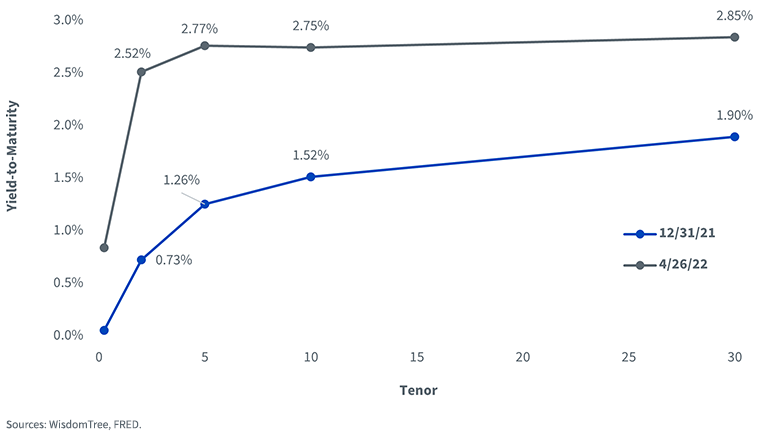
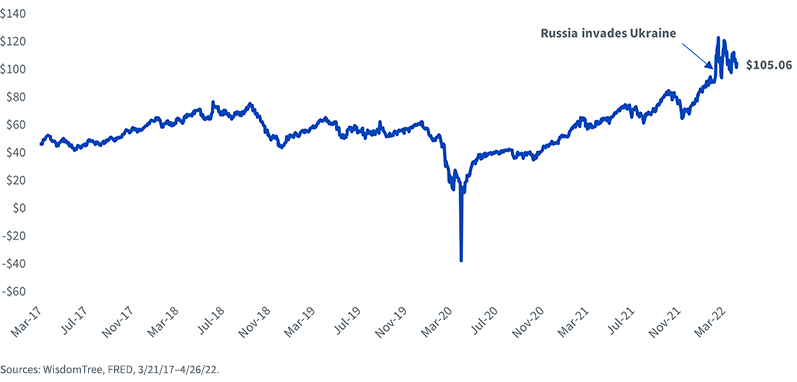
The main arguments underpinning the case for stagflation are a flat—and briefly inverted—yield curve that indicates expectations for an impending economic slowdown coupled with surging energy prices.
Treasury Yield Curve
WTI Spot Oil Prices per Barrel
While stagflation may not be the base-case scenario for many investors, how to allocate in this scenario now requires at least some consideration.
Sector Allocations
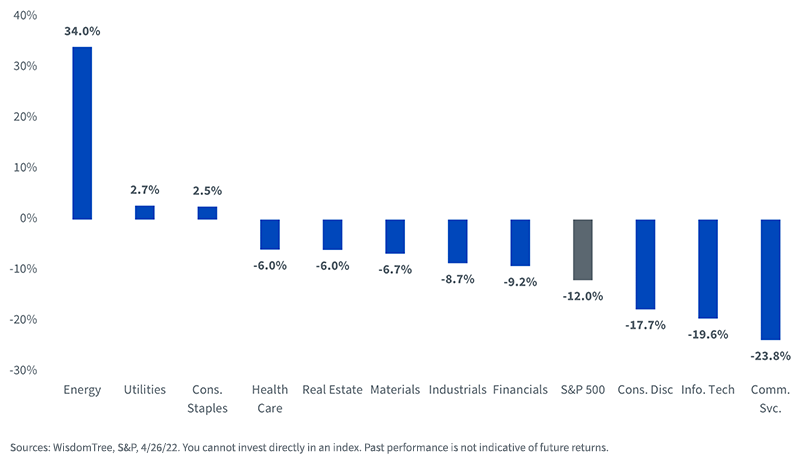
According to Bank of America research, the best-performing sectors during stagflation have historically been Utilities, Energy and Staples. The worst have been Consumer Discretionary, Information Technology and Communication Services.
Year-to-date performance has thus far favored the stagflation havens. Energy (+34%), Utilities (+3%) and Staples (+3%) have been the best performing sectors, while Consumer Discretionary (-18%), Information Technology (-20%) and Communication Services (-24%) have been the worst.
Year-to-Date Sector Returns
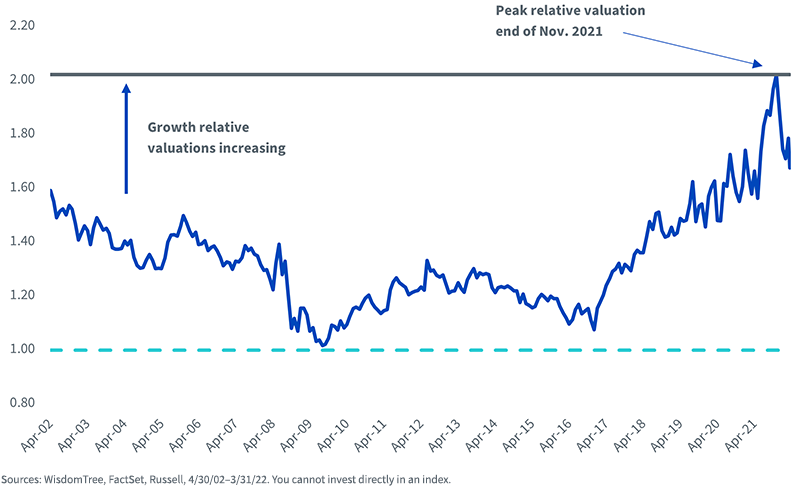
Sector performance can arguably be explained as much by stagflation concerns as by a rotation from growth to value after growth index multiples became wildly stretched and the forward price-to-earnings ratio of the Russell 1000 Growth Index (32.0x) peaked at over two times the multiple on the Russell 1000 Value Index (15.8x) last November.
Relative P/E Ratios: Russell 1000 Growth/Russell 1000 Value
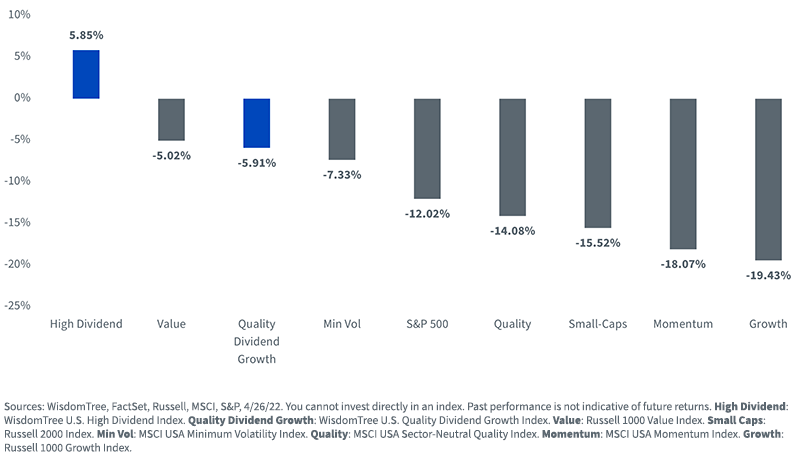
Amid this rotation, high dividends—which tend to skew toward value—have been one of the best-performing pockets of global equity markets.
YTD Factor Index Performance
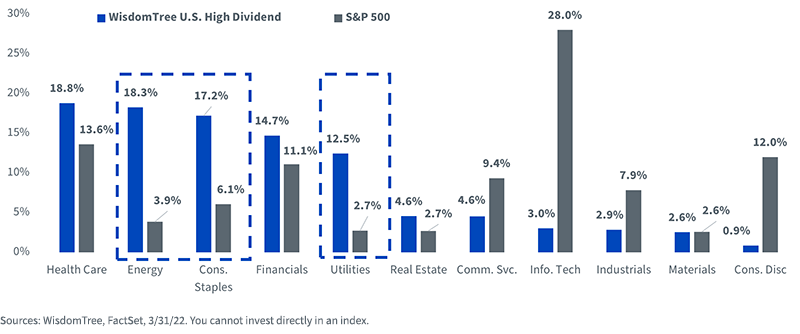
Sector allocations of the WisdomTree U.S. High Dividend Index are well aligned with the sectors that, according to BofA’s research, tend to benefit the most from a stagflation environment. The Index has a combined over-weight of 35% in Energy (+14%), Staples (+11%) and Utilities (+10%).
Index Sector Weights
For clients considering how to allocate in a world of slow economic growth and persistently high inflation, an allocation to high-dividend payers may be just the solution.
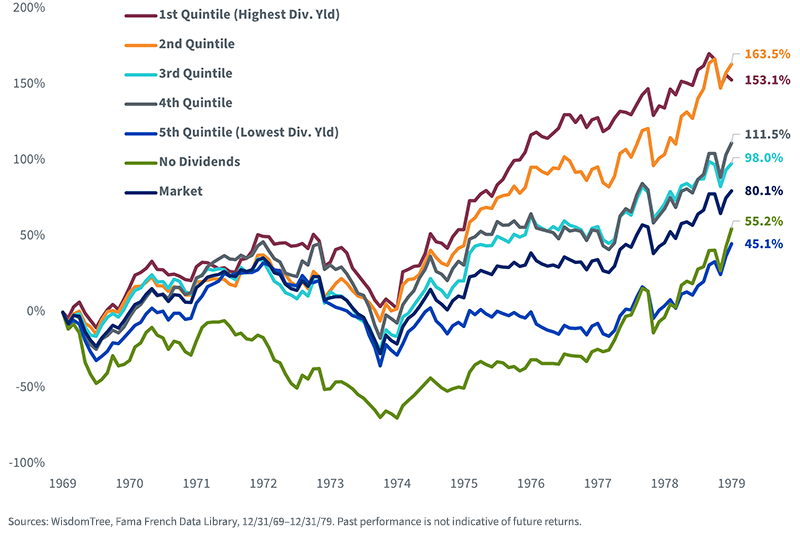
To compare to the 1970s experience, the two highest-dividend-yield quintiles handily outperformed the market, and the lowest-dividend-yield companies were laggards.
Cumulative Total Returns
Important Risks Related to this Article
There are risks associated with investing, including possible loss of principal. Funds focusing their investments on certain sectors increase their vulnerability to any single economic or regulatory development. This may result in greater share price volatility. Dividends are not guaranteed, and a company currently paying dividends may cease paying dividends at any time. Please read the Fund’s prospectus for specific details regarding the Fund’s risk profile.
Categories
Related articles

Beyond Market Cap: A Nearly 19-Year Case for Dividend-Driven Emerging Markets
Quality as a Foundation in an Uncertain World
Value Isn’t What It Used to Be
Don’t Mistake Speculation for Strength: The Mirage of Small-Cap “Junk” Outperformance
From Momentum to Discipline: Navigating Volatility in Emerging Markets
A Rebalance Review for U.S. Large-Cap Dividends
The Discipline of Dividends: Capturing Value in U.S. Large Caps
A Review of Our 2025 Global Dividend Rebalance
Rebalancing Back to Value: 2025 Emerging Markets Rebalance
About the contributor

Matt Wagner, CFA
Director, Research
Matt Wagner joined WisdomTree in May 2017 as an Analyst on the Research team. He currently serves as a Director, where he supports the creation, maintenance, and reconstitution of WisdomTree’s indexes and actively managed ETFs. Matt began his career at Morgan Stanley, working as an analyst in Treasury Capital Markets from 2015 to 2017, focusing on unsecured funding planning, execution, and risk management. He graduated magna cum laude from Boston College in 2015 with a B.A. in International Studies, concentrating in Economics. In 2020, he earned a Certificate in Advanced Valuation from NYU Stern. He is also a Chartered Financial Analyst (CFA) charterholder.