

Mid-Cap Value: The Most-Hipster Asset Class
Published February 7, 2019

Director, Model Portfolios
With a market segment that is often overlooked, and in an investment style that the markets seem to hate, mid-cap value may be the most-hipster equity-style box out there.
As a Brooklyn resident, I can attest firsthand that there are many hipster favorites to pass on (just about every clothing trend comes to mind). But mid-cap value is like the always-underrated PBR beer—consistently better than you expected it to be.
Mid-cap value has been one of the most consistently performing asset classes over the last 25 years. Despite the relentless underperformance of the value factor since the mid-2000s, mid-cap value has held up much better than its large- and small-cap counterparts. In fact, mid-cap value has beaten the S&P 500 Index on 63% of all rolling 3-year periods, 76% of rolling 5-year periods, 97% of rolling 10-year periods, and on every single rolling 15- and 20-year period.1
The asset class has seen its performance take off like it has been guzzling sustainably farmed, fair-trade coffee.
Active, Passive or Somewhere in Between
We often hear that mid-caps are an inefficient asset class in which investors will opt to use active managers in hope of outperformance. This philosophy has come under fire given the continued underperformance of so many active managers. According to the latest SPIVA® report, that measures the performance of active funds against their benchmarks, at least 75% of all mid-cap value funds underperformed the S&P MidCap 400 Value Index benchmark over each of the latest 1-, 3-, 5-, 10-, and 15-year periods!2
Investors may be starting to realize the struggles of active managers in mid-cap value. Currently, there is $27 billion in exchange-traded funds (ETFs) that track either the Russell Midcap Value Index, the S&P MidCap 400 Value Index or the CRSP U.S. Mid Cap Value Index.3 While we advocate for investors utilizing the ETF structure, we think an approach that can offer better performance than pure beta is optimal. The WisdomTree U.S. MidCap Dividend Fund (DON) epitomizes the idea of Modern AlphaTM—the potential for outperformance in what we believe to be the superior ETF vehicle.
The numbers prove this. DON has outperformed each of the three beta indexes on all standard time frames since its inception in 2006.
WisdomTree U.S. Dividend MidCap Fund (DON) Performance vs. Mid-Cap Value Indexes
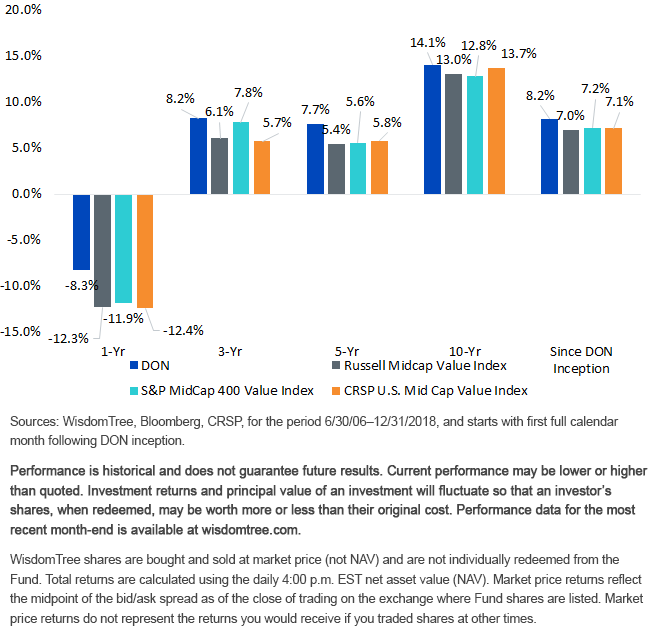
DON: A Model of Consistency
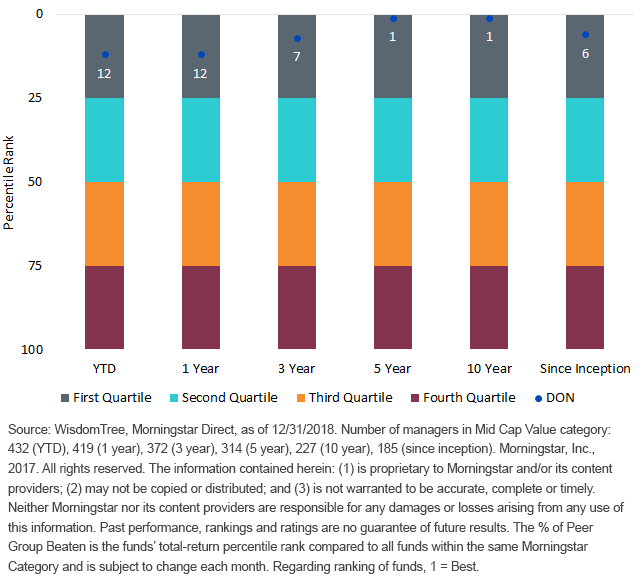
Since our approach fits between active and passive, we think it’s fair to compare ourselves to both peer groups—and compared to both active mutual funds and passive ETFs, DON stacks up well.
Following another strong year relative to its benchmark, DON is in the top quartile of its Morningstar Mid-Cap Value peer group on all time frames. This includes the latest 5- and 10-year periods in which DON is in the first percentile of all mid-cap value funds.
Over the last 12+ years, DON has been a remarkably consistent outperformer in an unexpectedly consistent asset class. In true hipster fashion, DON has been beating its peers since before it was cool.
DON vs Active and Passive Mid-Cap Value Managers
1Sources: WisdomTree, Zephyr StyleADVISOR, for the period 6/30/1995–12/31/2018.
2Source: S&P Dow Jones Indices, SPIVA® U.S. Scorecard, Mid-Year 2018.
3Source: Bloomberg, as of 1/24/19.
Important Risks Related to this Article
There are risks associated with investing, including possible loss of principal. Funds focusing their investments on certain sectors and/or smaller companies increase their vulnerability to any single economic or regulatory development. This may result in greater share price volatility. Please read the Fund’s prospectus for specific details regarding the Fund’s risk profile.
Categories
About the contributor

Director, Model Portfolios
Joe Tenaglia joined WisdomTree as Asset Allocation Strategist in 2016. He is responsible for building and managing WisdomTree’s CIO-managed and custom model portfolios. In this role he focuses on asset allocation, security selection, and portfolio construction for the firm’s open architecture models, with objectives ranging from strategic to tactical. Joe sits on WisdomTree’s Model Portfolio Investment Committee, which oversees the firm’s ETF models and helps shape and communicate WisdomTree’s thoughts on the markets. Prior to joining WisdomTree, he held roles at Emerging Global Advisors (acquired by Columbia Threadneedle) and BNY Mellon. Joe received his B.S. in Finance and Marketing from Boston College. He is a holder of both the Chartered Financial Analyst designation and Chartered Market Technician designation.