

The Barbell Approach: A Time-Tested Fixed Income Strategy
Published August 15, 2018

Head of Investment and Fixed Income Strategy
Although U.S. interest rates have risen from their record-setting depths, there is no doubt that, from a historical basis, they still remain rather low. Against this backdrop, I am asked on a regular basis: What’s a prudent strategy that fixed income investors can follow to not only help mitigate the potential for a further move up in rates but also take income-conscious needs into consideration? A time-tested approach that aims to solve for both of these factors is the barbell strategy.
For those readers who are unfamiliar with such an approach, a fixed income barbell is a strategy that essentially replicates the weight-lifting apparatus. In other words, the investor utilizes two parts of the yield curve: on the one side, the focus will tend to be on an intermediate or longer-duration vehicle while the other end of the spectrum will concentrate on a short-duration instrument. These two “weights” on the barbell serve two different purposes. The intermediate/longer-duration aspect can help to solve for income needs, while the short-duration investment serves as the “rate-mitigating” force.
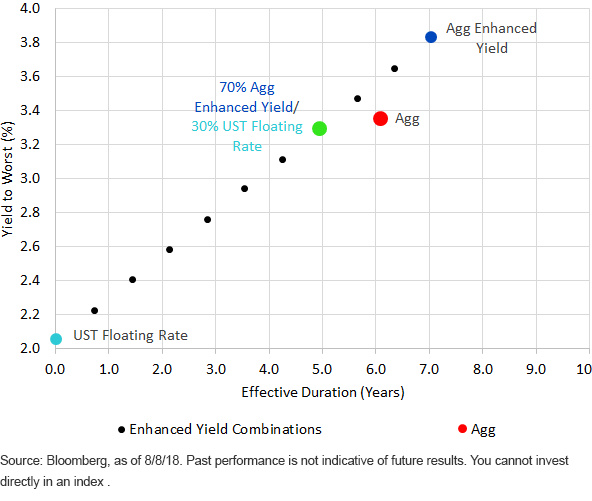
Yield to Worse and Effective Duration Comparison
Enhanced Yield/UST FRN vs. Aggregate
For definitions of terms in the glossary, please click here.
So, what does the barbell look like in practice? In this blog post, I will focus on two specific indexes: the Bloomberg Barclays U.S. Aggregate Enhanced Yield Index (AEY) and the Bloomberg U.S. Treasury Floating Rate Bond Index (UST FRN). The latter index, UST FRN, will serve as the short-duration weight of the barbell and is based on the 2-Year Treasury floating rate note. AEY is a yield-enhanced index that reweights the sectors of the Bloomberg Barclays U.S. Aggregate Bond Index (Agg) and serves as the longer-duration weight.
The accompanying graph illustrates how an investor can implement various allocations between these two “weights” of the barbell in order to achieve the desired result. I would like to highlight the combination of 70% AEY and 30% UST FRN. As of this writing, this barbell offers a yield of 3.30%, or only a scant 6 basis points below the Agg, while one could potentially reduce duration by more than a year versus the Agg.
While the Federal Reserve (Fed) kept rates unchanged at last month’s Federal Open Market Meeting, it does appear as if the policy makers are on track to raise the Fed Funds target range at their next gathering on September 26, and perhaps even one more additional time in 2018, finishing the year off at the December 19 convocation with another move to the upside. The Fed’s outlook for 2019 calls for even more rate hikes.
Conclusion
The barbell strategy laid out here offers investors a solution that takes income needs and rate risk into the equation. The WisdomTree Yield Enhanced U.S. Aggregate Bond Fund (AGGY), which seeks to track the Bloomberg Barclays U.S. Aggregate Enhanced Yield Index, and the WisdomTree Floating Rate Treasury Fund (USFR), which seeks to track the Bloomberg U.S. Treasury Floating Rate Bond Index, can be utilized as the two “weights” discussed here. Needless to say, the Fed’s monetary policy decisions are a crucial element to the fixed income investment landscape, and given the aforementioned outlook, I’ll continue to revisit this issue in upcoming blog posts.
Unless otherwise noted, all data is from Bloomberg as of August 8, 2018.
Important Risks Related to this Article
There are risks associated with investing, including possible loss of principal. Fixed income investments are subject to interest rate risk; their value will normally decline as interest rates rise. Fixed income investments are also subject to credit risk, the risk that the issuer of a bond will fail to pay interest and principal in a timely manner or that negative perceptions of the issuer’s ability to make such payments will cause the price of that bond to decline. Investing in mortgage- and asset-backed securities involves interest rate, credit, valuation, extension and liquidity risks and the risk that payments on the underlying assets are delayed, prepaid, subordinated or defaulted on. Securities with floating rates can be less sensitive to interest rate changes than securities with fixed interest rates, but may decline in value. The issuance of floating rate notes by the U.S. Treasury is new and the amount of supply will be limited. Fixed income securities will normally decline in value as interest rates rise. The value of an investment in the Fund may change quickly and without warning in response to issuer or counterparty defaults and changes in the credit ratings of the Fund’s portfolio investments. Due to the investment strategy of these Funds, they may make higher capital gain distributions than other ETFs. Please read each Funds’ prospectus for specific details regarding the Funds’ risk profile.
Categories
About the contributor

Head of Investment and Fixed Income Strategy
Kevin serves as the Head of Investment and Fixed Income Strategy. In this role, he writes macro and fixed income-related content and works closely with the sales, research and marketing teams. In addition, Kevin conducts client-facing webinars and meetings, providing expertise on WisdomTree’s existing and future bond ETFs. Prior to joining WisdomTree, Kevin spent 30 years at Morgan Stanley, where he was Managing Director and Chief Fixed Income Strategist for Wealth Management. He was responsible for tactical and strategic recommendations and created asset allocation models for fixed income securities. He was a contributor to the Morgan Stanley Wealth Management Global Investment Committee, primary author of Morgan Stanley Wealth Management’s monthly and weekly fixed income publications, and collaborated with the firm’s Research and Consulting Group Divisions to build ETF and fund manager asset allocation models. Kevin has an MBA from Pace University’s Lubin Graduate School of Business, and a B.S. in Finance from Fairfield University.