

What Factors Outperform When Rates Rise?
Published November 14, 2016

Director, Model Portfolios
President-elect Trump scored a surprising victory on November 8, and one of the big market reactions the day after the election was a large pickup in interest rates. We addressed this theme recently, in a post about how low-volatility strategies and sectors such as Utilities could be vulnerable to rising interest rates. Below, we discuss how various investment factors have performed in different rising rate scenarios.
Previously, we discussed how Japan was one of better hedges against rising interest rates. But focusing on the U.S. equities here, we also found that while rising rates were generally positive for equities, small caps performed particularly well during these times. Outside of small caps, taking a deeper look within the equity market reveals more information about which other individual factors outperformed during these times of rising rates.
Average Annual Performance During Increases in 10-Year Treasury Yield Since 12/31/1963
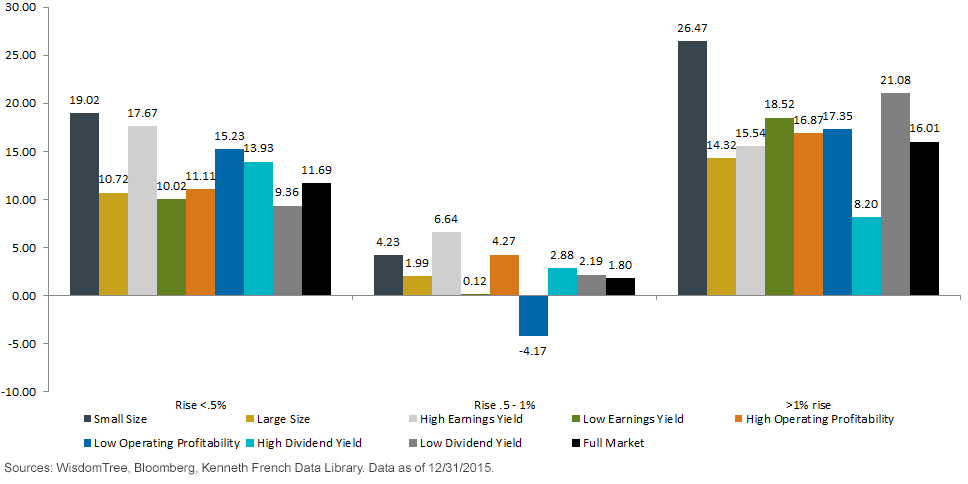
We divided the universe of U.S. stocks into quintiles by several factors—market capitalization, earnings yield, operating profitability and dividend yield—and analyzed the top quintile against the bottom quintile for each.
Even though fixed income yields generally have been falling since the mid-1980s, 27 of the last 52 calendar years have seen an increase in the 10-Year U.S. Treasury yield. Of those 27 years, yields have risen to various degrees. In years that saw yields increase by less than .50%, we generally see that the factors we know to outperform over time—small caps, high earnings yielders and high-dividend payers—did exactly that. Interestingly, companies with low operating profitability outperformed those with high profitability, but by the smallest margin of all the factors we measured.
Big Moves in Rates Had Strong Equity Markets
In years that saw interest rates rise more than 1.00%, every factor except one returned at least 14.32%, once again led by small caps (these years were the typical “risk-on” years, such as 2009 and 2013). The only factor to significantly lag the market was the highest-yielding stocks, which we would expect to underperform in a rapidly rising yield environment.
However, for investors that believe we will see interest rates increase at a moderate pace, looking specifically at times when yields rose between .50% and 1.00% may be the most informative, as these periods show us a significant divergence between factors.
Repeating a common theme, small-cap stocks outperformed large caps. However, earnings yield and operating profitability appear to be even stronger indicators of outperformance during these occasions. The top stocks by earnings yield outperformed the bottom stocks by an average of more than 6.5% per year. Further, companies with high operating profitability outperformed those with low profitability by nearly 8.5% per year. High-yielding stocks narrowly beat low-yielding stocks over the last 40-plus years, implying that the income cushion provided by dividend payers can help offset the loss in principal during moderate rises in yields.
What does this tell us about how to position portfolios? We recommend positioning toward strategies that are small-cap focused with high earnings yields and strong operating profitability, as those should do well in a rising rate environment.
The WisdomTree Earnings Index Family: Tilts toward Profitability and High Earnings Yields
WisdomTree has a small-cap strategy that assigns greater weights to the most profitable companies and each year rebalances toward stocks with high earnings yields—the WisdomTree SmallCap Earnings Index.
To confirm our beliefs, we analyzed the excess return of the WisdomTree SmallCap Earnings Index against the S&P 500 Index on a rolling one-year basis since the WisdomTree Index’s inception in 2007. We also looked at the rolling one-year excess returns of the S&P 500 Utilities Index over the broader S&P 500 Index, as we’ve just seen a period with significant outperformance of this sector, followed by the past few months, where we witnessed a distinct change in trend as the 10-Year Treasury yield began to rise.
Since we already know the Utilities sector has a record of doing well (especially recently) in falling interest rate environments, does the WisdomTree SmallCap Earnings Index provide complementarity by generating excess returns during past rising interest rate environments?
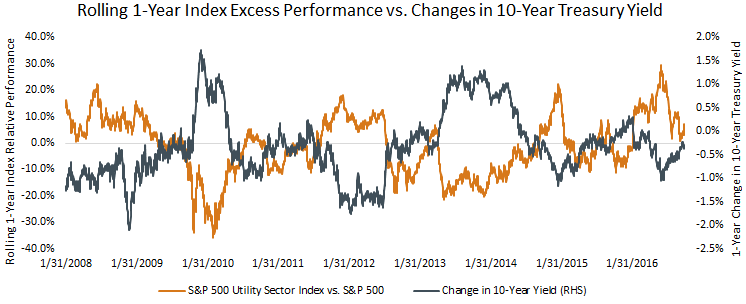
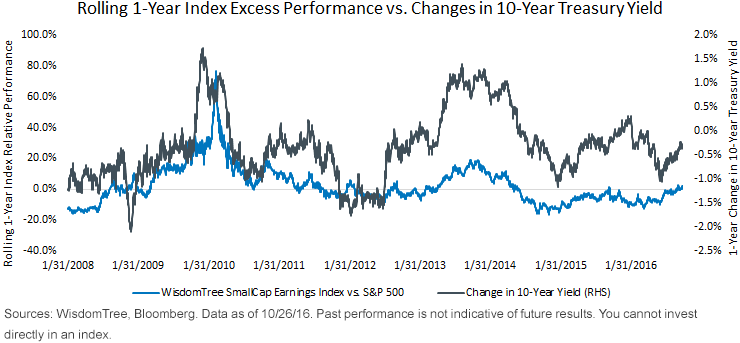
The excess return of the WisdomTree Index tends to move along with changes in the 10-Year yield; in fact, the two variables have a
Share & Comment


Popular Posts
Don’t Overlook the State Tax Exemption on U.S. Treasury Income—It Could Be Costly The New Defensive Playbook: Defense Spending as a Long-Term Reality Capital Efficiency: Expanding the Frontier in Portfolio Construction
Categories
Women in Asset Management Series
Related Links
REGISTER TO RECEIVE BLOG ALERTS
Already registered? Please log in to sign up for blogs.
Financial Professional Individual Investor Select Country Afghanistan Åland Islands Albania Algeria American Samoa Andorra Angola Anguilla Antarctica Antigua and Barbuda Argentina Armenia Aruba Australia Azerbaijan Bahamas Bahrain Bangladesh Barbados Belarus Belize Benin Bermuda Bhutan Bolivia Bosnia and Herzegovina Botswana Bouvet Island Brazil British Indian Ocean Territory Brunei Darussalam Burkina Faso Burundi Cambodia Cameroon Canada Cape Verde Cayman Islands Central African Republic Chad Chile China Christmas Island Cocos (Keeling) Islands Colombia Comoros Congo Congo, The Democratic Republic of the Cook Islands Costa Rica Côte d'Ivoire Cuba Djibouti Dominica Dominican Republic Ecuador Egypt El Salvador Equatorial Guinea Eritrea Ethiopia Falkland Islands (Malvinas) Faroe Islands Fiji French Guiana French Polynesia French Southern Territories Gabon Gambia Georgia Ghana Gibraltar Greenland Grenada Guadeloupe Guam Guatemala Guernsey Guinea Guinea-Bissau Guyana Haiti Heard Island and McDonald Islands Holy See (Vatican City State) Honduras Hong Kong India Indonesia Iran, Islamic Republic of Iraq Isle of Man Israel Jamaica Japan Jersey Jordan Kazakhstan Kenya Kiribati Kuwait Kyrgyzstan Laos People's Democratic Republic Lebanon Lesotho Liberia Libyan Arab Jamahiriya Macau Madagascar Malawi Malaysia Maldives Mali Marshall Islands Martinique Mauritania Mauritius Mayotte Mexico Micronesia, Federated States of Moldova Monaco Mongolia Montenegro Montserrat Morocco Mozambique Myanmar Namibia Nauru Nepal Netherlands Antilles New Caledonia New Zealand Nicaragua Niger Nigeria Niue Norfolk Island Korea, Democratic People's Republic of Northern Mariana Islands Oman Pakistan Palau Palestinian Territory, Occupied Panama Papua New Guinea Paraguay Peru Philippines Pitcairn Islands Puerto Rico Qatar Réunion Russian Federation Rwanda Saint Barthélemy Saint Helena Saint Kitts and Nevis Saint Lucia Saint Martin Saint Pierre and Miquelon Saint Vincent and the Grenadines Samoa San Marino Sao Tome and Principe Saudi Arabia Senegal Serbia Seychelles Sierra Leone Singapore Solomon Islands Somalia South Africa Korea, Republic of Sri Lanka Sudan Suriname Svalbard and Jan Mayen Swaziland Switzerland Syrian Arab Republic Taiwan, Province of China Tajikistan Tanzania, United Republic of Thailand Timor-Leste Togo Tokelau Tonga Trinidad and Tobago Tunisia Turkey Turkmenistan Turks and Caicos Islands Tuvalu Uganda Ukraine United Arab Emirates United States United States Minor Outlying Islands Uruguay Uzbekistan Vanuatu Venezuela Vietnam Virgin Islands, British Virgin Islands, U.S. Wallis and Futuna Western Sahara Yemen Zambia Zimbabwe StateAlabamaAlaskaArizonaArkansasCaliforniaColoradoConnecticutDelawareDistrict of ColumbiaFloridaGeorgiaHawaiiIdahoIllinoisIndianaIowaKansasKentuckyLouisianaMaineMarylandMassachusettsMichiganMinnesotaMississippiMissouriMontanaNebraskaNevadaNew HampshireNew JerseyNew MexicoNew YorkNorth CarolinaNorth DakotaOhioOklahomaOregonPennsylvaniaRhode IslandSouth CarolinaSouth DakotaTennesseeTexasUtahVermontVirginiaWashingtonWest VirginiaWisconsinWyomingOther Select Your Broker (optional) Fidelity Charles Schwab TD Ameritrade Vanguard E*Trade Other How Did You Hear About Us? (optional) Online search (Google, Bing) Online advertising TV advertising Streaming TV Event Word of mouth
By submitting below you certify that you have read and agree to our privacy policy.
REGISTER
Categories
About the contributor

Director, Model Portfolios
Joe Tenaglia joined WisdomTree as Asset Allocation Strategist in 2016. He is responsible for building and managing WisdomTree’s CIO-managed and custom model portfolios. In this role he focuses on asset allocation, security selection, and portfolio construction for the firm’s open architecture models, with objectives ranging from strategic to tactical. Joe sits on WisdomTree’s Model Portfolio Investment Committee, which oversees the firm’s ETF models and helps shape and communicate WisdomTree’s thoughts on the markets. Prior to joining WisdomTree, he held roles at Emerging Global Advisors (acquired by Columbia Threadneedle) and BNY Mellon. Joe received his B.S. in Finance and Marketing from Boston College. He is a holder of both the Chartered Financial Analyst designation and Chartered Market Technician designation.