


The Bond Market’s Sell-Off Is Taking Out the Stock Market’s Leaders
Published March 26, 2021

Jeff Weniger, CFA
Head of Equity Strategy
This is part 1 of a two-part blog series. In part 2, “Plenty of Price, Not Much Sales,” we will take a look at the growing list of companies that are trading at extraordinary valuations.
Long duration bonds are witnessing some ugly price action.
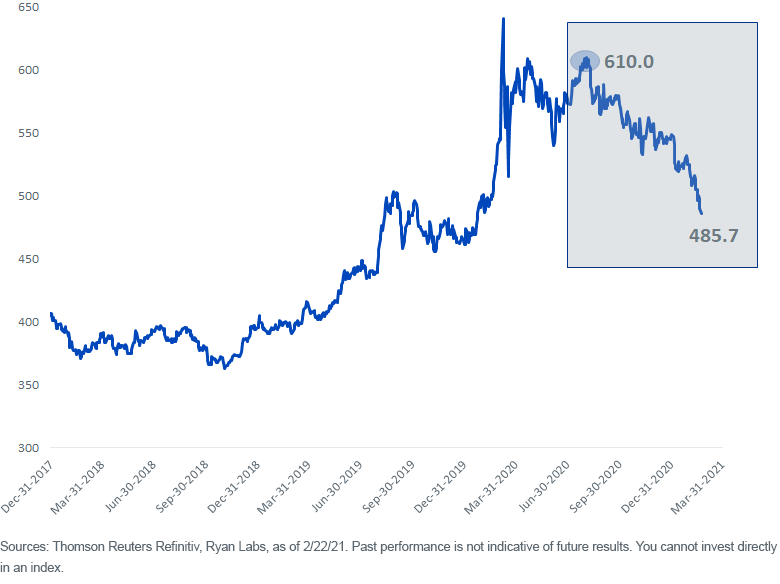
It came so quickly that you could be forgiven for not fully appreciating the extent of the pain—the 30-Year U.S. Treasury is officially in a bear market, defined as a loss of more than 20% (figure 1).
Figure 1: Ryan Labs U.S. 30-Year Treasury Total Return Index
My suspicion is that rising yields—bond market pain—amount to a greater headwind for growth stocks than value stocks, owing to the effect that higher discount rates have on distant cash flows.
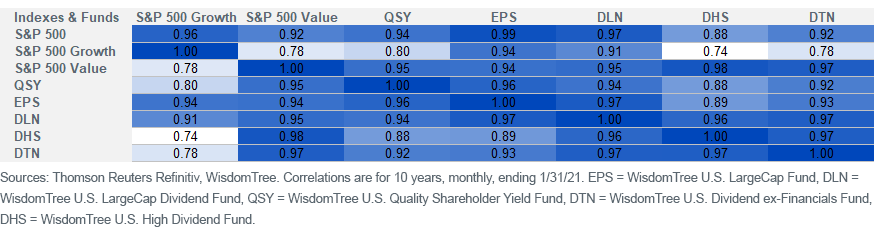
Focus on the bold fonts in figure 2, which show the correlation to the S&P 500 Growth of some of our major U.S. large-cap value-tilted Funds.
Figure 2: WisdomTree Large Cap Core & Value Correlations
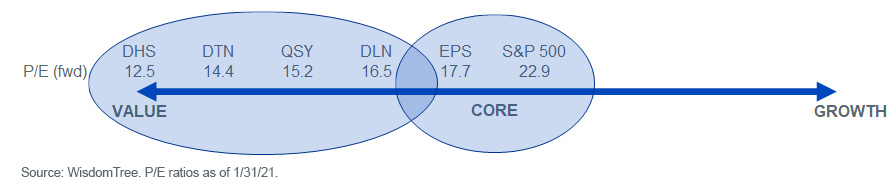
On a value-core-growth spectrum, the five Funds look something like figure 3. DHS, DTN and QSY give a deeper value bias than DLN, which is a more traditional value. EPS is more of a core Fund that has a value flavor.
Figure 3: WisdomTree Funds’ Value-Core-Growth Positioning
It’s still early days, but the stock market’s response to the bond sell-off has been to take out growth stocks. For sure, not all of the market’s leaders are in trouble: Google-parent Alphabet is still near its highs, while Microsoft’s decline since mid-February is just a blip on the long-term chart. Then again, I am not sure many people consider that one to be a growth stock anymore.
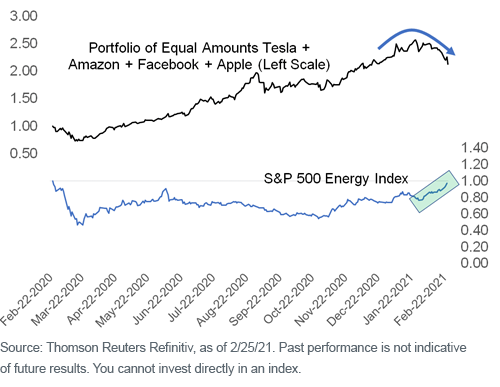
But things are looking ugly with some of the market’s “generals,” with Tesla, Amazon, Facebook and Apple acting sickly of late. That is a sharp contrast to the surge in the reflation-themed Energy sector.
Figure 4 is the 2021’s reflation thesis in one exhibit: disinflation beneficiaries are “off,” and inflation beneficiaries are “on.”
Figure 4: Old Leaders vs. New Leaders
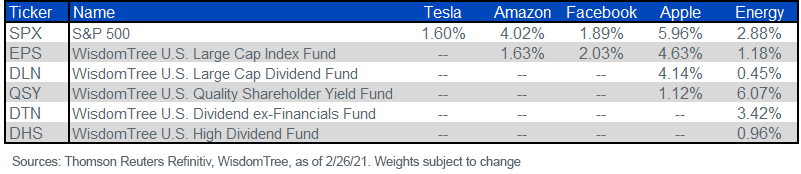
The “value-lite” EPS tends to under-weight in high flyers because its 500-stock methodology weights components by their earnings as a proportion of all stocks’ earnings. It only has 1% in Energy, owing to that group’s low profits. If the goal is to have more in that sector, maybe something like QSY is the angle.
DLN requires a dividend for inclusion, so it is a course that can be taken to completely exclude a handful of the market’s darlings. Similar concepts are found in DTN and DHS, which have their own twists on dividend screens.
Figure 5: Fund & Index Weights
In part 2 of this two-part blog series, we look at the abundance of companies in the S&P 500 that are trading at a price-to-sales ratio above 10—and what may happen to them if rising interest rates hinder growth stocks.
Important Risks Related to this Article
There are risks associated with investing, including the possible loss of principal. Funds focusing their investments on certain sectors increase their vulnerability to any single economic or regulatory development. This may result in greater share price volatility. Please read each Fund’s prospectus for specific details regarding the Fund’s risk profile.
Dividends are not guaranteed, and a company currently paying dividends may cease paying dividends at any time. References to specific securities and their issuers are for illustrative purposes only and are not intended to be, and should not be interpreted as, recommendations to purchase or sell such securities.
Related articles

Rules Over Headlines: WisdomTree’s Approach to Growth Investing

Two Prices, One Fund: Understanding NAV and Market Price in ETFs

When AI Leaves the Screen and Enters the Physical World

Dividend Growth Is Not One Strategy

Beyond Market Cap: A Nearly 19-Year Case for Dividend-Driven Emerging Markets

Behind the Charts: Is the Energy Trade Running Out of Fuel?
Quality as a Foundation in an Uncertain World

The Company at the Center of the AI Economy

A Dog, a Diagnosis and a Different Way to Understand AI
About the contributor

Jeff Weniger, CFA
Head of Equity Strategy
Jeff Weniger, CFA, has been with WisdomTree since 2017 and serves as the Head of Equities. He shapes the firm’s market outlook through a combination of macroeconomic and fundamental analysis. With more than two decades in investment strategy, Jeff is known for his work on market cycles and valuations. Before joining WisdomTree, Jeff was with BMO Private Bank and BMO Global Asset Management for 11 years. At BMO, he sat on the firm’s Asset Allocation Committee and co-managed ETF model portfolios across the U.S. and Canada. In 2013, at age 32, he became the youngest member of BMO’s Global Investment Forum. When he left BMO to come to WisdomTree, his final role was Director, Senior Strategist in the Office of the CIO in 2017.
Jeff is a frequent television guest on networks such as CNBC, Bloomberg, and Schwab, with regular print appearances in The Wall Street Journal, Barron’s and Reuters. He also appears weekly on the Behind the Markets podcast and is a regular on SiriusXM’s The Business Briefing. On X, Jeff has developed one of the larger followings in financial media. He earned a B.S. in Finance from the University of Florida and an MBA from the University of Notre Dame. He has held the CFA charter since 2006.