
QGRW
U.S. Quality Growth Fund

Published June 17, 2026

Head of Indexes, U.S.

Director, Quantitative Research
The anticipated IPO of SpaceX has become one of the most closely watched events in global equity markets. In response, some index providers have made special accommodations to gain exposure to the company ahead of their standard inclusion timelines.
Such developments reflect the growing demand from investors to access innovative companies earlier in their lifecycle. They also highlight an important point about index construction: rules should be assessed in the context of the exposure an index is designed to deliver.
While, for some strategies, faster inclusion of a newly listed company may be consistent with the objective of capturing a specific market segment or investment theme, for strategies driven by fundamentals, the answer should be straightforward and depend on where the company’s fundamentals land..
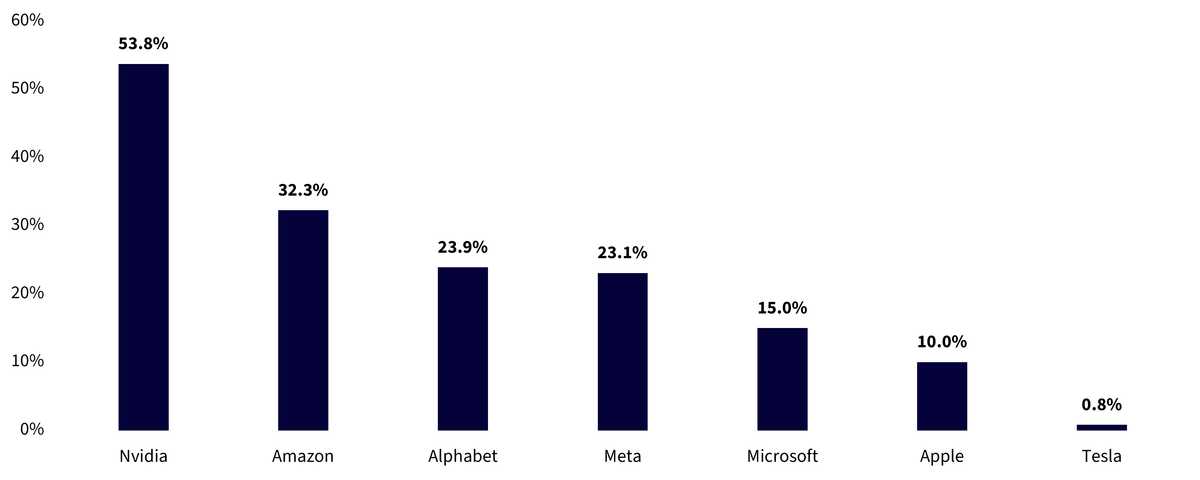
That distinction matters. During the latest reconstitution, Tesla was removed from the WisdomTree U.S. Quality Growth Index (WTQGRW) after falling below the quality and growth thresholds required by the methodology. The exclusion is not a judgment on Tesla’s long-term potential, nor a view on investor demand for disruptive companies. It is the outcome of a rules-based process applying the same fundamental tests to every eligible company. Figure 1 shows the time-smoothed five-year earnings-per-share (EPS) growth rates for Magnificent Seven (Mag 7) companies. At 0.8%, Tesla’s 5-year EPS growth rate has stalled out and looks nothing like the high-growth tech company its earnings multiple implies.
Figure 1: Mag 7 5-Yr EPS Growth Rates
Source: WisdomTree, FactSet, as of 5/31/26. 5yr EPS Growth Rates = a regression-based, mean-normalized EPS growth rate.
Regardless of market attention, company size or investor popularity, constituents of the WisdomTree U.S. Quality Growth Index must continue to meet the index’s quality and growth requirements. Companies that no longer satisfy those criteria are removed, while companies that qualify are added.
Growth Investing Grounded in Fundamentals
Many growth-oriented indexes are heavily influenced by market capitalization, resulting in portfolios that increasingly concentrate in the largest and most widely owned technology companies. They can also be driven by listing venues or commercial considerations rather than company fundamentals. Over time, this can create exposure to businesses whose index weight is driven primarily by market value rather than by the strength of their underlying fundamentals.
The WisdomTree U.S. Quality Growth Index takes a different approach.
Rather than simply owning the largest growth companies, the index seeks businesses that combine strong growth characteristics with high-quality fundamentals. Companies are evaluated using measures of profitability, earnings and sales growth, creating a portfolio designed to identify businesses capable of sustaining growth through strong underlying economics.
This disciplined screening process often leads to a portfolio composition that can differ significantly from traditional growth benchmarks such as the Nasdaq 100 Index.
The result is a strategy that seeks exposure to companies demonstrating both growth and quality, rather than simply those attracting the greatest investor attention.
A Different Portfolio by Design
The differences between the two approaches become evident when examining the stocks that are unique to each index.
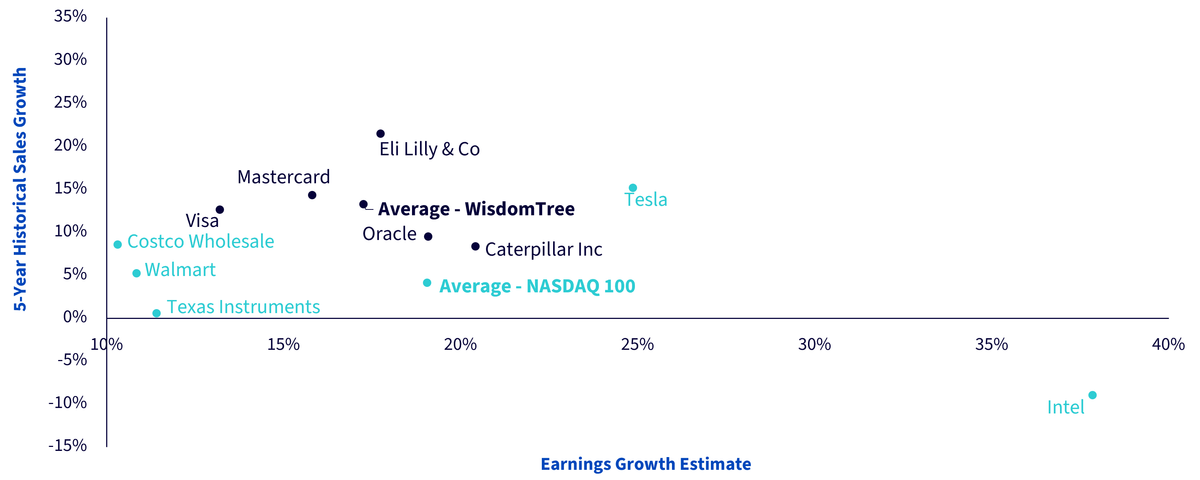
Comparison of unique stocks in the WisdomTree U.S. Quality Growth Index (effective post rebalance in June 2026) and the Nasdaq 100 Index.
Figure 2: Figure 2: Unique Holdings in the WisdomTree U.S. Quality Growth Index vs. the Nasdaq 100 Index
Source: WisdomTree, FactSet. As of 6/29/26. Past performance is not indicative of future results.
Figure 3: Top 5 Unique Holdings in the WisdomTree U.S. Quality Growth Index
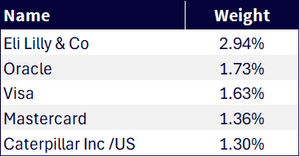
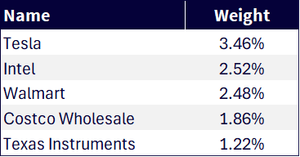
Figure 4: Top 5 Unique Holdings in the Nasdaq 100 Index
These differences are not accidental. They are the natural outcome of two distinct index construction philosophies.
One approach is designed to represent the largest companies listed on Nasdaq while the other seeks to identify businesses that exhibit a combination of strong growth potential and high-quality fundamentals across all U.S. exchanges.
On average, the unique stocks in the WisdomTree U.S. Quality Growth Index exhibited more than twice the sales growth over the last five years (13.3%), dwarfing the single-digit sales growth of unique Nasdaq 100 stocks (4.1%).
Although Tesla and Intel have strong forward earnings growth estimates, their low profitability is what led to their exclusion from the WisdomTree index. Tesla ranked outside the top third by profitability among the 500 largest US stocks and Intel fared much more poorly, ranking outside the top 95% by profitability.
Staying Disciplined When Markets Are Focused on Individual Companies
Periods of heightened investor interest often test the discipline of investment methodologies. Whether driven by a highly anticipated IPO, a popular investment theme or a company that has become synonymous with market leadership, there can be pressure to adapt index construction rules to reflect prevailing market sentiment.
The value of a rules-based process lies in its ability to remain consistent through these periods.
The differences between the WisdomTree U.S. Quality Growth Index and traditional growth benchmarks are the outcome of a systematic process designed to identify companies that combine strong growth potential with high-quality fundamentals.
This approach naturally leads to a portfolio that can look very different from market-cap-weighted growth indexes. At times, it may exclude some of the market's most popular stocks while highlighting companies that receive far less attention from investors.
Importantly, this differentiated exposure has translated into results. Since its inception in December 2023, the WisdomTree U.S. Quality Growth Fund (QGRW), which tracks the WisdomTree U.S. Quality Growth Index, has outperformed several widely followed benchmarks, including the Nasdaq 100, S&P 500 and Russell 1000 Growth Index. While past performance does not guarantee future returns, the track record to date demonstrates the potential benefits of maintaining a disciplined focus on fundamentals.
Figure 5: Performance Comparison
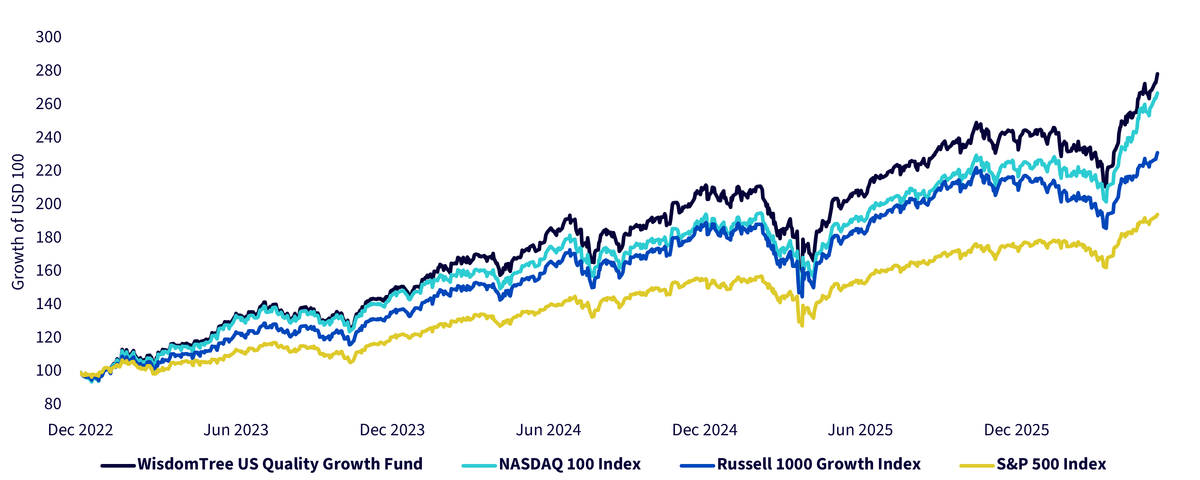
Source: WisdomTree, FactSet. From 12/15/22 to 5/31/26.
U.S. Quality Growth Fund

Head of Indexes, U.S.
Alejandro Saltiel joined WisdomTree in May 2017 as part of the Quantitative Research team. Alejandro oversees the firm’s Equity indexes and actively managed ETFs. He is also involved in the design and analysis of new and existing strategies. Alejandro leads the quantitative analysis efforts across equities and alternatives and contributes to the firm’s website tools and model portfolio infrastructure. Prior to joining WisdomTree, Alejandro worked at HSBC Asset Management’s Mexico City office as Portfolio Manager for multi-asset mutual funds. Alejandro received his Master’s in Financial Engineering degree from Columbia University in 2017 and a Bachelor’s in Engineering degree from the Instituto Tecnológico Autónomo de México (ITAM) in 2010. He is a holder of the Chartered Financial Analyst designation.

Director, Quantitative Research
Ayush Babel is the Director of Quantitative Research in WisdomTree's multi-asset quantitative research and index teams. In this role, he focuses on developing innovative quantitative strategies across various asset classes while supporting WisdomTree's diverse range of products. His expertise spans factor exploration, portfolio construction and optimization, quantitative investment research, and product development.
With over a decade of experience in the financial services industry, Ayush has held investment research roles at J.P. Morgan and Franklin Templeton. At these institutions, he was responsible for developing and managing equity and fixed income smart beta products, as well as cross-asset risk premia solutions for global institutional and retail clients. His experience covers a broad spectrum of asset classes and investment styles.
Ayush holds a bachelor's in Engineering Physics and a master’s degree in Nanoscience from the Indian Institute of Technology, Bombay.


