
DHS
U.S. High Dividend Fund

Published August 5, 2026

Global Head of Research
For much of the past several years, the story of U.S. equity markets has been, in large part, the story of seven companies, the so-called Magnificent 7 (Alphabet, Amazon, Apple, Meta, Microsoft, NVIDIA, and Tesla). These firms have dominated in their contribution to S&P 500 Index performance, commanded an outsized share of investor attention, and become nearly synonymous with the idea of owning U.S. equities in the first place. For investors who rode that wave, it was an extraordinary run.
But concentration cuts both ways, and increasingly, a different kind of question is being asked in client conversations and portfolio reviews:
What does a U.S. equity allocation look like if you want to step back from that concentration and from the AI trade that has powered so much of it?
The WisdomTree U.S. High Dividend Fund (DHS) offers one potential answer. Designed to track the higher-yielding segment of the U.S. dividend-paying universe,1 DHS gravitates toward companies that may not have been riding such an explicit wave of performance momentum because this would make it challenging to exhibit a dividend-yield high enough to gain inclusion.
As of July 2026, the result is a portfolio that effectively avoids the Magnificent 7. This is not an explicit mandate, but as a natural consequence of how the strategy is built.2 That said, it would be an overstatement to say DHS fully avoids the AI trade; some of the companies powering AI infrastructure and adoption do pay meaningful dividends, and they can find their way into the portfolio. What DHS does provide, though, is a meaningfully different composition than what the S&P 500 Index and the S&P 500 Value Index provide today.
What’s been surprising in 2026 is, even amid all of the fervor around AI with the continued capital spending and analysis of structural bottlenecks in building data centers, DHS has been outperforming the S&P 500 Index. The strategy has been live for more than 20 years at this point and, over this particular 20-year period, it has not usually been able to outperform.
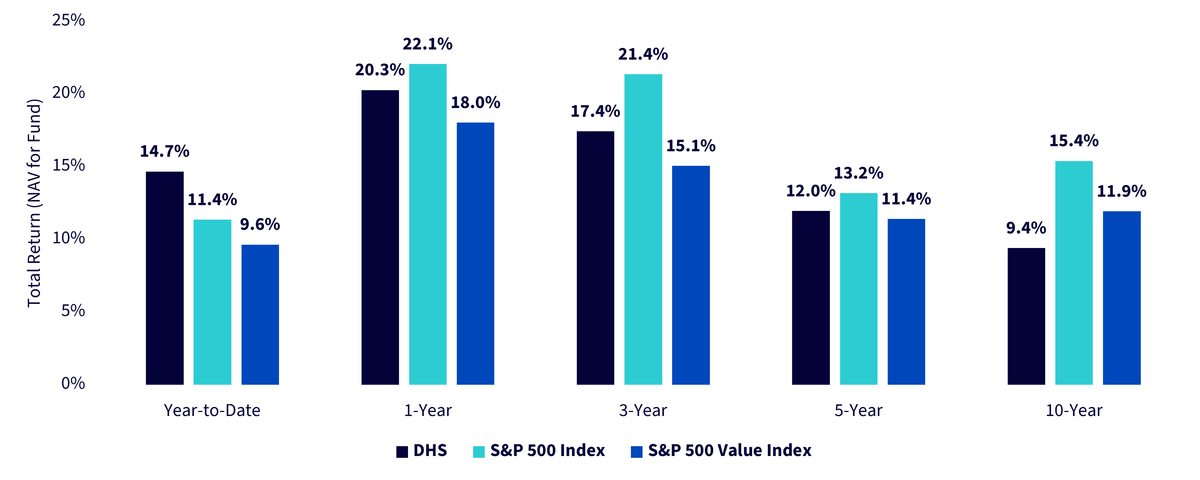

Sources: Morningstar, FactSet and WisdomTree, specifically data is from the PATH Fund Comparison Tool, accessed as of July 12, 2026, but showing returns for the period ended July 10, 2026 for Figure 1a and June 30, 2026 for 1b. NAV denotes total return performance at net asset value. MP denotes market price performance. Past performance is not indicative of future results. Investment return and principal value of an investment will fluctuate so that an investor’s shares, when redeemed, may be worth more or less than their original cost. Current performance may be lower or higher than the performance data quoted. For the most recent month-end and standardized performance and to download the respective Fund prospectuses, click here.
Perhaps the most direct way to illustrate what DHS is, and what it isn't, is to look at the top 10 holdings side by side against both the S&P 500 and S&P 500 Value Indexes.
In the S&P 500 Index, the Magnificent 7 dominate. NVIDIA leads at over 7%, followed by Apple, Alphabet, Microsoft, and Amazon. Even Broadcom, one of the central AI semiconductor stories of recent years, claims a spot. These firms have earned their weight through extraordinary growth.
The S&P 500 Value Index tells a more nuanced story. Apple still appears at the top. Amazon and Tesla hold positions as well. Value, as a label, has not fully escaped the gravitational pull of mega-cap technology.
Then there is DHS. AbbVie, Merck, Altria, Texas Instruments, Exxon Mobil, Philip Morris, AT&T, Verizon, Bristol Myers Squibb, Chevron. The top 10 reads like a roster of the U.S. economy's cash-generating workhorses, covering such areas as pharmaceuticals, tobacco, energy, telecommunications. These are companies that have, for decades, returned capital to shareholders as a central part of their investment proposition.
Not a single Magnificent 7 name appears.
This is not a quirk of the moment, but rather it is a structural outcome of the strategy's design. When dividend yield is the organizing principle, the companies that define today's market narrative, and drive today's AI investment wave, largely filter themselves out, and what remains is genuinely different exposure.
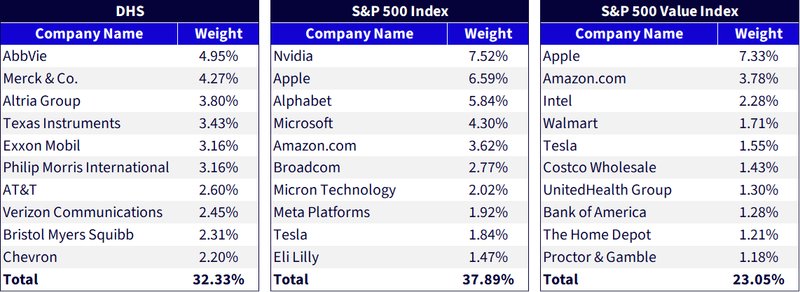
Sources: WisdomTree, FactSet, with data from WisdomTree’s Fund Compare Tool within the broader PATH set of tools. Data is as of June 30, 2026. Holdings subject to change.
In contextualizing the current environment, just passed the midpoint of 2026, it’s clear that there is a nervousness. We are living through a historic technology buildout, and the Mag 7 are driving a large part of that. Some investors may look at these companies and see opportunities from this buildout, while others looking at the same firms might have a vision overwhelmed by risk.
There is no one way to measure risk, but one of the more popular is through valuation. While it cannot tell us anything about future returns with a certainty, it is good at telling us what type of expectations are currently being priced in. In short, higher valuations mean higher expectations. If these expectations fail to be met, corrections could result.
Figure 3 takes an array of valuation measures and indicates how DHS exhibited something significantly below both the S&P 500 as well as the S&P 500 Value Indexes. What’s notable about that is combining this with what we showed in Figure 1a. DHS has been outperforming these benchmarks in 2026, but its current valuation metrics are still significantly below. For investors considering managing risk in U.S. equities, this could be an interesting approach for consideration.
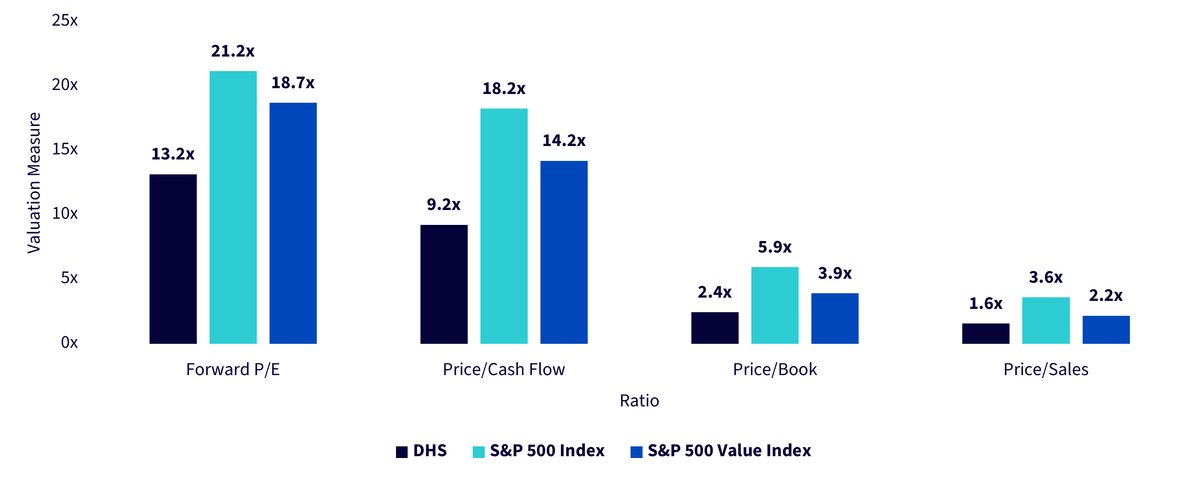
Sources: WisdomTree, FactSet, with data sourced from the WisdomTree Fund Compare tool within WisdomTree’s broader PATH suite of tools. Data is as of June 30, 2026. Past performance is not indicative of future results.
1 DHS is designed to track the total return performance, before fees and expenses, of the WisdomTree U.S. High Dividend Index, which does focus on the relatively higher dividend-yielding stocks, weighted by their cash dividends.
2 Source: DHS fund page, with holdings as of July 10, 2026. Holdings subject to change.
There are risks associated with investing, including possible loss of principal. Dividends are not guaranteed, and a company currently paying dividends may cease paying dividends at any time. Funds focusing their investments on certain sectors and/or regions increase their vulnerability to any single economic or regulatory development. The Fund invests in the securities included in, or representative of, its Index regardless of their investment merit and the Fund does not attempt to outperform its Index. The composition of the Index is governed by an Index Committee and the Index may not perform as intended. Please read the Fund’s prospectus for specific details regarding the Fund’s risk profile.
U.S. High Dividend Fund


Global Head of Research
Christopher Gannatti began at WisdomTree as a Research Analyst in December 2010, working directly with Jeremy Schwartz, CFA®, Director of Research. In January of 2014, he was promoted to Associate Director of Research where he was responsible to lead different groups of analysts and strategists within the broader Research team at WisdomTree. In February of 2018, Christopher was promoted to Head of Research, Europe, where he was based out of WisdomTree’s London office and was responsible for the full WisdomTree research effort within the European market, as well as supporting the UCITs platform globally. In November 2021, Christopher was promoted to Global Head of Research, now responsible for numerous communications on investment strategy globally, particularly in the thematic equity space. Christopher came to WisdomTree from Lord Abbett, where he worked for four and a half years as a Regional Consultant. He received his MBA in Quantitative Finance, Accounting, and Economics from NYU’s Stern School of Business in 2010, and he received his bachelor’s degree from Colgate University in Economics in 2006. Christopher is a holder of the Chartered Financial Analyst Designation.