
QGRW
U.S. Quality Growth Fund

Published August 11, 2026

Equity Strategist
The WisdomTree U.S. Quality Growth Fund (QGRW) just concluded an impressive month of relative outperformance in July that was heavily driven by its Quality- and Growth-focused methodology.
On a net asset value (NAV) basis, QGRW comfortably outperformed several of the market’s flagship U.S. growth gauges amid declines in Information Technology and a deep bear market in semiconductor shares. Though it fell in sympathy with the broader market, its 1.6% dip paled in comparison to a 6.6% decline in the NASDAQ® 100 Index, a 4.8% swoon in the Russell 1000 Growth Index and a 2.9% hiccup within the MSCI USA Growth Index. It even maintained a 20-basis point (bp) advantage over the , which modestly fell 1.8%.1
One month of outperformance is typically unremarkable, but QGRW’s record in July was closely tied to the core Quality and Growth tenets of its methodology, which have been on full display this summer.
In accordance with its semi-annual rebalance schedule, QGRW’s June reconstitution allowed it to reevaluate the U.S. equity landscape for the highest-quality companies with proven track records, and promising prospects, of growth. Equally important, the rebalance allowed it to shed the companies mired in low growth environments with weakening fundamentals.
Tesla was one such example.
During the screening process, Tesla exhibited several red flags that ultimately caused it to be the first of the Magnificent 7 companies removed from QGRW since inception in late 2022.
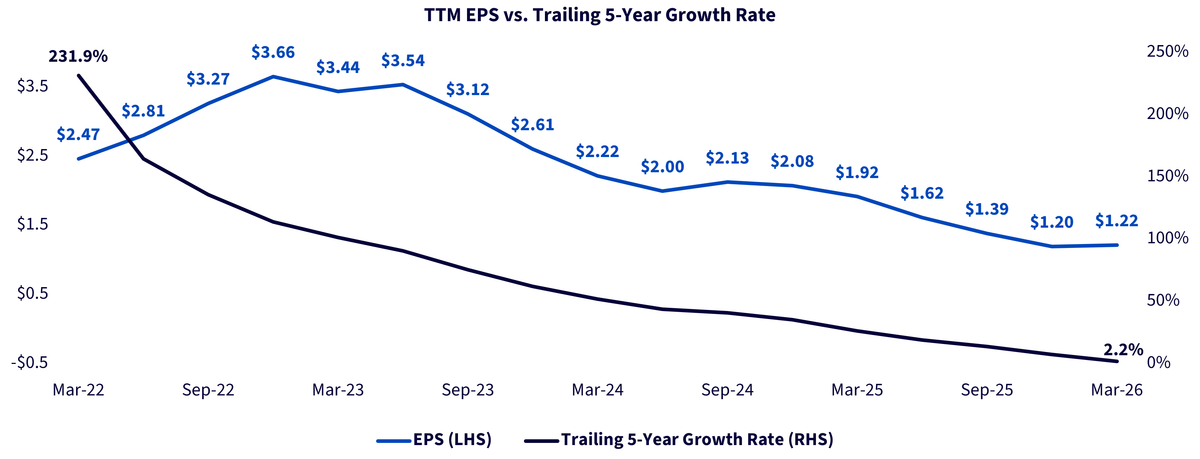
Source: WisdomTree, FactSet as of 3/31/2026, corresponding to the most recent quarterly report prior to QGRW’s June 2026 rebalance.
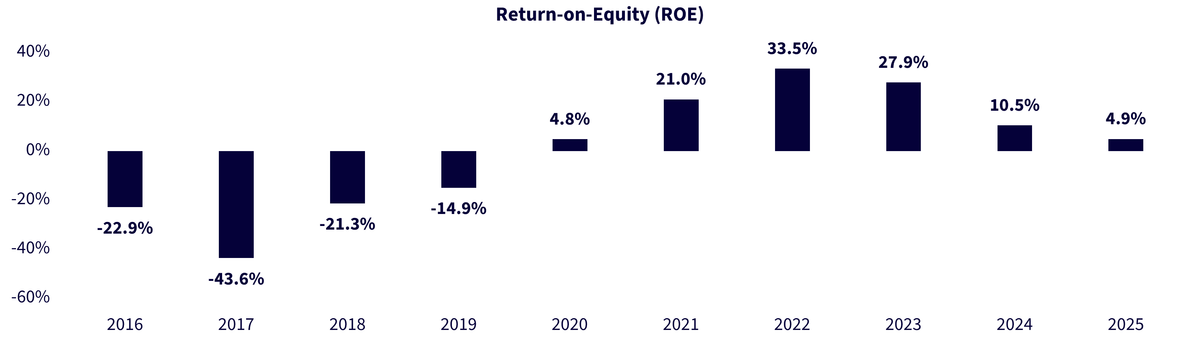
Source: WisdomTree, FactSet as of 12/31/2025, corresponding to the most recent annual report prior to QGRW’s June 2026 rebalance.
The trio of declining fundamentals, coupled with nearly 200x forward and trailing price-to-earnings (P/E) multiples, precluded Tesla’s inclusion in June, and its elimination proved prescient.
Since QGRW’s 2.4% position in Tesla was sold on June 11th, its shares fell an additional 22% through July’s end, indicative of investors’ concerns about its underlying health and efficacy of operations as they awaited its Q2 earnings report.
Meanwhile, the broader market held tightly onto Tesla shares and endured the decline, a consequence of ignoring high-quality fundamentals within growth-centric allocations and inflexible rebalancing. As of writing, ETFs tracking2 the Russell 1000 Growth Index own a 2.9% Tesla position, while those tracking the NASDAQ® 100 and S&P 500 Growth Indexes own 2.6% and 1.6% positions, respectively.
While strong relative performance stories often emerge from the companies avoided during periods of weakness, the more exciting stories originate from those held in contravention to the market. Surprisingly, Amazon is a shining example.
During FTSE Russell’s June 2026 style rebalance, Amazon was pushed deep into the Russell 1000 Value Index (scored as 92% Value with only a residual sliver to Growth) despite still being widely viewed as a growth leader.
By contrast, QGRW’s June rebalance left the fund with meaningful exposure to Amazon, upgrading it to a 7% position overall and creating a large active bet versus the Russell 1000 Growth Index precisely when the market began to reward it.
Amazon climbed 20% from June 25th (when it was virtually eliminated from the Russell 1000 Growth Index) through the end of July, contributing over 1% of positive relative return versus the Russell 1000 Growth Index.
Amazon quickly became a hallmark example of what differentiates QGRW’s stock selection process. It does not own growth names simply because they are large or familiar, nor does it follow the status quo established by conventional growth approaches. It targets something in between: high-quality companies that continue to clear its profitability, earnings growth and sales growth screens, which is why the portfolio can look meaningfully different from a conventional growth benchmark.
In this case, QGRW’s factor discipline enabled it to remain invested in a strong fundamental story even as competing methodology reclassified it into Value, a divergence that proved highly rewarding.
Stories like these underscore how fickle conventional style classification approaches can be, and how strong performance results are often tied to a marriage of factors instead, like Quality and Growth.
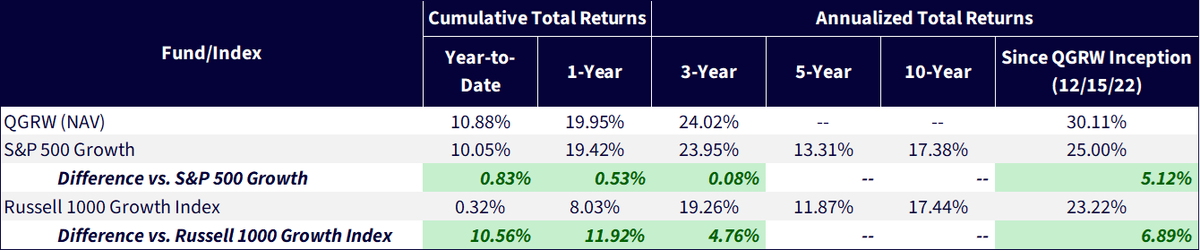
Source: WisdomTree, S&P, Bloomberg as of 7/31/2026. QGRW total returns measured at net asset value (NAV). You cannot invest directly in an index. Past performance is not indicative of future results.
Over the three and a half years since inception, QGRW’s factor pairing has delivered impressive outperformance over conventional growth indexes. It’s outperformed the S&P 500 Growth Index by over 5% per year and the Russell 1000 Growth Index by nearly 7% per year, demonstrating consistency in process and application.
July's results provide another illustration of how a disciplined quality-growth process can capitalize when benchmark classifications diverge from company fundamentals. Rather than chasing style definitions, QGRW focuses on identifying businesses with the quality and growth characteristics to compound value over time.
1 Source: Bloomberg, using 1-month total returns, as of 7/31/2026. Past performance is not indicative of future results. You cannot invest directly in an index. Total returns for QGRW are measured at net asset value (NAV).
2 Source: Bloomberg, as of 8/4/2026.
There are risks associated with investing, including possible loss of principal. Growth stocks, as a group, may be out of favor with the market and underperform value stocks or the overall equity market. Growth stocks are generally more sensitive to market movements than other types of stocks. The Fund is non-diversified, as a result, changes in the market value of a single security could cause greater fluctuations in the value of Fund shares than would occur in a diversified fund. The Fund invests in the securities included in, or representative of, its Index regardless of their investment merit and the Fund does not attempt to outperform its Index. The composition of the Index is governed by an Index Committee and the Index may not perform as intended. Please read the Fund’s prospectus for specific details regarding the Fund’s risk profile.
U.S. Quality Growth Fund


Equity Strategist
Brian Manby is an Equity Strategist at WisdomTree and part of the Investment Strategy team.
He is responsible for developing and communicating equity market insights, investment themes, and portfolio strategies that support the firm’s ETF and investment solutions platform. He evaluates sectors, valuations, fundamentals and equity styles to identify investment opportunities and provide actionable perspectives to clients and advisors. He also helps investors understand how WisdomTree’s equity strategies can be used to achieve long-term investment objectives in evolving market environments.
Brian joined WisdomTree in October 2018 as an Investment Strategy Analyst after a few years as a Consultant for FactSet Research Systems, Inc. He earned a B.A. in Economics and Political Science from the University of Connecticut in 2016 and has been a Chartered Financial Analyst since 2022.