
QGRW
U.S. Quality Growth Fund

Published August 18, 2026

Global Head of Research
For advisors looking to build a core U.S. equity allocation with more intentional factor exposure, a 50/50 blend of two WisdomTree funds offers a compelling starting point. One strategy targets quality growth, the other focuses on shareholder yield and value characteristics. Together, there has been complementarity across different market environments while maintaining meaningful differentiation from the S&P 500 Index.
The two funds in the blend:
The sections below evaluate the 50/50 blend across five dimensions.
Each lens captures a different aspect of what advisors might expect from this combination relative to the S&P 500 Index.
Performance is the natural starting point, but the full picture requires looking across time horizons. Figure 1a shows cumulative returns, capturing how the blend has compounded relative to each fund individually and the S&P 500 Index. Figure 1b anchors the comparison with standardized periods.
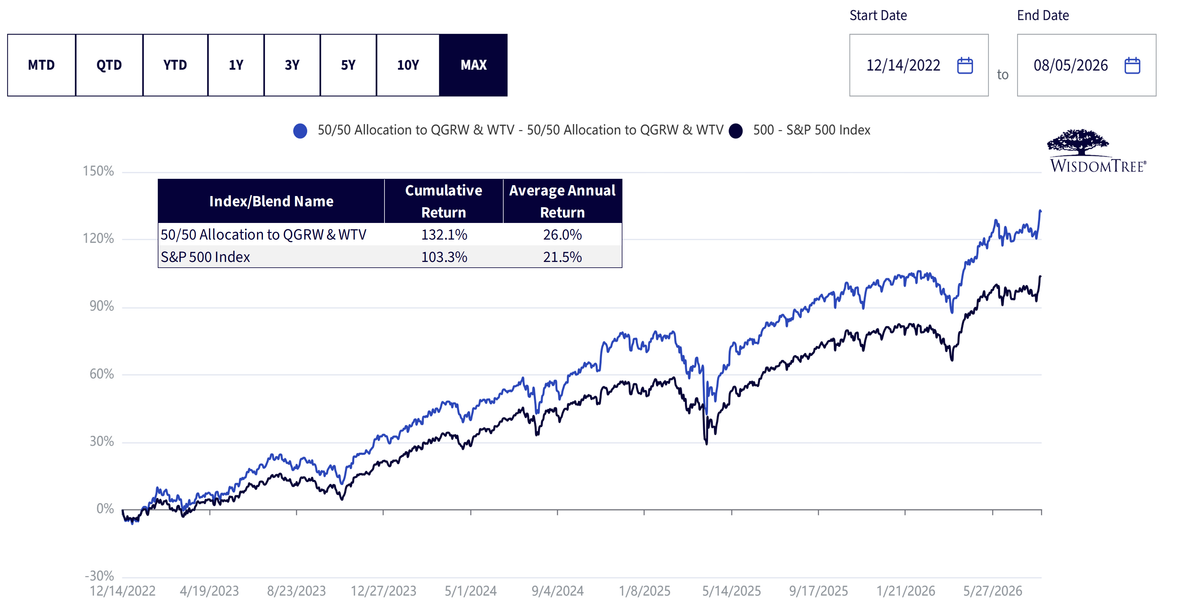
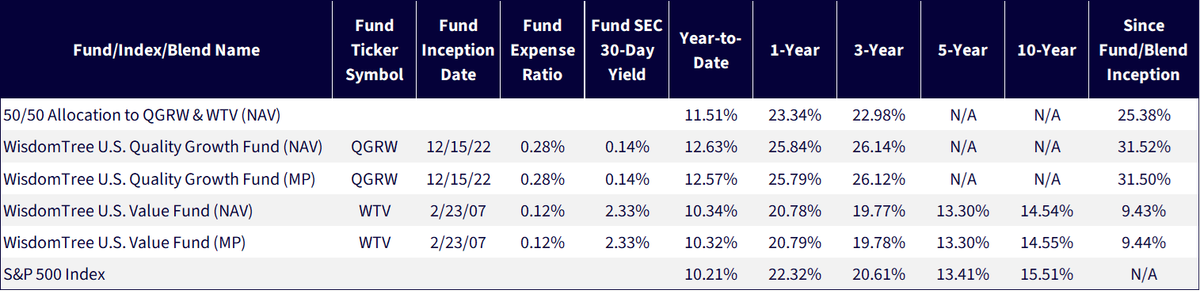
Sources: WisdomTree, Morningstar, FactSet specifically data from the Fund Comparison Tool in the PATH suite of tools, accessed August 7, 2026 with returns for Figure 1a as of August 5, 2026 and for Figure 1b as of June 30, 2026. NAV denotes total return performance at net asset value. MP denotes market price performance. In the case of WTV, the Fund’s objective changed effective December 18, 2017. Prior to December 18, 2017, Fund performance reflects the investment objective of the Fund when it tracked the performance, before fees and expenses, of the WisdomTree U.S. LargeCap Value Index. Past performance is not indicative of future results. Investment return and principal value of an investment will fluctuate so that an investor’s shares, when redeemed, may be worth more or less than their original cost. Current performance may be lower or higher than the performance data quoted. For the most recent month-end and standardized performance, click the relevant ticker: QGRW, WTV.
No single valuation metric tells the full story. Figure 2 presents multiple ratios side by side reflecting how the 50/50 blend is priced relative to the S&P 500 Index across different ways the market assigns value.

Sources: WisdomTree, FactSet, Morningstar, with data as of July 31, 2026 and from the Fund Compare Tool within WisdomTree’s PATH suite of tools. Past performance is not indicative of future results.
Dividends alone understate how companies return capital to shareholders. Buybacks have become an equally significant, and in many cases dominant, mechanism. Figure 3 shows total shareholder yield for the blend and its components versus the S&P 500 Index.
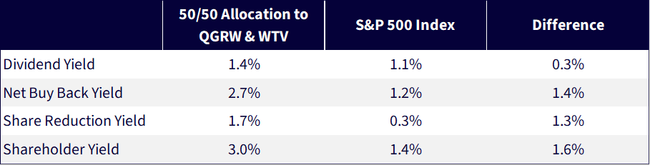
Sources: WisdomTree, FactSet, Morningstar, with data as of July 31, 2026 and from the Fund Compare Tool within WisdomTree’s PATH suite of tools. Past performance is not indicative of future results.
Both funds in the blend emphasize quality as a selection criterion, though they approach it from different angles. Figure 4 examines the underlying fundamentals for the combined blend against the S&P 500 Index.
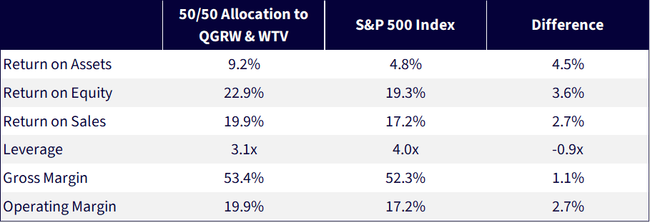
Sources: WisdomTree, FactSet, Morningstar, with data as of July 31, 2026 and from the Fund Compare Tool within WisdomTree’s PATH suite of tools. Past performance is not indicative of future results.
Concentration in the Magnificent 7 is one of the defining characteristics of cap-weighted U.S. equity exposure today. Figure 5 shows the top 10 holdings of the S&P 500 Index, highlighting where the blend diverges and where it maintains selective exposure to these influential names.
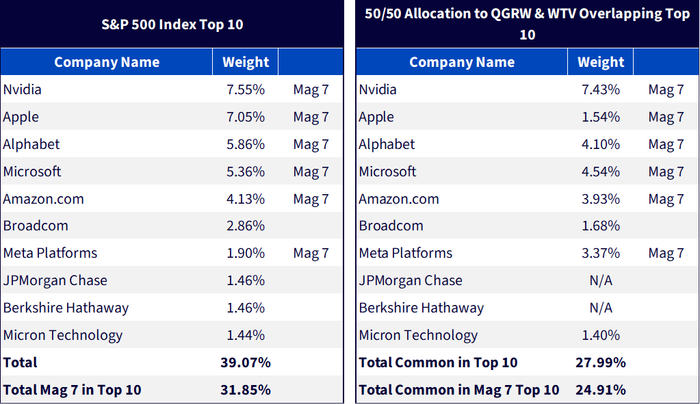
Sources: WisdomTree, FactSet, Morningstar, with data as of July 31, 2026 and from the Fund Compare Tool within WisdomTree’s PATH suite of tools. The Magnificent 7 includes Nvidia, Apple, Alphabet, Microsoft, Amazon.com, Meta Platforms and Tesla. As of July 31, 2026, Tesla was not in the top 10 of the S&P 500 Index and therefore is not shown. As of July 31, 2026, Tesla is not included in either QGRW or WTV. Holdings subject to change.
There are risks associated with investing, including possible loss of principal. Please read the Fund’s prospectus for specific details regarding the Fund’s risk profile.
WTV: Value stocks, as a group, may be out of favor with the market and underperform growth stocks or the overall equity market. Funds focusing their investments on certain sectors increase their vulnerability to any single economic or regulatory development. This may result in greater share price volatility. While the Fund is actively managed, the Fund’s investment process is heavily dependent on quantitative models and the models may not perform as intended.
QGRW: Growth stocks, as a group, may be out of favor with the market and underperform value stocks or the overall equity market. Growth stocks are generally more sensitive to market movements than other types of stocks. The Fund is non-diversified, as a result, changes in the market value of a single security could cause greater fluctuations in the value of Fund shares than would occur in a diversified fund. The Fund invests in the securities included in, or representative of, its Index regardless of their investment merit and the Fund does not attempt to outperform its Index. The composition of the Index is governed by an Index Committee and the Index may not perform as intended.


Global Head of Research
Christopher Gannatti began at WisdomTree as a Research Analyst in December 2010, working directly with Jeremy Schwartz, CFA®, Director of Research. In January of 2014, he was promoted to Associate Director of Research where he was responsible to lead different groups of analysts and strategists within the broader Research team at WisdomTree. In February of 2018, Christopher was promoted to Head of Research, Europe, where he was based out of WisdomTree’s London office and was responsible for the full WisdomTree research effort within the European market, as well as supporting the UCITs platform globally. In November 2021, Christopher was promoted to Global Head of Research, now responsible for numerous communications on investment strategy globally, particularly in the thematic equity space. Christopher came to WisdomTree from Lord Abbett, where he worked for four and a half years as a Regional Consultant. He received his MBA in Quantitative Finance, Accounting, and Economics from NYU’s Stern School of Business in 2010, and he received his bachelor’s degree from Colgate University in Economics in 2006. Christopher is a holder of the Chartered Financial Analyst Designation.