


Is China a Buy?
Published September 20, 2021

Jeff Weniger, CFA
Head of Equity Strategy
This year’s sharp declines in China-dominated emerging markets equity funds have forced a considerable valuation rerating—while markets in the U.S., Europe, Japan and other developed regions have largely witnessed static or rising multiples.
Amid the S&P 500’s flirtation with the 4,500 level, up from 3,756 at year-end, the MSCI China Index has witnessed acute trouble, with an ugly downtrend persisting since February. You could be forgiven for not fully appreciating the damage, what with stock markets in other emerging nations such as India working on new highs.
China’s plunges happened across industries and business lines, and at the “top of the house” too (figure 1).
Figure 1: MSCI China: Top 10 Components
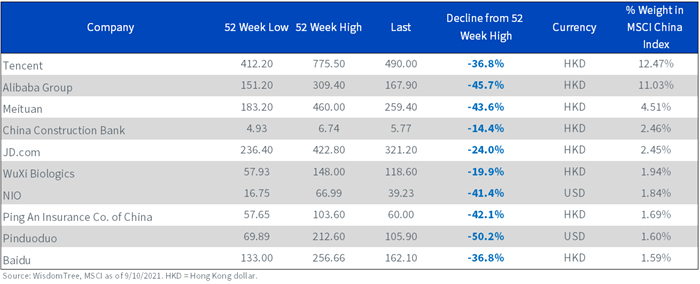
China’s Declines Had No Shortage of Catalysts
There have been several drivers of China’s stock market pain. For one, the country’s geopolitical risk premium has risen with each incursion into Taiwan’s Air Defense Identification Zone. Additionally, the mess in Kabul emboldens China’s more hawkish generals, who may be recalculating the odds of U.S. engagement in a Taiwanese military venture.
At the very least, the Afghanistan debacle gives China’s social media-savvy “wolf warrior” diplomats a chance to stir the pot with antagonistic Twitter rhetoric.
Meanwhile, notable billionaires Bernard Arnault (LVMH, Moët, Hennessy and Louis Vuitton) and Jeff Bezos (Amazon)1 have nary a fear of sequestration. Yet that is exactly the fate that befell Alibaba’s Jack Ma, who disappeared for several months after criticizing China’s state-owned banks.
Additionally, questions abound about the profitability of China’s largest company, Tencent, owing to Beijing’s crackdowns on social media and gaming, which it calls “spiritual opium.” Tencent has a double-digit weight in many Chinese indexes.
Adding to the murky water, the global supply chain is in such disarray that the Drewry World Container Index, the gauge of ocean freight costs, is up more than fivefold from where it stood at this time in 2019. It remains anyone’s guess when the COVID-19-inspired clog-up clears a path toward greater profitability for the country’s export machine.
It’s very grim. Decidedly grim.
But here’s the thing: all of this is already on the table. It has been well covered by the financial press. The question is whether the sheer size of the country’s market declines this year offers up a buying opportunity.
The answer may be yes.
One of our growth-oriented mandates, the China-heavy WisdomTree Emerging Markets ex-State-Owned Enterprises Fund (XSOE), has estimated three-year sales growth of 13.8%, whereas the pricey S&P 500’s projection is 9.3%, according to WisdomTree’s Digital Portfolio Developer software.
Despite headier growth prospects, the WisdomTree Fund trades for 21.1 times trailing earnings and 16.5 times forward earnings—a sharp discount to the 29.5 trailing and 22.2 multiples accorded the U.S. market. Meantime, the MSCI EAFE Index of developed equities is expected to have just 2.8% annual sales growth, yet its P/Es are 22.0 on trailing earnings and 16.1 on forward earnings.
Our pure play on China Fund is called the WisdomTree China ex-State-Owned Enterprises Fund (CXSE). Because of its nearly 20% weight to the Communication Services sector, its trailing P/E is 21.7 and its forward multiple is 20.8. Its approach has a very “future of China” feel to it, with top holdings including firms like Tencent (gaming, social media), Alibaba (e-commerce and fintech), Meituan (DoorDash-style delivery), JD.com (e-commerce), Wuxi Biologics (drugs), Baidu (Internet search) and Nio (electric vehicles).2
1 LVMH Moët, Hennessy and Louis Vuitton Amazon have 0% weight in CXSE and XSOE.
2 For all current holdings of CXSE, please click here.
Important Risks Related to this Article
There are risks associated with investing, including the possible loss of principal. Foreign investing involves special risks, such as risk of loss from currency fluctuation or political or economic uncertainty. Investments in emerging or offshore markets are generally less liquid and less efficient than investments in developed markets and are subject to additional risks, such as risks of adverse governmental regulation and intervention or political developments. Funds focusing their investments on certain sectors and/or regions increase their vulnerability to any single economic or regulatory development. This may result in greater share price volatility. Investments in currency involve additional special risks, such as credit risk and interest rate fluctuations. XSOE invests in the securities included in, or representative of, its Index regardless of their investment merit and the Fund does not attempt to outperform its Index or take defensive positions in declining markets. CXSE focuses its investments in China, including A-shares, which include the risk of the Stock Connect program, thereby increasing the impact of events and developments associated with the region which can adversely affect performance. As CXSE can have a high concentration in some issuers, the Fund can be adversely impacted by changes affecting those issuers. Please read each Fund’s prospectus for specific details regarding the Fund’s risk profile.
Categories
Related articles

China’s 2025 Rebound: Why Selectivity Has Mattered

Navigating China’s Economic Crossroads: Stimulus, Trade and Global Positioning

April’s Shockwave: Tariff Drama, Dollar Drift and the Small-Cap Squeeze
Global Trade’s New Fault Lines: Positioning Portfolios for a Fractured World
Diverging Paths: A Look at WisdomTree’s Best and Worst ETFs in Q1 2025
Emerging Markets without State Ownership
China vs. Japan: A Battle for the Sharpest Equity Market Turns of 2024
China’s Monetary Stimulus and Liquidity Support for the Capital Market

China’s Third Plenum: Focus on Manufacturing and Very Short-Term Stimulus
About the contributor

Jeff Weniger, CFA
Head of Equity Strategy
Jeff Weniger, CFA, has been with WisdomTree since 2017 and serves as the Head of Equities. He shapes the firm’s market outlook through a combination of macroeconomic and fundamental analysis. With more than two decades in investment strategy, Jeff is known for his work on market cycles and valuations. Before joining WisdomTree, Jeff was with BMO Private Bank and BMO Global Asset Management for 11 years. At BMO, he sat on the firm’s Asset Allocation Committee and co-managed ETF model portfolios across the U.S. and Canada. In 2013, at age 32, he became the youngest member of BMO’s Global Investment Forum. When he left BMO to come to WisdomTree, his final role was Director, Senior Strategist in the Office of the CIO in 2017.
Jeff is a frequent television guest on networks such as CNBC, Bloomberg, and Schwab, with regular print appearances in The Wall Street Journal, Barron’s and Reuters. He also appears weekly on the Behind the Markets podcast and is a regular on SiriusXM’s The Business Briefing. On X, Jeff has developed one of the larger followings in financial media. He earned a B.S. in Finance from the University of Florida and an MBA from the University of Notre Dame. He has held the CFA charter since 2006.