
BTCW
Bitcoin Fund

Published May 16, 2025

Global Head of Research
April 2025 might be remembered not just for the policies announced, but for the ripple effects they unleashed across asset classes. It started with a bang—"Liberation Day,"1 as some called it—a declaration of sweeping tariffs unlike anything seen in years. Market participants didn't just react. They recalibrated. The exchange-traded fund/exchange-traded product (ETF/ETPs) scorecard from WisdomTree tells a compelling tale of that recalibration.
The month of April was about clarity. Not in the traditional sense—markets were volatile and uncertain—but clarity in narrative. Investors voted with capital: they favored hard assets, international exposure and anything that got them away from U.S. dollar exposure.
Figure 1 indicates the top five and bottom five WisdomTree ETF/ETPs, ranked by total return performance, for the month of April 2025.
The WisdomTree Bitcoin Fund (BTCW)2 returned 13.25%, topping the list of best-performing ETF/ETPS/ETPs at WisdomTree during April 2025. In a world where fiat risk was back on the table, Bitcoin served as the opt-out clause. The WisdomTree Efficient Gold Plus Gold Miners Strategy Fund (GDMN),3 a strategy with exposure to both gold and gold miners, returned 11.18% as investors sought real assets. Both the WisdomTree Europe SmallCap Dividend Fund (DFE)4 at 7.12% and the WisdomTree International MidCap Dividend Fund (DIM)5 at 6.21% showed a preference for non-U.S. equities. We also note that that smaller companies typically do less exporting, so it's possible investors are looking abroad and looking for companies not selling their products as much abroad, for instance, back to the U.S.
Disclosure: The WisdomTree Bitcoin Fund is not a fund registered under the Investment Company Act of 1940, as amended (“1940 Act”), and is not subject to regulation under the 1940 Act, unlike most exchange-traded products or ETFs. The WisdomTree Bitcoin Fund is also not a commodity pool for purposes of the Commodity Exchange Act of 1936, as amended, and the sponsor is not subject to regulations by the Commodity Futures Trading Commission as a commodity pool operator or commodity trading advisor. The WisdomTree Bitcoin Fund’s shares are neither interests in nor obligations of the sponsor or the trustee or any of their affiliates.
Meanwhile, U.S. small-cap strategies—WisdomTree U.S. SmallCap Fund (EES),6 WisdomTree U.S. SmallCap Dividend Fund (DES),7 WisdomTree U.S. SmallCap Quality Dividend Growth Fund (DGRS)8—sank. The companies in these Funds, often domestically focused and rate-sensitive, now face rising input costs, tariff-induced distortions and constrained pricing power. The market appears to be saying: "Until we understand how Main Street U.S. digests this, we're stepping back." Small-cap stocks can also be among the most sensitive to a recession, should one materialize, which we know is a topic of ongoing debate.
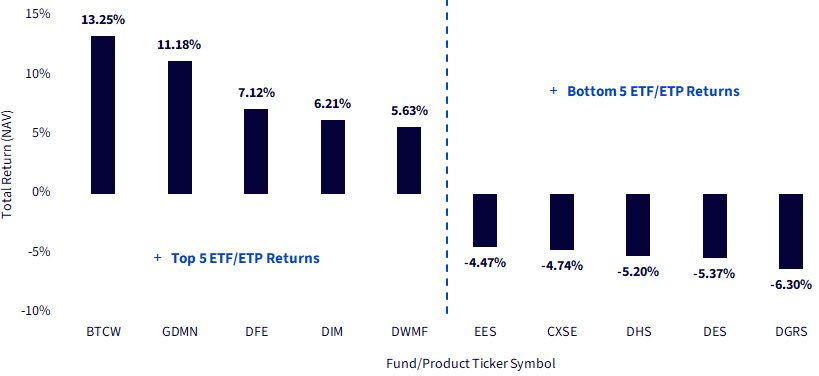
Source: WisdomTree, specifically data from the Fund Comparison Tool in the PATH suite of tools, accessed 5/1/25, with returns as of 4/30/25. NAV denotes total return performance at net asset value. MP denotes market price performance. Past performance is not indicative of future results. Investment return and principal value of an investment will fluctuate so that an investor's shares, when redeemed, may be worth more or less than their original cost. Current performance may be lower or higher than the performance data quoted. For the most recent month-end and standardized performance click the relevant ticker: BTCW, GDMN, DFE, DIM, DWMF, EES, CXSE, DHS, DES and DGRS.
Figure 2 zooms out to year-to-date returns, where there is a broad similarity to some of the aspects we saw in figure 1. GDMN dominated the first four months with a 68.43% return. We know that many investors have been watching the price of gold hit new highs, even crossing the $3,500 per troy ounce level for the first time. GDMN builds in an exposure to gold and an exposure to gold miners, companies that may actually make more money as the price of gold rises.
The WisdomTree Efficient Gold Plus Equity Strategy Fund (GDE)9 captures the same overall theme that we mentioned for , just instead of the equity component being gold miners it is a broad basket of U.S. large-cap stocks. Other top performers? WisdomTree International AI Enhanced Value Fund (AIVI),10 WisdomTree International High Dividend Fund (DTH)11 and WisdomTree International LargeCap Dividend Fund (DOL),12 which are all equity strategies focused on the developed international space. If April was a tactical pivot, year-to-date returns suggest a foundational repricing of what matters. Investors are favoring assets that produce cash, sell real stuff and live outside the U.S. dollar's shadow.
Bottom of the list? The WisdomTree U.S. SmallCap Quality Growth Fund (QSML),13 DGRS, EES, the WisdomTree Cloud Computing Fund (WCLD)14 and DES. They represent what markets are currently discounting: the sensitivity of smaller market cap companies to a potential economic slowdown, and a move away from more speculative, higher-multiple tech.
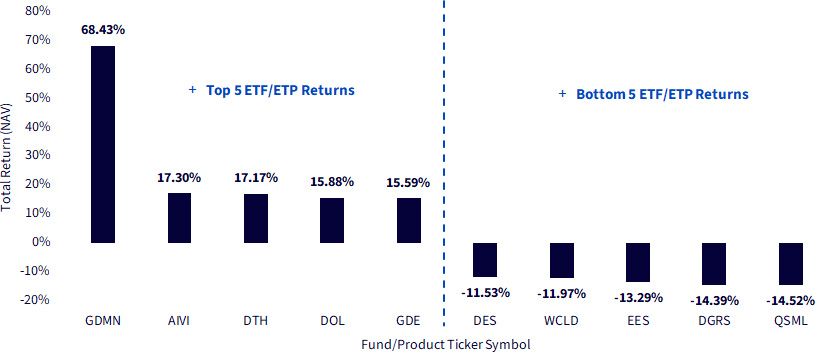
Source: WisdomTree, specifically data from the Fund Comparison Tool in the PATH suite of tools, accessed 5/1/25, with returns as of 4/30/25. NAV denotes total return performance at net asset value. MP denotes market price performance. Past performance is not indicative of future results. Investment return and principal value of an investment will fluctuate so that an investor's shares, when redeemed, may be worth more or less than their original cost. Current performance may be lower or higher than the performance data quoted. For the most recent month-end and standardized performance click the relevant ticker: GDMN, EES, DES, DGRS, AIVI, DTH, DOL, GDE, WCLD and QSML.
When we juxtapose April and YTD, a few deeper themes emerge:
There is little question that GDMN has had a remarkable four-month run, and investors may get a bit skittish on seeing that result. GDE, with its equity component focused on 500 large-cap U.S. stocks, may be the more conservative option for investors thinking about the nexus of gold and U.S. equities as a strategy.
On the other hand, we think it's possible that the tariff policy is so fluid and so tough to analyze that there is a chance the negative performance of U.S. small caps could be overdone. Investors with dry powder might start looking in that direction, as there can be different announcements with positive impacts to the market that could benefit that more beaten-down segment.
In any event, we look forward to continuing to analyze what the top and bottom-performing ETF/ETPs at WisdomTree will tell us over the coming periods.
1 Source: https://www.whitehouse.gov/articles/2025/04/president-trumps-bold-trade-action-draws-praise/
2 The WisdomTree Bitcoin Fund is an exchange-traded fund whose investment objective is to gain exposure to the price of bitcoin, less expenses and liabilities, by holding bitcoin. The Fund will generally value its shares daily using an independently calculated value based on an aggregation of executed trade flow of major bitcoin spot exchanges.
3 The WisdomTree Efficient Gold Plus Gold Miners Strategy Fund seeks total return by investing in gold miners and gold futures contracts.
4 WisdomTree Europe SmallCap Dividend Fund seeks to track the investment results of dividend-paying small-cap companies in the European equity market.
5 WisdomTree International MidCap Dividend Fund seeks to track the investment results of dividend-paying mid-cap companies in the developed world, excluding the U.S. and Canada.
6 WisdomTree U.S. SmallCap Fund seeks to track the investment results of earnings-generating small-cap companies in the U.S. equity market.
7 WisdomTree U.S. SmallCap Dividend Fund seeks to track the investment results of dividend-paying small-cap companies in the U.S. equity market.
8 WisdomTree U.S. SmallCap Quality Dividend Growth Fund seeks to track the investment results of dividend-paying small-cap companies with growth characteristics in the U.S. equity market.
9 The WisdomTree Efficient Gold Plus Equity Strategy Fund seeks total return by investing, either directly or through a wholly owned subsidiary, in a portfolio of U.S.-listed gold futures contracts and U.S. large-cap equity securities.
10 WisdomTree International AI Enhanced Value Fund seeks income and capital appreciation by investing primarily in equity securities selected from a universe of developed market equities, excluding the U.S. and Canada, that exhibit value characteristics based on the selection results of a proprietary, quantitative artificial intelligence (AI) model developed by Voya Investment Management Co., LLC.
11 WisdomTree International High Dividend Fund seeks to track the investment results of high-dividend-yielding companies in the developed world, excluding the U.S. and Canada.
12 WisdomTree International LargeCap Dividend Fund seeks to track the investment results of dividend-paying large-cap companies in the developed world, excluding the U.S. and Canada.
13 The WisdomTree U.S. SmallCap Quality Growth Fund seeks to track the price and yield performance, before fees and expenses, of the WisdomTree U.S. SmallCap Quality Growth Index.
14 The WisdomTree Cloud Computing Fund seeks to track the price and yield performance, before fees and expenses, of the BVP Nasdaq Emerging Cloud Index, an equally weighted Index designed to measure the performance of emerging public companies focused on delivering cloud-based software to customers.
BTCW: Crypto assets, such as bitcoin and ether, are complex, generally exhibit extreme price volatility and unpredictability, and should be viewed as highly speculative assets. Crypto assets are frequently referred to as crypto “currencies,” but they typically operate without central authority or banks, are not backed by any government or issuing entity (i.e., no right of recourse), have no government or insurance protections, are not legal tender and have limited or no usability as compared to fiat currencies. Federal, state or foreign governments may restrict the use, transfer, exchange and value of crypto assets, and regulation in the U.S. and worldwide is still developing.
Crypto asset exchanges and/or settlement facilities may stop operating, permanently shut down or experience issues due to security breaches, fraud, insolvency, market manipulation, market surveillance, KYC/AML (know your customer/anti-money laundering) procedures, non-compliance with applicable rules and regulations, technical glitches, hackers, malware or other reasons, which could negatively impact the price of any cryptocurrency traded on such exchanges or reliant on a settlement facility or otherwise may prevent access or use of the crypto asset. Crypto assets can experience unique events, such as forks or airdrops, which can impact the value and functionality of the crypto asset. Crypto asset transactions are generally irreversible, which means that a crypto asset may be unrecoverable in instances where: (i) it is sent to an incorrect address, (ii) the incorrect amount is sent, or (iii) transactions are made fraudulently from an account. A crypto asset may decline in popularity, acceptance or use, thereby impairing its price, and the price of a crypto asset may also be impacted by the transactions of a small number of holders of such crypto asset. Crypto assets may be difficult to value and valuations, even for the same crypto asset, may differ significantly by pricing source or otherwise be suspect due to market fragmentation, illiquidity, volatility and the potential for manipulation. Crypto assets generally rely on blockchain technology and blockchain technology is a relatively new and untested technology which operates as a distributed ledger. Blockchain systems could be subject to internet connectivity disruptions, consensus failures or cybersecurity attacks, and the date or time that you initiate a transaction may be different then when it is recorded on the blockchain. Access to a given blockchain requires an individualized key, which, if compromised, could result in loss due to theft, destruction or inaccessibility. In addition, different crypto assets exhibit different characteristics, use cases and risk profiles. Information provided by WisdomTree regarding digital assets, crypto assets or blockchain networks should not be considered or relied upon as investment or other advice, as a recommendation from WisdomTree, including regarding the use or suitability of any particular digital asset, crypto asset, blockchain network or any particular strategy.
To view the prospectus, please click here.
Bitcoin and, accordingly, the WisdomTree Bitcoin Fund, which holds bitcoin, are highly speculative and involve a high degree of risk, including the potential for loss of the entire investment. An investment in the WisdomTree Bitcoin Fund involves significant risks (including the potential for quick, large losses) and may not be suitable for all shareholders. You should carefully consider whether your financial condition permits you to invest in the WisdomTree Bitcoin Fund, and you should be willing to accept more risk than may be involved with other exchange-traded products or ETFs that do not hold bitcoin.
Extreme volatility of trading prices that many digital assets, including bitcoin, have experienced in recent periods and may continue to experience, could have a material adverse effect on the value of the Shares and the Shares could lose all or substantially all of their value. The value of the Shares is dependent on the acceptance of digital assets, such as bitcoin, which represent a new and rapidly evolving industry. Digital assets such as bitcoin were only introduced within the past two decades, and the medium-to-long term value of the Shares is subject to a number of factors relating to the capabilities and development of blockchain technologies and to the fundamental investment characteristics of digital assets. Regulatory changes or actions may affect the value of the Shares or restrict the use of Bitcoin, mining activity or the operation of the Bitcoin Network or the Digital Asset Markets in a manner that adversely affects the value of the Shares. Digital Asset Markets may experience fraud, business failures, security failures or operational problems, which may adversely affect the value of Bitcoin and, consequently, the value of the Shares.
The WisdomTree Bitcoin Fund is not a fund registered under the Investment Company Act of 1940, as amended (“1940 Act”), and is not subject to regulation under the 1940 Act, unlike most exchange-traded products or ETFs. The WisdomTree Bitcoin Fund is also not a commodity pool for purposes of the Commodity Exchange Act of 1936, as amended, and the sponsor is not subject to regulations by the Commodity Futures Trading Commission as a commodity pool operator or commodity trading advisor. The WisdomTree Bitcoin Fund’s shares are neither interests in nor obligations of the sponsor or the trustee or any of their affiliates.
The WisdomTree Bitcoin Fund has filed a registration statement (including a prospectus) with the SEC for the offering to which this communication relates. Before you invest, you should read the prospectus in that registration statement and other documents the WisdomTree Bitcoin Fund has filed with the SEC for more complete information about the WisdomTree Bitcoin Fund and this offering. You may get these documents for free by visiting EDGAR on the SEC website at www.sec.gov. Alternatively, the WisdomTree Bitcoin Fund will arrange to send you the prospectus if you request it by calling toll-free at 866.909.9473.
Neither WisdomTree, Inc., nor its affiliates, nor Foreside Fund Services, LLC, nor its affiliates, provide tax advice. All references to tax matters or information provided on this site are for illustrative purposes only and should not be considered tax advice and cannot be used for the purpose of avoiding tax penalties. Investors seeking tax advice should consult an independent tax advisor.
Foreside Funds Services, LLC, is the Marketing Agent for the WisdomTree Bitcoin Fund (BTCW). Foreside Fund Services, LLC, is not affiliated with WisdomTree, Inc. nor any other entities mentioned.
DWMF: Investments in non-U.S. securities involve political, regulatory and economic risks that may not be present in U.S. securities. For example, foreign securities may be subject to risk of loss due to foreign currency fluctuations, political or economic instability, or geographic events that adversely impact issuers of foreign securities. Derivatives used by the Fund to offset exposure to foreign currencies may not perform as intended. There can be no assurance that the Fund’s hedging transactions will be effective. The value of an investment in the Fund could be significantly and negatively impacted if foreign currencies appreciate at the same time that the value of the Fund’s equity holdings falls. While the Fund is actively managed, the Fund’s investment process is expected to be heavily dependent on quantitative models and the models may not perform as intended.
CXSE: Foreign investing involves special risks, such as risk of loss from currency fluctuation or political or economic uncertainty. The Fund focuses its investments in China, including A-shares, which include the risk of the Stock Connect program, thereby increasing the impact of events and developments associated with the region which can adversely affect performance. Investments in emerging or offshore markets are generally less liquid and less efficient than investments in developed markets and are subject to additional risks, such as risks of adverse governmental regulation and intervention or political developments. The Fund’s exposure to certain sectors may increase its vulnerability to any single economic or regulatory development related to such sectors. As this Fund can have a high concentration in some issuers, the Fund can be adversely impacted by changes affecting those issuers.
DHS: There are risks associated with investing, including the possible loss of principal. Funds focusing their investments on certain sectors increase their vulnerability to any single economic or regulatory development related to such sectors. This may result in greater share price volatility. Dividends are not guaranteed, and a company currently paying dividends may cease paying dividends at any time. Please read the Fund’s prospectus for specific details regarding the Fund’s risk profile.
GDMN: There are risks associated with investing, including the possible loss of principal. The Fund is actively managed and invests in U.S.-listed gold futures and global equity securities issued by companies that derive at least 50% of their revenue from the gold mining business (“Gold Miners”). The Fund’s use of U.S.-listed gold futures contracts will give rise to leverage, magnifying gains and losses and causing the Fund to be more volatile than if it had not been leveraged. Moreover, the price movements in gold and gold futures contracts may fluctuate quickly and dramatically, and have a historically low correlation with the returns of the stock and bond markets. By investing in the equity securities of Gold Miners, the Fund may be susceptible to financial, economic, political or market events that impact the gold mining sub-industry, including commodity prices and the success of exploration projects. The Fund may invest a significant portion of its assets in the securities of companies of a single country or region, including emerging markets, and thus, the Fund is more likely to be impacted by events and political, economic or regulatory conditions affecting that country or region, or emerging markets generally. The Fund’s investment strategy will also require it to redeem shares for cash or to otherwise include cash as part of its redemption proceeds, which may cause the Fund to recognize capital gains. Please read the Fund’s prospectus for specific details regarding the Fund’s risk profile.
EES: Funds focusing their investments on certain sectors and/or smaller companies increase their vulnerability to any single economic or regulatory development related to such sectors or companies. This may result in greater share price volatility.
DES/DGRS: Funds focusing their investments on certain sectors and/or smaller companies increase their vulnerability to any single economic or regulatory development related to such sectors or companies. This may result in greater share price volatility. Dividends are not guaranteed, and a company currently paying dividends may cease paying dividends at any time.
AIVI: Investments in non-U.S. securities involve political, regulatory and economic risks that may not be present in U.S. securities. For example, foreign securities may be subject to risk of loss due to foreign currency fluctuations, political or economic instability, or geographic events that adversely impact issuers of foreign securities. Funds focusing their investments on certain sectors increase their vulnerability to any single economic or regulatory development related to such sectors. This may result in greater share price volatility. While the Fund is actively managed, the Fund’s investment process is expected to be heavily dependent on a quantitative model and the model may not perform as intended.
DTH: Foreign investing involves special risks, such as risk of loss from currency fluctuation or political or economic uncertainty. Dividends are not guaranteed, and a company currently paying dividends may cease paying dividends at any time. Funds focusing their investments on certain sectors increase their vulnerability to any single economic or regulatory development related to such sectors. This may result in greater share price volatility.
DOL: Foreign investing involves special risks, such as risk of loss from currency fluctuation or political or economic uncertainty. Funds focusing their investments on certain sectors increase their vulnerability to any single economic or regulatory development related to such sectors. This may result in greater share price volatility. Dividends are not guaranteed, and a company currently paying dividends may cease paying dividends at any time.
DIM: Foreign investing involves special risks, such as risk of loss from currency fluctuation or political or economic uncertainty. Funds focusing their investments on certain sectors and/or smaller companies increase their vulnerability to any single economic or regulatory development related to such sectors or companies. Dividends are not guaranteed, and a company currently paying dividends may cease paying dividends at any time. This may result in greater share price volatility.
DFE: Foreign investing involves special risks, such as risk of loss from currency fluctuation or political or economic uncertainty. Funds focusing their investments on certain sectors and/or smaller companies increase their vulnerability to any single economic or regulatory development related to such sectors or companies. This may result in greater share price volatility.
GDE: The Fund is actively managed and invests in U.S.-listed gold futures and U.S. equity securities. The Fund’s use of U.S.-listed gold futures contracts will give rise to leverage, magnifying gains and losses and causing the Fund to be more volatile than if it had not been leveraged. Moreover, the price movements in gold and gold futures contracts may fluctuate quickly and dramatically, and have a historically low correlation with the returns of the stock and bond markets. U.S. equity securities, such as common stocks, are subject to market, economic and business risks that may cause their prices to fluctuate. The Fund’s investment strategy will also require it to redeem shares for cash or to otherwise include cash as part of its redemption proceeds, which may cause the Fund to recognize capital gains.
WCLD: The Fund invests in cloud computing companies, which are heavily dependent on the internet and utilizing a distributed network of servers over the internet. Cloud computing companies may have limited product lines, markets, financial resources or personnel and are subject to the risks of changes in business cycles, world economic growth, technological progress, and government regulation. These companies typically face intense competition and potentially rapid product obsolescence. Additionally, many cloud computing companies store sensitive consumer information and could be the target of cybersecurity attacks and other types of theft, which could have a negative impact on these companies and the Fund. Securities of cloud computing companies tend to be more volatile than securities of companies that rely less heavily on technology and, specifically, on the internet. Cloud computing companies can typically engage in significant amounts of spending on research and development, and rapid changes to the field could have a material adverse effect on a company’s operating results. The composition of the Index is heavily dependent on quantitative and qualitative information and data from one or more third parties, and the Index may not perform as intended.
QSML: Growth stocks, as a group, may be out of favor with the market and underperform value stocks or the overall equity market. Growth stocks are generally more sensitive to market movements than other types of stocks. Funds focusing their investments on certain sectors and/or smaller companies increase their vulnerability to any single economic or regulatory development related to such sectors or companies. This may result in greater share price volatility. The Fund is non-diversified, as a result, changes in the market value of a single security could cause greater fluctuations in the value of Fund shares than would occur in a diversified fund. The Fund invests in the securities included in, or representative of, its Index regardless of their investment merit. The Fund does not attempt to outperform its Index or take defensive positions in declining markets and the Index may not perform as intended. The securities of small-capitalization companies generally trade in lower volumes and are subject to greater and more unpredictable price changes than larger-capitalization stocks or the stock market as a whole. Small-capitalization companies may be particularly sensitive to adverse economic developments as well as changes in interest rates, government regulation, borrowing costs and earnings. The Fund is new and has limited operating history.

Global Head of Research
Christopher Gannatti began at WisdomTree as a Research Analyst in December 2010, working directly with Jeremy Schwartz, CFA®, Director of Research. In January of 2014, he was promoted to Associate Director of Research where he was responsible to lead different groups of analysts and strategists within the broader Research team at WisdomTree. In February of 2018, Christopher was promoted to Head of Research, Europe, where he was based out of WisdomTree’s London office and was responsible for the full WisdomTree research effort within the European market, as well as supporting the UCITs platform globally. In November 2021, Christopher was promoted to Global Head of Research, now responsible for numerous communications on investment strategy globally, particularly in the thematic equity space. Christopher came to WisdomTree from Lord Abbett, where he worked for four and a half years as a Regional Consultant. He received his MBA in Quantitative Finance, Accounting, and Economics from NYU’s Stern School of Business in 2010, and he received his bachelor’s degree from Colgate University in Economics in 2006. Christopher is a holder of the Chartered Financial Analyst Designation.