
GDMN
Efficient Gold Plus Gold Miners Strategy Fund

Published August 20, 2026

Global Head of Research
It is worth remembering just how extraordinary 2025 was for gold. The metal climbed relentlessly, driven by central bank accumulation, dollar uncertainty and a renewed appetite among investors for assets that sit outside the traditional financial system. Gold miners, with their built-in operating leverage to the gold price, amplified those gains. The trade was not subtle; it was one of the clearest, most rewarding themes of the year.
2026 has been a different story. Gold’s price has been more range-bound, and depending on the time horizon, mildly negative. That has made the narrative less obvious, the enthusiasm somewhat more muted, and the question more complex.
Does the so-called ‘gold thesis’ still hold?
We think the honest answer is yes, but it requires looking more carefully at what is actually happening with gold producers at the business level, not just reacting to where the spot price closed on any given day. Certain fundamentals appear compelling, and there may be something stirring in the recent performance data worth paying attention to.
To frame the opportunity, it helps to think about how investors typically access gold in a portfolio. At the broadest level, three distinct avenues exist:
Or, there is a third option, specifically, capital-efficient exposures that combine gold and gold miners into a single vehicle, such as the WisdomTree Efficient Gold Plus Gold Miners Strategy Fund (GDMN).3 The design is intentional: 90 cents of every hypothetical dollar is exposed to gold miners, another 90 cents to gold futures contracts, with 10 cents held in U.S. Treasury collateral. The result is a capital-efficient structure that captures both the monetary hedge characteristics of the metal and the earnings power of the producers, without requiring an investor to choose between them.
With that structure in mind, Figure 1a examines how GDMN has performed relative to a pure gold exposure (GLD) and a pure miner exposure (GDX) across recent periods. After a stretch in which miners lagged and the gold trade felt one-dimensional, something in the most recent month’s data is worth noting. We are not in the business of calling turns with certainty, markets have a way of humbling that kind of confidence, but the pattern is notable enough to warrant a closer look.
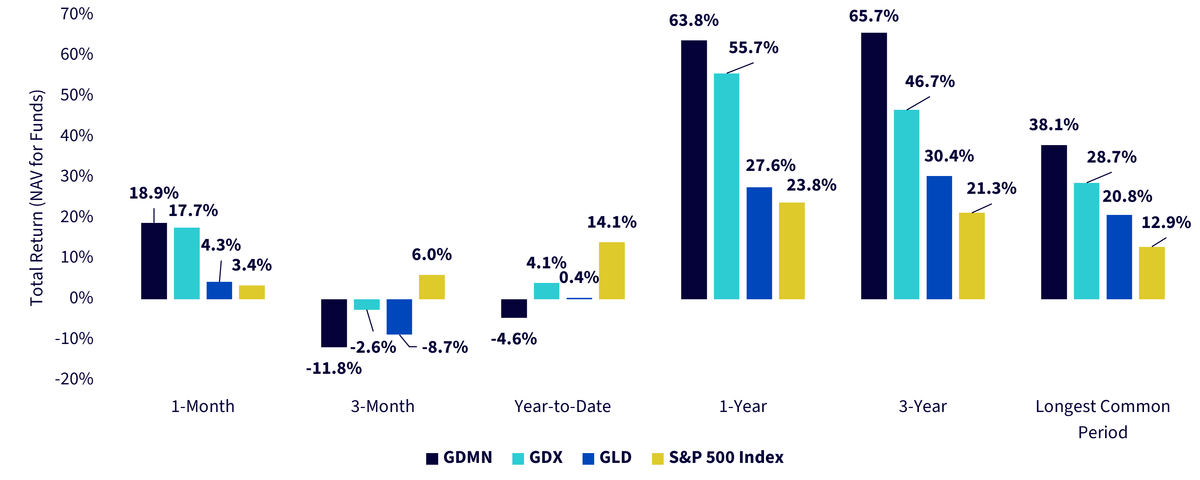
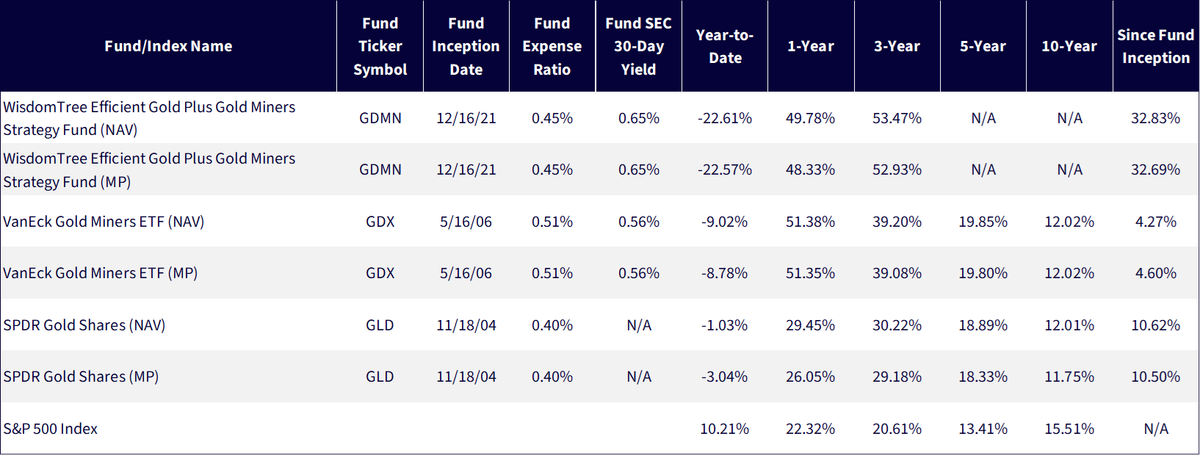
Sources: Morningstar, FactSet and WisdomTree, specifically data is from the PATH Fund Comparison Tool, accessed as of August 10, 2026, but showing returns for the period ended August 7, 2026 for Figure 1a and June 30, 2026 for 1b. NAV denotes total return performance at net asset value. MP denotes market price performance. Past performance is not indicative of future results. Investment return and principal value of an investment will fluctuate so that an investor’s shares, when redeemed, may be worth more or less than their original cost. Current performance may be lower or higher than the performance data quoted. For the most recent month-end and standardized performance, click the relevant ticker: GDMN, GDX, GLD.
To understand why the fundamental picture for miners remains attractive despite the softer gold price environment in 2026 thus far, it helps to focus on a metric that practitioners rely on heavily but that rarely makes headlines: all-in sustaining cost, or AISC. Unlike simple cash cost figures, AISC attempts to capture the full economic cost of maintaining a gold mining operation.
It is, in essence, the break-even threshold below which miners cannot sustain their business long-term.
The spread between the gold price and a miner’s AISC could be the clearest expression of operating profitability in this industry. When gold trades well above AISC, miners could be thought to, in general, generate substantial free cash flow. When the gap narrows, margins, in general, compress and capital allocation decisions become more difficult. We say ‘in general’ because any individual company can have idiosyncratic risk factors that cause a divergence from expected results. Figure 2 shows where major gold producers stand today.
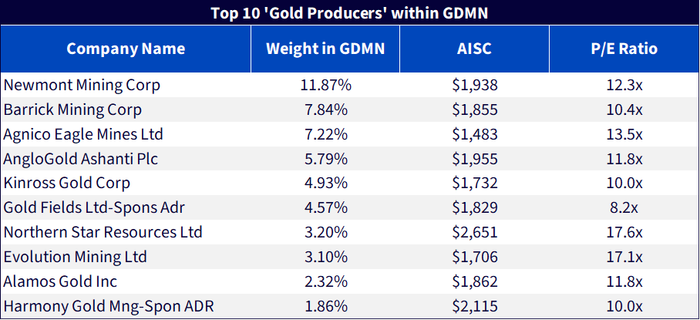
Source: Company filings and earnings reports for all-in sustaining cost (AISC); Stock Analysis for trailing price-to-earnings ratios. Data as of August 2026. AISC represents the latest reported company figure and may differ in reporting period, currency, or methodology across issuers. These companies represent the 10 largest ‘gold producers’ by weight in GDMN as of August 7, 2026. Holdings subject to change.
The snapshot in Figure 2 tells an encouraging story, but the longer arc is even more striking. Over the past decade, gold prices have risen substantially faster than the cost to mine it. This is not a trivial observation. It means the structural profitability of the industry has improved, even accounting for inflationary pressures on labor, energy, and equipment that all producers face. Miners have not simply been riding a rising gold price, they have been doing so while keeping their cost bases relatively contained, which is a meaningful operational achievement.
Figure 3 captures this dynamic across a ten-year window. The widening gap between the gold price line and the AISC line represents overall expanding operating margins, at least in general, margins that may not yet have been fully reflected in how these equities are priced relative to their historical averages. That is where the potential opportunity lies for investors willing to look past the near-term noise in spot prices. Gold’s price can move quickly, as anyone can see, but judging on the basis of history, the costs that gold mining companies face have not tended to move with anywhere near the same degree of rapidity.
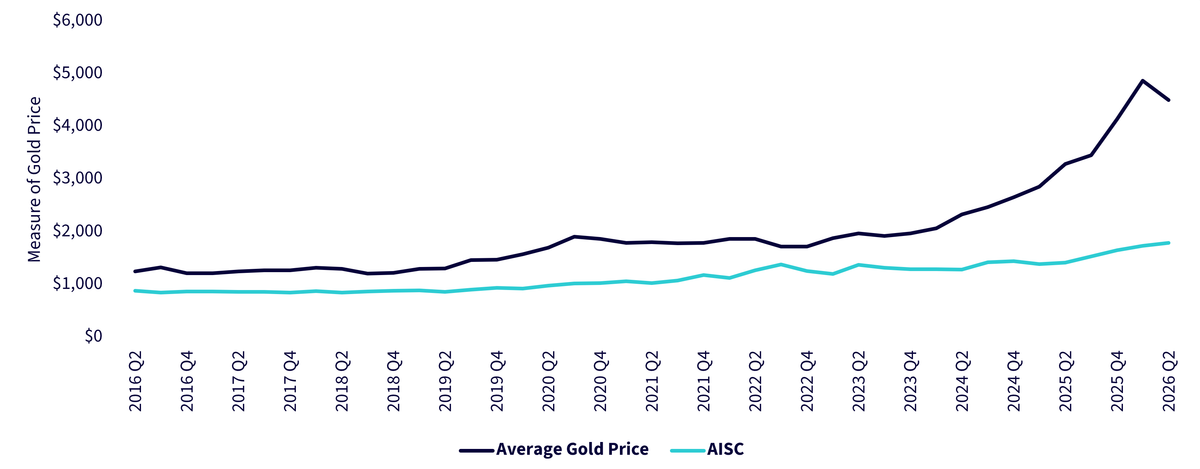
Source: Average gold prices are based on quarterly market data; AISC represents a production-weighted proxy for major gold producers using company-reported results and estimates where necessary. Sources: World Gold Council and company filings. Data through Q2 2026. AISC calculated on a quarterly basis for the universe of gold producing companies within GDMN as of August 7, 2026. Past performance is not indicative of future results.
For investors assessing how to access this thesis, context on the vehicles themselves is useful.
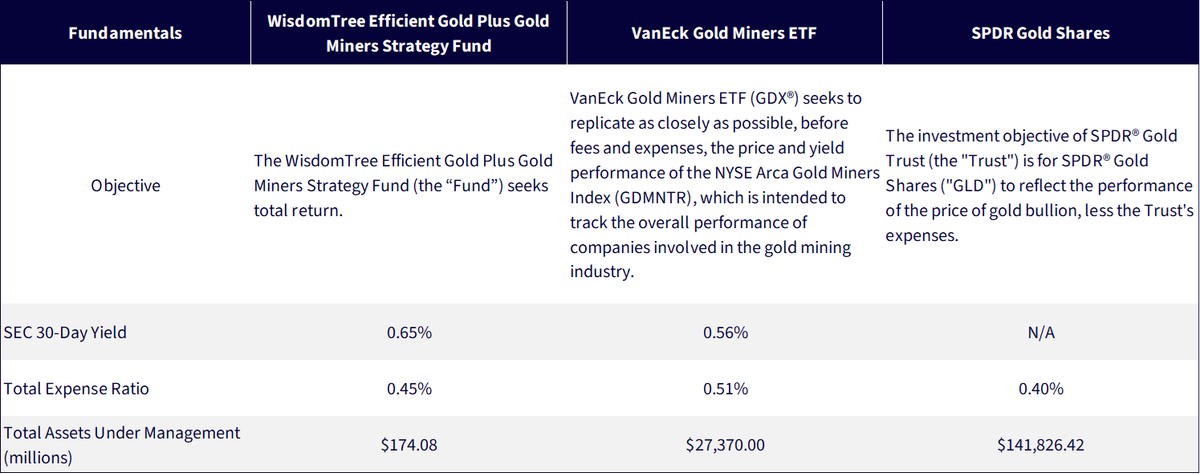
Sources: WisdomTree, VanEck and SPDR. Assets under management as of August 7, 2026.
The beginning of this piece posed what might seem like a binary choice: the stability of gold, or the growth potential of gold miners. 2025 made that question feel almost academic, and we saw that everything worked. 2026 has restored the complexity, and with it, the need to think more carefully.
What the data suggests is that the miner story has not broken down, it has simply become less obvious. Producers are operating with margins that would have looked enviable by almost any historical standard. Their all-in sustaining costs have risen far more slowly than the gold price over the past decade, leaving them structurally better positioned than their equity valuations might imply. And something in the most recent performance data hints that the market may be beginning to recognize this.
GDMN was designed precisely for moments like this, when the case for gold and the case for miners both have merit, and choosing between them feels like leaving return on the table. The capital-efficient structure means investors do not have to make that choice. We cannot know with certainty whether the turn suggested in Figure 1a marks the beginning of a sustained move. But we believe the fundamental groundwork is in place. Sometimes that is the most honest and useful thing we can offer.
1 The investment objective of SPDR® Gold Trust (the "Trust") is for SPDR® Gold Shares ("GLD") to reflect the performance of the price of gold bullion, less the Trust's expenses. It is the largest fund ranked by assets under management that provides exposure to movements in the price of physical gold.
2 VanEck Gold Miners ETF (GDX®) seeks to replicate as closely as possible, before fees and expenses, the price and yield performance of the NYSE Arca Gold Miners Index (GDMNTR), which is intended to track the overall performance of companies involved in the gold mining industry. It is the largest fund ranked by assets under management that provides exposure to movements in the share prices of a group of gold mining companies.
3 The WisdomTree Efficient Gold Plus Gold Miners Strategy Fund seeks total return by investing in gold miners and gold futures contracts. The exposure is designed such that for each $100, $90 is exposed to equities of gold miners, $90 is exposed to gold futures contracts, and $10 is in U.S. treasury collateral.
All funds are managed differently and do not react the same to economic or market events. The investment objectives, strategies, policies or restrictions of other funds may differ and more information can be found in their respective prospectuses. Therefore, we generally do not believe it is possible to make direct fund to fund comparisons in an effort to highlight the benefits of a fund versus another similarly managed fund.
GDMN: There are risks associated with investing, including possible loss of principal. The Fund is actively managed and invests in U.S.-listed gold futures and global equity securities issued by companies that derive at least 50% of their revenue from the gold mining business (“Gold Miners”). The Fund’s use of U.S.-listed gold futures contracts will give rise to leverage, magnifying gains and losses and causing the Fund to be more volatile than if it had not been leveraged. Moreover, the price movements in gold and gold futures contracts may fluctuate quickly and dramatically, and have a historically low correlation with the returns of the stock and bond markets. By investing in the equity securities of Gold Miners, the Fund may be susceptible to financial, economic, political, or market events that impact the gold mining sub-industry, including commodity prices and the success of exploration projects. The Fund may invest a significant portion of its assets in the securities of companies of a single country or region, including emerging markets, and thus, the Fund is more likely to be impacted by events and political, economic, or regulatory conditions affecting that country or region, or emerging markets generally. While the Fund is actively managed, the Fund’s investment process is heavily dependent on quantitative models and the models may not perform as intended. Please read the Fund’s prospectus for specific details regarding the Fund’s risk profile.
GDX: An investment in the Fund may be subject to risks which include, but are not limited to, risks related to investments in gold and silver mining companies, special risk considerations of investing in Australian and Canadian issuers, foreign securities, emerging market issuers, foreign currency, depositary receipts, small- and medium-capitalization companies, equity securities, market, operational, index tracking, authorized participant concentration, no guarantee of active trading market, trading issues, passive management, fund shares trading, premium/discount risk and liquidity of fund shares, non-diversified and index-related concentration risks, all of which may adversely affect the Fund. Emerging market issuers and foreign securities may be subject to securities markets, political and economic, investment and repatriation restrictions, different rules and regulations, less publicly available financial information, foreign currency and exchange rates, operational and settlement, and corporate and securities laws risks. Small- and medium-capitalization companies may be subject to elevated risks.
For more information about GDX, including prospectus with complete objectives and risks, click here.
GLD: Investing involves risk, and you could lose money on an investment in GLD.
ETFs trade like stocks, are subject to investment risk, fluctuate in market value and may trade at prices above or below the ETF’s net asset value. Brokerage commissions and ETF expenses will reduce returns.
Commodities and commodity-index linked securities may be affected by changes in overall market movements, changes in interest rates and other factors such as weather, disease, embargoes, or political and regulatory developments, as well as the trading activity of speculators and arbitrageurs in the underlying commodities.
Frequent trading of ETFs could significantly increase commissions and other costs such that they may offset any savings from low fees or costs.
Diversification does not ensure a profit or guarantee against loss.
For more information about GLD, including prospectus with complete objectives and risks, click here.
Efficient Gold Plus Gold Miners Strategy Fund


Global Head of Research
Christopher Gannatti began at WisdomTree as a Research Analyst in December 2010, working directly with Jeremy Schwartz, CFA®, Director of Research. In January of 2014, he was promoted to Associate Director of Research where he was responsible to lead different groups of analysts and strategists within the broader Research team at WisdomTree. In February of 2018, Christopher was promoted to Head of Research, Europe, where he was based out of WisdomTree’s London office and was responsible for the full WisdomTree research effort within the European market, as well as supporting the UCITs platform globally. In November 2021, Christopher was promoted to Global Head of Research, now responsible for numerous communications on investment strategy globally, particularly in the thematic equity space. Christopher came to WisdomTree from Lord Abbett, where he worked for four and a half years as a Regional Consultant. He received his MBA in Quantitative Finance, Accounting, and Economics from NYU’s Stern School of Business in 2010, and he received his bachelor’s degree from Colgate University in Economics in 2006. Christopher is a holder of the Chartered Financial Analyst Designation.