


Bessent & Warsh Go Down the Jackson Hole
Published August 24, 2026

Kevin Flanagan
Head of Investment and Fixed Income Strategy
Key Takeaways
- Longer-dated Treasury yields have climbed back to levels not seen since before the 2007 Financial Crisis, reflecting a return to normal rather than the abnormal, zero-rate era.
- The Treasury Department’s expanded buyback program in the 10- to 30-year sector produced only a brief rally before yields resumed their climb.
- We view the bond market as being in a “selling on strength” mode, with Fed Chair Warsh’s lack of forward guidance keeping yield volatility elevated ahead of his first Jackson Hole appearance.
Without a doubt, the number-one story in the financial markets of late has been the run-up in longer-dated Treasury (UST) yields. Indeed, headlines in both traditional and social media have centered on the fact that bond yields are now at levels not seen in nearly 20 years, or the time period right before the Financial Crisis hit in 2007. We have highlighted what are the key forces driving UST yields higher, and investors have recently witnessed the Treasury Department’s ‘response function’ and are awaiting to see if there is any type of Fed reaction.
Either way, what the investment community is experiencing are Treasury yields, in general, returning to ‘normal’ levels, not the ‘abnormal’ days of negative and zero interest rates (see below).
Figure 1: U.S. Treasury Yields
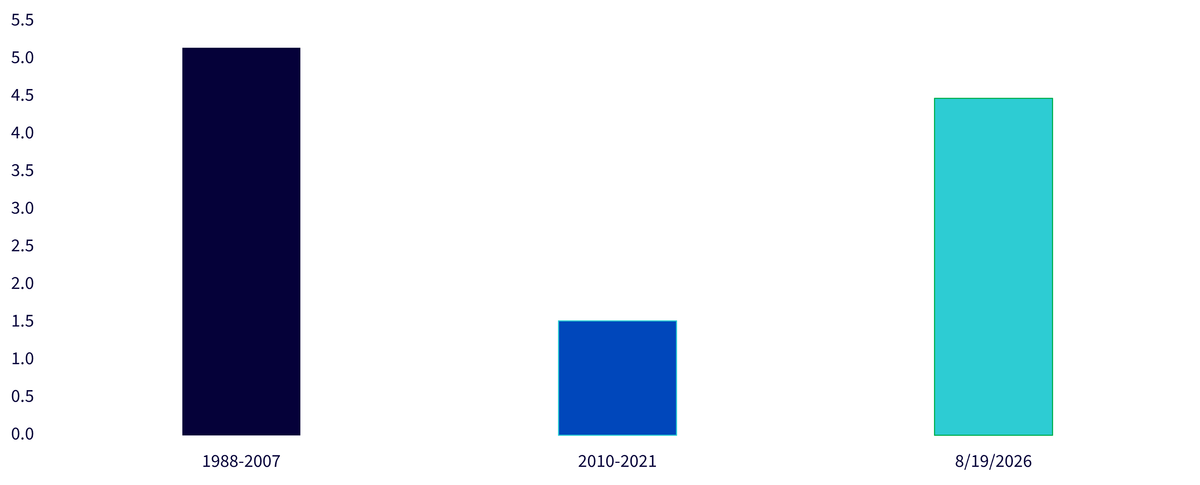
Source: Bloomberg, as of 8/19/2026.
Treasury Buybacks
The headline grabber thus far has been the Treasury Department’s recent announcement of increased sizes in their current buyback program within the 10- to 30-year sector. The buyback operations themselves are not new but have been ongoing the last few years to help mitigate any potential liquidity issues that have previously occurred at the back-end of the yield curve. The operation involves what are known as ‘off-the-runs’, or call them ‘older’ securities, not the newest, or most recently auctioned issues which trade as the ‘benchmark’. The goal is to try and minimize any ‘off-the-run’ liquidity issues from occurring and then spreading, which could then push the benchmark 10- to 30-year yields higher.
What is new was the timing of the announcement, which just so happened to have occurred while the rise in longer-term Treasury yields was gathering a great deal of attention. This was done on purpose to try and attain ‘maximum’ impact and push those yields lower, or at a minimum, place a ‘cap’ on any further increases. While the back-end did rally in a knee-jerk reaction, the drop in yields was reversed quickly, as of this writing. The fact remains that the main drivers of this run-up in longer-dated Treasury yields are still with us and will not go away with this, or any future announcement/operation.
Warsh’s First Jackson Hole
That brings us to part two of the equation, Warsh’s Jackson Hole appearance. As part of our ‘New Warsh Cycle’ campaign, we have identified the uncertainty created by Warsh’s forward guidance policy as a key force pushing both bond market yields and volatility higher. The lack of a Fed ‘reaction function’, or no forward guidance from the Fed Chair, to incoming jobs and inflation data has created an environment where bond investors are requiring more yield as compensation for this elevated uncertainty.
Given the UST market’s negative response to Warsh’s roll-out of this revised Fed policy, it is natural to wonder if the Chair makes any concessions at his Jackson Hole appearance. In the past, Fed Chairs have used this platform as a means to communicate policy intentions and provide guidance for the markets. Based on Warsh’s July FOMC presser, it would not appear as if any groundbreaking revelations will be forthcoming. Instead, the Chair emphasized “I want to frame the big questions.”
Conclusion
The bond market is in selling on strength, or ‘SOS’ mode. This means that any potential rally at the back-end of the curve is not sustainable and would be reversed in relatively short order. For fixed income investors, it is important to reiterate that the primary drivers of this increase in longer-dated UST yields are not only still with us, but show no signs of changing course any time soon.
Categories

About the contributor

Kevin Flanagan
Head of Investment and Fixed Income Strategy
Kevin serves as the Head of Investment and Fixed Income Strategy. In this role, he writes macro and fixed income-related content and works closely with the sales, research and marketing teams. In addition, Kevin conducts client-facing webinars and meetings, providing expertise on WisdomTree’s existing and future bond ETFs. Prior to joining WisdomTree, Kevin spent 30 years at Morgan Stanley, where he was Managing Director and Chief Fixed Income Strategist for Wealth Management. He was responsible for tactical and strategic recommendations and created asset allocation models for fixed income securities. He was a contributor to the Morgan Stanley Wealth Management Global Investment Committee, primary author of Morgan Stanley Wealth Management’s monthly and weekly fixed income publications, and collaborated with the firm’s Research and Consulting Group Divisions to build ETF and fund manager asset allocation models. Kevin has an MBA from Pace University’s Lubin Graduate School of Business, and a B.S. in Finance from Fairfield University.