
WTLS
Efficient Long/Short U.S. Equity Fund

Published October 9, 2026

Director of Market Strategy
For much of the post-financial-crisis era, the most effective equity strategy was also the simplest: own the market. Near-zero rates, abundant liquidity and a handful of dominant mega-cap companies made broad beta hard to beat. That success left investors weighing long/short equity with a fair question: why hedge when the S&P 500 keeps delivering?
We think the answer is changing, and not because we’re bearish on stocks. The case for long/short today rests on what’s happening beneath the index: wider dispersion between winners and losers, elevated concentration, sharper differences in corporate fundamentals, and a rate environment that once again penalizes weak business models.
The question is shifting from how much equity to own toward which equities deserve to be owned, and which don’t.
Long/short investing works best when stocks stop moving together. When the market moves as one block, there is little room to build a meaningful spread between longs and shorts. When dispersion rises across sectors, balance-sheet quality and exposure to secular themes, a manager has two levers. It can own companies whose fundamentals are improving and short those whose fundamentals are deteriorating.
Artificial intelligence is a good illustration. The first phase of the AI trade was about identifying beneficiaries. The next phase is likely to be about telling them apart:
The theme doesn’t go away.The dispersion within it becomes the opportunity.
The ability to short is the defining difference between long-only and long/short investing. A long-only manager can only avoid a company it dislikes. A long/short manager can turn that same view into a source of return.
The rate backdrop has made that ability more valuable. Central banks have moved off peak policy rates, but borrowing costs remain far above the zero-rate era. Some companies depend on continuous access to cheap capital because of weak balance sheets, unproven business models or persistent financing needs. Those companies now face real consequences when fundamentals disappoint. Higher short-term rates also improve the economics of the short book itself, because cash proceeds from short sales earn interest.
In other words, higher rates have restored something largely absent when money was free: a penalty for weak corporate economics.
Academic evidence suggests that skilled long/short positioning carries real information. A 2026 study by Alan Kwan, Po-Yu Liu and Yukun Liu used daily position data covering roughly one-fifth of global hedge fund gross market value. It found that hedge fund net positions significantly forecast subsequent stock returns. Equity long/short managers' positions were less tied to conventional academic factors. They also predicted earnings surprises and earnings-day returns, which is consistent with an ability to identify firm-specific information.
That is the essence of long/short equity. The point is not simply to take less risk. It is to generate alpha from the differences between companies.
Here’s the catch. Traditional market-neutral strategies target near-zero beta, so their returns come from security selection rather than market direction. That can be valuable in drawdowns. But in a strong bull market, investors watch the index climb without them, and diversification starts to feel like underperformance. This is a big reason many allocators struggle to hold market-neutral strategies through a full cycle.
Portable alpha addresses this directly. Investors don’t have to choosebetween equity beta and a long/short strategy. A capital-efficient structure can seek to deliver both.
The WisdomTree Efficient Long/Short U.S. Equity Fund (WTLS) is built on this concept. For every $100 invested, the Fund seeks approximately $90 of S&P 500 futures exposure. It layers a roughly $90 long/short equity portfolio on top. That adds up to about $180 of total notional exposure. The goal is to preserve core U.S. equity participation while adding a second potential return engine.
The objective isn’t to replace the S&P 500. It's to keep marketbeta and add something that behaves differently.
The long/short sleeve is designed to pursue market-neutral alpha independent of the futures position:
So investors don't have to give up the return potential of their strategic equity allocation to add a differentiated return source. They can stack the two.
WTLS began trading in January 2026, so its live record is short and should be read that way. Still, the early results illustrate what the structure is designed to do.
These figures cover rolling one-month periods from February 24 through October 6, 2026, based on market price:
From inception through October 6, WTLS returned 22.36% at NAV versus 13.17% for SPY.
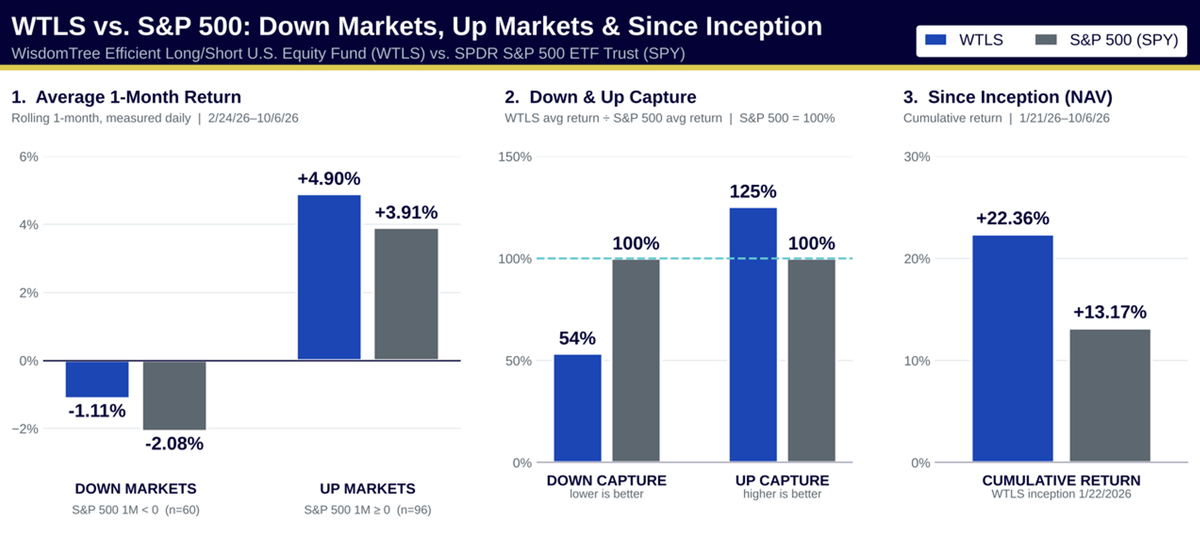
Source: WisdomTree; analysis of daily adjusted closing prices. Calculation methodology: Panels 1–2 use rolling 1-month (21 trading-day) returns calculated every trading day from adjusted closing market prices for 2/24/2026–10/6/2026 (156 daily observations); the first full 21-day window after WTLS began trading on 1/23/2026. The S&P 500 is represented by the SPDR S&P 500 ETF Trust (SPY). A “down market” is any rolling 1-month period in which SPY’s return was below 0% (60 observations); an “up market” is any period in which it was 0% or above (96 observations). Panel 1 shows the simple average of rolling 1-month returns within each group. Panel 2 capture = WTLS average return ÷ SPY average return for the same group. Rolling periods overlap (each shares 20 of 21 trading days with the next) and are not independent observations. Panels 1–2 are based on market price, not NAV; WTLS has a limited trading history and low trading volume, so its market price may differ from NAV. Panel 3 shows cumulative NAV total returns from 1/21/2026 to 10/6/2026 as reported by WisdomTree; WTLS inception date is 1/22/2026. Returns for periods of less than one year are cumulative and not annualized. Performance quoted represents past performance and is no guarantee of future results. Investment return and principal value will fluctuate. You cannot invest directly in an index. Past performance is not indicative of future results. Investment return and principal value of an investment will fluctuate so that an investor’s shares, when redeemed, may be worth more or less than their original cost. Current performance may be lower or higher than the performance data quoted. For the most recent month-end and standardized performance, click here.
These results are not evidence that the pattern will persist. A track record measured in months is far too short for long-term conclusions, and overlapping rolling periods are not independent observations. But they illustrate the goal of portable alpha: participate in the market while seeking an independent source of return above it.
None of this argues for abandoning long-only equities. If anything, it argues the opposite. Equities remain a core engine of long-term wealth creation, and investors have good reason to keep that exposure. But several forces are at work today: concentration, rising dispersion, technological disruption and real consequences for weak fundamentals. Together they make this an unusually compelling environment for strategies that can invest on both sides of the market.
Broad beta still matters. But in a market increasingly defined by winners and losers, the ability to tell them apart may matter more.
Portable alpha offers a simple proposition: investors may not have to choose between owning the market and trying to beat it. They can pursue both.
There are risks associated with investing, including possible loss of principal. The Fund invests in a basket of equity securities of large capitalization U.S. companies generally weighted by market capitalization. The Fund expects to invest most of its assets in the securities of U.S. companies and is therefore, more likely to be impacted by events or conditions affecting the United States. The Fund invests in derivatives to gain exposure to U.S. equity securities. The return on a derivative instrument may not correlate with the return of its underlying reference asset. The Fund’s use of derivatives will give rise to leverage. Derivatives can be volatile and may be less liquid than other securities. As a result, the value of an investment in the Fund may change quickly and without warning and you may lose money. While the Fund is actively managed, the Fund's investment process is heavily dependent on quantitative models and the models may not perform as intended. Please read the Fund’s prospectus for specific details regarding the Fund’s risk profile.

Director of Market Strategy
Jonathan Flynn serves as Director of Market Strategy at WisdomTree, helping bridge research, product strategy, distribution and investor engagement through data-driven market insights and thematic storytelling.
He brings more than 25 years of experience working with leading wealth management teams and advisors, with deep expertise in investor behavior, ETF trends, market flows and behavioral finance. Jonathan specializes in identifying emerging themes early, translating complex ideas into compelling investment narratives and helping investors better understand the intersection of sentiment, positioning and long-term opportunity.
His work is grounded in the belief that understanding investor behavior and crowd dynamics can help uncover tomorrow’s investment opportunities before they become consensus.


