
NTSI
International Efficient Core Fund

Published October 9, 2026

Associate Director, Research Content
For decades, the 60/40 portfolio has served as a foundational framework for investors, pairing equities for growth potential with fixed income for diversification and stability. But today, portfolio construction has become increasingly complex with higher yields, heightened inflation uncertainty, and shifting correlations between stocks and bonds.
As investors look to broaden their sources of return and diversification, one of the challenges is preserving core equity and fixed income exposure while creating room for alternative strategies.
This is the idea behind capital efficiency. Rather than viewing a portfolio as a fixed amount of capital that must be divided among stocks, bonds and alternatives, capital efficient strategies allow investors to think differently about how that capital is deployed.
The goal isn’t necessarily to move beyond the core. It is to make the core work harder.
WisdomTree Efficient Core Models build on this concept by combining capital efficient equity and fixed income exposure with traditional equity, fixed income and alternative strategies. The result is a multi-asset portfolio designed to provide diversified sources of return while maintaining a core allocation of stocks and bonds.
Consider a hypothetical investor who wants a traditional 60/40 portfolio but also wants a 20% allocation to alternative strategies.
A conventional approach would require a reduction in the allocation to stocks and bonds:
50% Equity + 30% Fixed Income + 20% Alternatives
The investor has added alternatives but at the expense of the traditional portfolio’s core allocation.
A capital efficient approach provides another option. By using equities and overlays of Treasury futures to maintain core stock and bond exposure, investors can create additional capacity that can be used to expand the investment opportunity set.
60% Equity + 40% Fixed Income + 20% Alternatives
This is the role capital efficiency plays within the WisdomTree Efficient Core Model Portfolios.
The WisdomTree U.S. Efficient Core Fund (NTSX) illustrates this concept.
NTSX seeks to provide exposure to U.S. large-cap equities while using Treasury futures to obtain additional fixed income exposure. Approximately 90% of the portfolio is allocated to equities, with approximately 60% notional exposure to Treasury futures and the remaining 10% of capital invested as collateral.
The result is approximately 150% notional exposure to 60/40 from 100% of invested capital.
To diversify outside the U.S., we apply this concept to international developed and emerging markets through WisdomTree International Efficient Core Fund (NTSI) and WisdomTree Emerging Markets Efficient Core Fund (NTSE).
The WisdomTree Efficient Core Moderate Model Portfolio and the WisdomTree Efficient Core Aggressive Model Portfolio provide different starting points for investors with different risk tolerances.
The Moderate Model is designed around a 60/40 risk profile placing greater emphasis on capital-efficient core exposure and maintains a meaningful allocation to alternatives and fixed income.
The Aggressive model is designed around an 80/20 risk profile and has greater allocation to traditional equities and less traditional fixed income exposure, while maintaining a meaningful alternatives allocation.
Efficient Core models employ capital efficiency as a tool to actively construct and optimize portfolios. The models are built using four structural components:
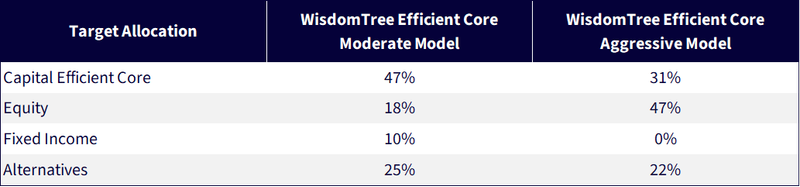
Model portfolio allocations as of 8/31/26.
The objective isn’t to identify one asset class that will outperform. It is to build a portfolio where different return drivers can potentially contribute during different market environments.
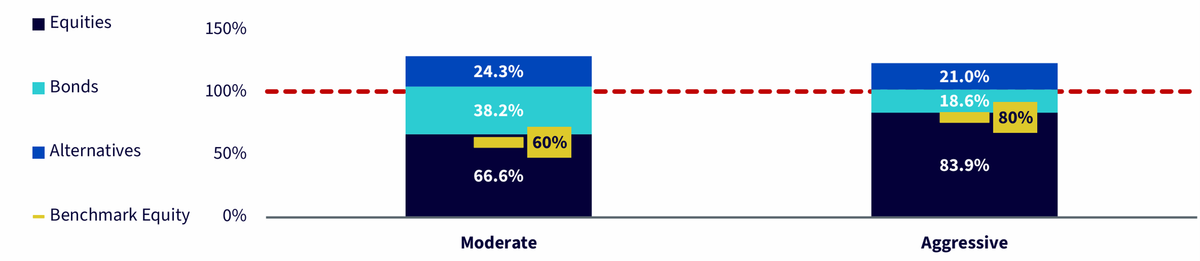
The capital efficiency of the models becomes particularly apparent when looking at notional exposure, i.e. the economic exposure a portfolio has to each asset class, rather than simply the amount of capital allocated to each holding. Because the Efficient Core ETFs use Treasury futures to supplement their underlying equity exposure, a portion of the portfolio’s capital can generate exposure greater than the amount invested.
The traditional 60/40 portfolio remains a useful starting point for thinking about portfolio construction. Today, investors have access to a much broader range of strategies than they did when the framework first became popular. The challenge is not simply finding additional investments. It is finding a way to incorporate them without unnecessarily sacrificing the core exposures that investors still require.
Capital efficiency provides one potential solution and Efficient Core Model Portfolios take the concept one step further by using that capital efficiency as part of a broader multi-asset portfolio construction framework.
For financial advisors: WisdomTree Model Portfolio information is designed to be used by financial advisors solely as an educational resource, along with other potential resources advisors may consider, in providing services to their end clients. WisdomTree’s Model Portfolios and related content are for information only and are not intended to provide, and should not be relied on for, tax, legal, accounting, investment or financial planning advice by WisdomTree, nor should any WisdomTree Model Portfolio information be considered or relied upon as investment advice or as a recommendation from WisdomTree, including regarding the use or suitability of any WisdomTree Model Portfolio, any particular security or any particular strategy.
For retail investors: WisdomTree’s Model Portfolios are not intended to constitute investment advice or investment recommendations from WisdomTree. Your investment advisor may or may not implement WisdomTree’s Model Portfolios in your account. The performance of your account may differ from the performance shown for a variety of reasons, including but not limited to: your investment advisor, and not WisdomTree, is responsible for implementing trades in the accounts; differences in market conditions; client-imposed investment restrictions; the timing of client investments and withdrawals; fees payable; and/or other factors. WisdomTree is not responsible for determining the suitability or appropriateness of a strategy based on WisdomTree’s Model Portfolios. WisdomTree does not have investment discretion and does not place trade orders for your account. This material has been created by WisdomTree, and the information included herein has not been verified by your investment advisor and may differ from information provided by your investment advisor. WisdomTree does not undertake to provide impartial investment advice or give advice in a fiduciary capacity. Further, WisdomTree receives revenue in the form of advisory fees for our exchange-traded funds and management fees for our collective investment trusts.

Associate Director, Research Content
Lonnie S. Jacobs joined WisdomTree in August 2006 as Senior Index Analyst overseeing creation, maintenance and reconstitution of the firm’s passive indexes and actively managed ETFs. In her current role as Associate Director, Research Content, she is focused on supporting the research pipeline and analyzing the impact of global markets on WisdomTree strategies. Lonnie has B.A. in Economics and M.S. in Information Systems.

