


September Gold Monthly: Sell the Rumour, Buy the News
Published October 1, 2026

Christopher Gannatti, CFA
Global Head of Research

Key Takeaways
- Gold may face a “sell the rumor, buy the news” dynamic if the Fed reverses 2025 cuts rather than delivering the additional hikes markets expect.
- Central banks added a reported net 23 tons of gold in July, bringing reported 2026 net purchases to around 130 tons.
- WisdomTree’s capital-efficient gold ETFs layer roughly 90% notional gold exposure over an approximately 90% allocation to equities, gold miners or TIPS.
The familiar market maxim is to buy the rumour and sell the news. This month, we think gold may face the reverse dynamic. It has already sold off as markets anticipated a renewed Federal Reserve hiking cycle, but the first hike may prove to be the point at which those fears are tested rather than confirmed.
The U.S. Federal Reserve delivered its first interest rate hike since 2023 in September 2026.1 The decision marked a well-telegraphed hawkish pivot, but it also reflected the difficult position in which the Fed had found itself. Some policymakers had argued for patience while the effects of energy supply shocks became clearer. However, Kevin Warsh’s Jackson Hole speech acknowledged that underlying inflation remained uncomfortably high, while stronger capital expenditure and manufacturing data pointed to a more resilient economy.2
The Fed had hoped that softer consumer spending and a weaker labor market would provide a sufficient offset to allow it to wait and assess the pass-through from higher energy costs. Instead, volatility in longer-dated Treasury yields and a rising term premium made inaction increasingly difficult.
We do not believe the Fed is embarking on a new, extended tightening cycle. Rather, it appears to be reversing part of the easing delivered in 2025. Yet, in an environment in which forward guidance has become less informative, markets will have to infer the likely policy path from incoming data. Those interpretations may themselves influence financial conditions and, ultimately, the Fed’s room for manoeuvre.
The first key variable is the conflict in the Middle East and its impact on global energy markets. The sharp rise in oil prices has contributed to increased volatility in bond markets, particularly at the shorter end of the yield curve. The backdrop is made more challenging by emerging shortages of refined products, including diesel and jet fuel.3
A second factor is the renewed strength in U.S. capital expenditure and manufacturing, supported by the artificial intelligence buildout. The multi-year nature of this investment supports economic activity and corporate earnings, while also contributing to higher issuance of predominantly investment-grade debt.4
Against this backdrop, the Federal Reserve may have felt more comfortable addressing the inflation side of its dual mandate as signs of labor-market weakness have begun to recede. Higher policy rates will do little to address supply-driven inflation directly, particularly where it stems from energy markets. However, the decision helps counter concerns that the new Chair may be insufficiently focused on returning inflation to the 2% target. The September press conference was also more assured than that in July, while the unanimous vote reduced concerns about a more fractured policy-making process.
Attention will now turn to evidence of broader price pass-through and, above all, to the trajectory of oil prices.
If we are right that the Fed is merely reversing some of the cuts delivered in 2025, rather than validating the three to four further hikes currently priced by markets, downward pressure on gold should ease in the coming months. Additional rate hikes ahead of the midterm elections would also be politically sensitive. Markets have fully priced a hike at the final Federal Open Market Committee meeting of the year, on December 9, as well as further tightening in 2027.
The period after the midterm elections could also create an opportunity for de-escalation in Iran. The Administration may be reluctant to compromise on terms that could be perceived as weak ahead of the vote. However, once the election has passed, it may have greater scope to pursue a settlement. Inflation pressures and rising debt-servicing costs, now exceeding defence spending, could reinforce the incentive to act.5 A moderation in energy prices would, in turn, reduce pressure on the Fed to tighten further.
Amid the bond-market volatility ahead of the September rate hike, gold held up considerably better than Treasuries. This reinforces a broader trend of recent years: gold has outperformed bonds despite periods of rising real yields and tighter monetary policy.
Figure 1: The Gold Price versus Real Interest Rates (Treasury Inflation-Protected Securities Yield)
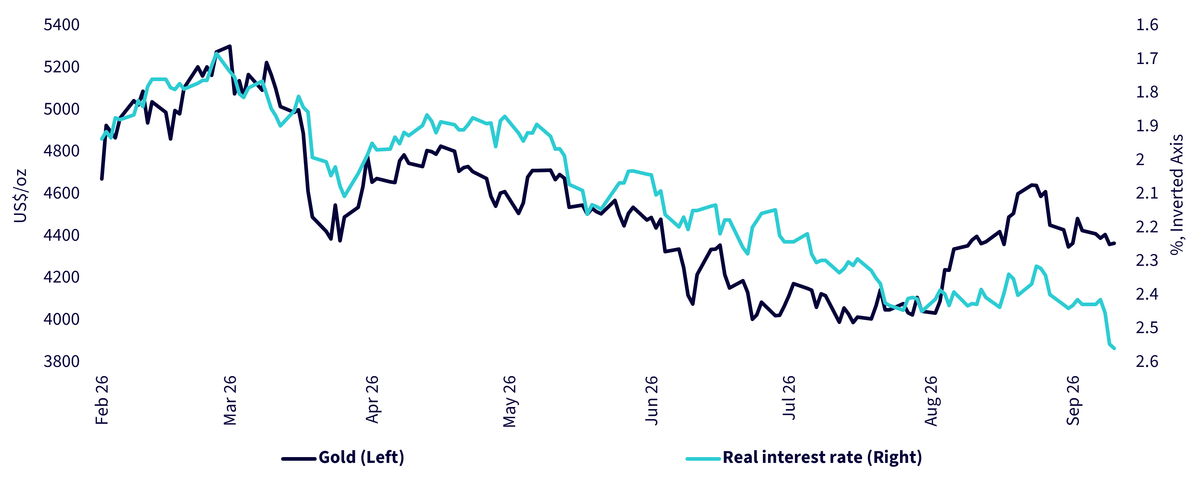
Source: Bloomberg Finance L.P., WisdomTree, February 2026 – September 2026. The specific rate is the 10-year U.S. Treasury Inflation-Protected Security. Past performance is not indicative of future results.
The Extraordinary Valuation Premium in Q1 2026 Has Largely Been Unwound
Although gold has outperformed bonds, higher interest-rate expectations halted the August rally. The exceptional valuation premium evident in January 2026 has also deflated, leaving gold closer to the level implied by our model.
Figure 2: Gold Price Attribution
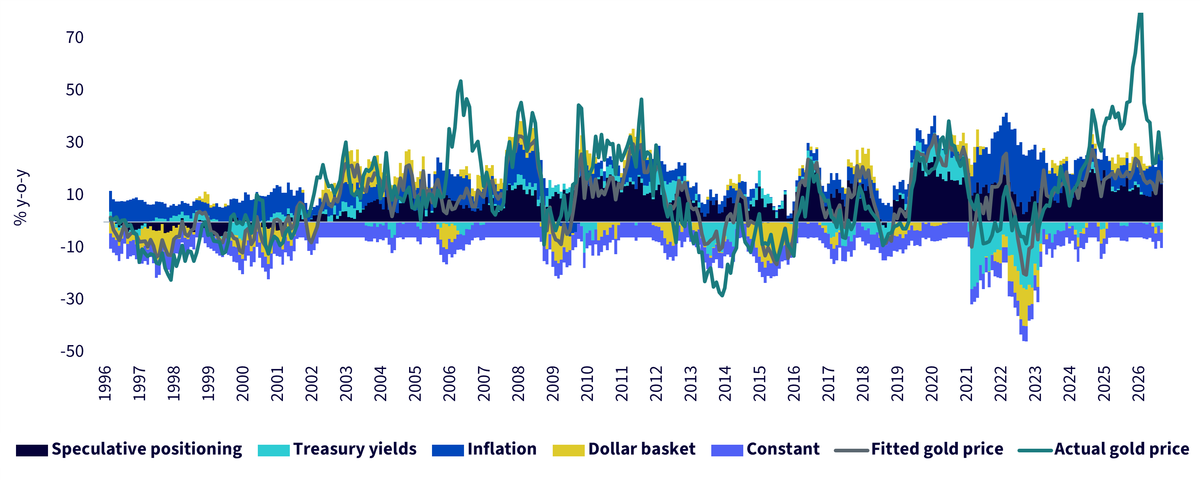
Source: Bloomberg Finance L.P., WisdomTree price model, data as of September 2026. The fitted gold price is the price the model would have forecast. The constant does not have economic meaning but is used in econometric modelling to capture other terms. It can be thought of as how much gold prices would change if all other variables are set to zero (although that would be unrealistic). We are ultimately putting together the impacts on the gold price movements from these different variables to indicate the extent to which each is having an impact. It’s interesting that the actual price has seemed to, at least to a degree, come back to the implied price of the model, while the model did not necessarily predict the big upward move that happened in the second half of 2025 into the start of 2026. Past performance is not indicative of future results.
Chinese Insurance Companies, Indian Pension Funds and Tether Were Major Buyers in Q1, but Demand Cooled in Q2 and Q3
The moderation in gold’s valuation premium may partly reflect softer physical and investment demand from China and India following the exceptionally strong period at the end of 2025 and the start of 2026. Chinese exchange-traded product (ETP) demand, supported by insurance-company buying, and Indian ETP demand, supported by pension-fund participation, both cooled sharply.6
Chinese ETP demand revived modestly in August, while Indian demand remains subdued.
Figure 3: China versus India ETP Flows
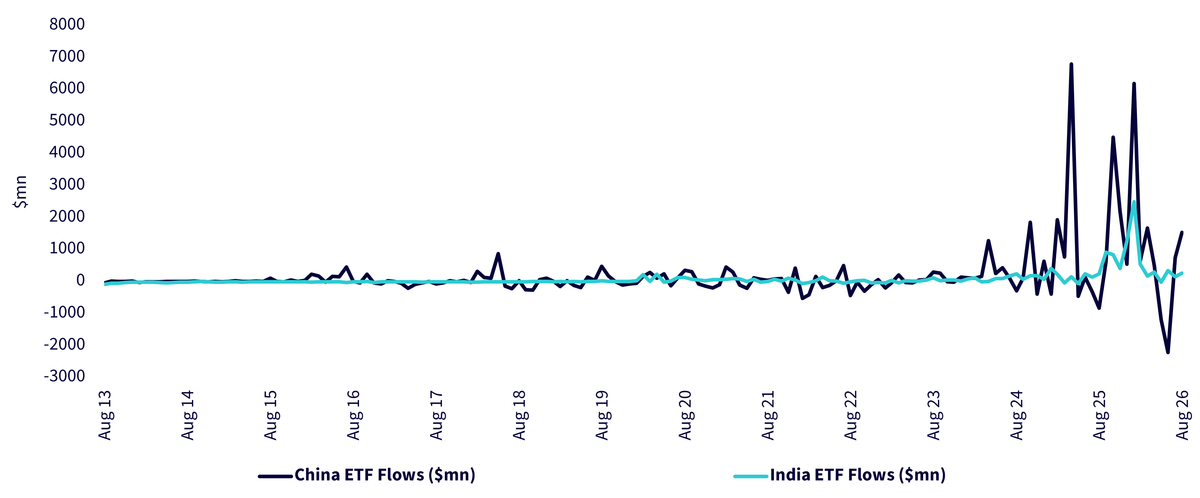
Source: World Gold Council, WisdomTree. August 2013 to August 2026. Past performance is not indicative of future results.
Stablecoin treasury-management demand for gold also moderated after surging in the second half of 2025. Tether’s purchases in the first half of 2026 appear broadly comparable with those in the first half of 2025, but remain well below the pace seen in the second half of 2025, which attracted considerable market attention at the start of 2026.
Figure 4: Estimated Tether Gold Purchases
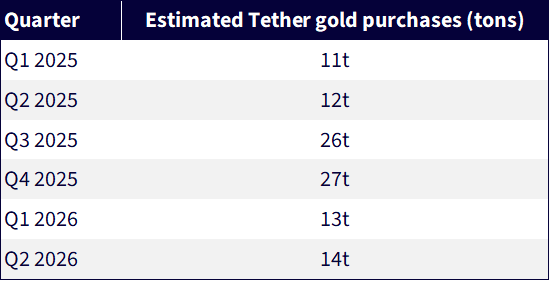
Source: Tether quarterly attestation reports and LBMA gold price. Historical performance is not an indication of future performance, and any investments may go down in value.
Official-Sector Gold Buying Remains Positive, Albeit Slower Than Last Year
Central banks added a reported net 23 tons to their gold reserves in July, taking reported net purchases to around 130 tons so far in 2026, compared with approximately 160 tons over the equivalent period in 2025. China and Poland were the largest reported buyers during the month, adding 20 tons and 8 tons respectively, while Russia was the largest seller, reducing holdings by 6 tons.7
Reported reserve data provide only a partial and lagged view of official-sector activity, but they continue to indicate that many central banks retain an interest in increasing gold exposure. The Bank of Korea recently disclosed a small allocation to gold-backed exchange-traded funds, while the Bank of Namibia has raised its target gold allocation from 1% to 3% of reserves by March 2027.8
Official interest in gold is also increasingly reflected in decisions about custody. De Nederlandsche Bank recently shifted part of its holdings from North America to London, increasing London’s share of Dutch gold reserves from 18.1% to 32.1%. The operation combined physical transfers with the sale of gold in New York and the purchase of internationally tradable gold in London.9
The aim was to improve liquidity, accessibility and crisis-readiness while retaining a diversified custody structure. This highlights that central banks are not simply repatriating gold; they are balancing domestic custody, jurisdictional resilience and access to liquid trading centers.
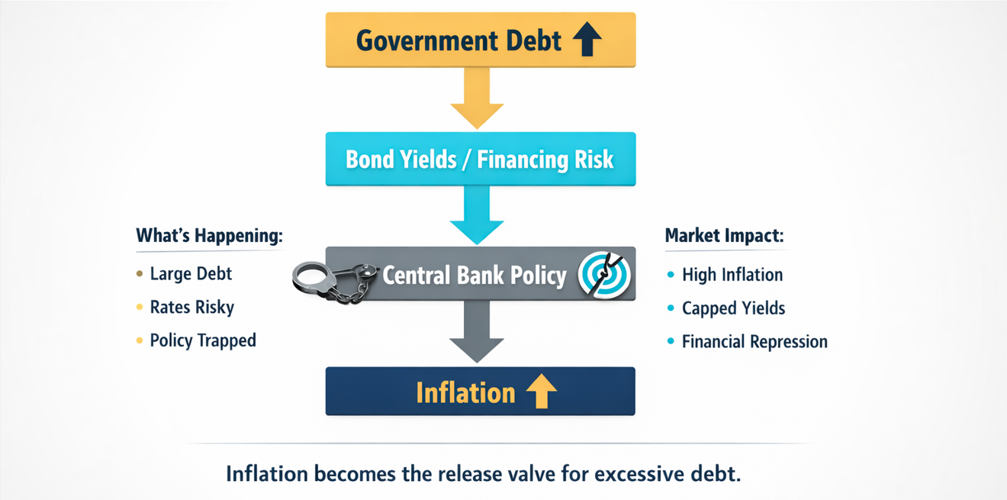
Fiscal Dominance Could Re-emerge as Gold’s Most Important Driver
Fiscal dominance was a major gold-market theme in 2025 but has been overshadowed this year by the prospect of higher policy rates. We believe it will re-emerge as a central driver of gold over the coming year.
Higher interest costs are more difficult to absorb when public debt is already elevated. In earlier decades, similarly high interest rates were more manageable because debt burdens were much lower. At some point, rising debt-service costs may constrain policy choices and increase pressure for more accommodative monetary settings.
That is the environment in which gold’s role as a non-fiat reserve asset is likely to become more prominent.
Figure 5: Illustration of How Inflation and Government Debt Interact
Source: Infographic done by WisdomTree.
Conclusion: Expressing the View: Capital-Efficient Gold Solutions
We have written before about how investors who find the setup compelling and are thinking about a potential rally back in gold, the practical question is how to add gold without giving up the exposures already doing work in a portfolio. WisdomTree’s capital-efficient suite is built for adding gold as an overlay to a sleeve in a portfolio and creates more room without having to sell an important asset.
Figure 6: WisdomTree Capital-Efficient Gold ETFs
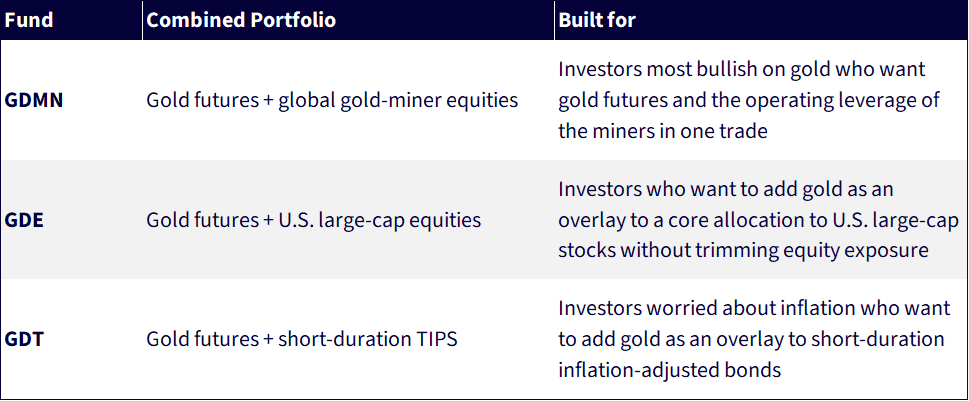
GDMN refers to the WisdomTree Efficient Gold Plus Gold Miners Strategy Fund, which is a strategy designed to provide exposure to 90% equities of gold mining companies, 10% short-term U.S. Treasuries to serve as collateral for a position that provides 90% notional exposure to gold futures. For each hypothetical $100 invested, there is $180 of notional exposure. GDE refers to the WisdomTree Efficient Gold Plus Equities Strategy Fund, which is a strategy designed to provide exposure to 90% equities of the 500 largest U.S. companies by market capitalization, 10% short-term U.S. Treasuries to serve as collateral for a position that provides 90% notional exposure to gold futures. For each hypothetical $100 invested, there is $180 of notional exposure. GDT refers to the WisdomTree Efficient Gold Plus TIPS Strategy Fund, which is a strategy designed to provide exposure to 90% U.S. Treasury Inflation-Protected bonds, 10% short-term U.S. Treasuries which serve as collateral for 90% notional exposure to gold futures. These ETFs do not hold physical gold.
Each fund uses U.S.-listed gold futures, collateralized by the fund’s core holdings, to layer roughly 90% notional gold exposure on top of an existing ~90% allocation, for about 1.8x total asset exposure per dollar invested.
Because the gold sits on top of the large-cap equity, gold miners or TIPS sleeve rather than replacing it, an investor can introduce a meaningful gold position without selling down the stocks or bonds they already own.
1Source: Board of Governors of the Federal Reserve System. (2026, September 16). Federal Reserve issues FOMC statement [Press release].
2Source: Warsh, K. M. (2026, August 28). In our time [Speech transcript]. Board of Governors of the Federal Reserve System.
3Sources: Ho, J. (2026, September 9). High oil prices are pushing up short-term bond yields. Marketplace; U.S. Energy Information Administration. (2026, September). Short-term energy outlook. U.S. Department of Energy.
4Source: De Vere, H., Ramaswamy, S., & Searls, S. (2026, February 10). How AI debt financing impacts duration supply and interest rates. Federal Reserve Bank of Dallas, Dallas Fed Economics.
5Source: Congressional Budget Office. (2026, February 11). The budget and economic outlook: 2026 to 2036. U.S. Congress.
6Sources: World Gold Council. (2026, July 30). Gold demand trends: India focus Q2 2026; World Gold Council. (2026, July 1). Gold mid-year outlook 2026: Point break.
7Source: Salim, M. (2026, September 3). Central bank gold statistics: Central banks make positive headlines on gold. World Gold Council.
8Source: Salim, M. (2026, September 3). Central bank gold statistics. World Gold Council.
9Source: De Nederlandsche Bank. (2026, September 2). DNB improves tradability of gold reserves [Press release].
Categories
About the contributors

Christopher Gannatti, CFA
Global Head of Research
Christopher Gannatti began at WisdomTree as a Research Analyst in December 2010, working directly with Jeremy Schwartz, CFA®, Director of Research. In January of 2014, he was promoted to Associate Director of Research where he was responsible to lead different groups of analysts and strategists within the broader Research team at WisdomTree. In February of 2018, Christopher was promoted to Head of Research, Europe, where he was based out of WisdomTree’s London office and was responsible for the full WisdomTree research effort within the European market, as well as supporting the UCITs platform globally. In November 2021, Christopher was promoted to Global Head of Research, now responsible for numerous communications on investment strategy globally, particularly in the thematic equity space. Christopher came to WisdomTree from Lord Abbett, where he worked for four and a half years as a Regional Consultant. He received his MBA in Quantitative Finance, Accounting, and Economics from NYU’s Stern School of Business in 2010, and he received his bachelor’s degree from Colgate University in Economics in 2006. Christopher is a holder of the Chartered Financial Analyst Designation.

Nitesh Shah
Head of Commodities and Macroeconomic Research, WisdomTree Europe
@NiteshShahWTNitesh Shah is a seasoned financial professional with over 24 years of experience in research and investment strategy. As Head of Commodities & Macroeconomic Research at WisdomTree Europe, he leads market analysis and insights across asset classes, with a focus on commodities and exchange-traded products. Previously, he held roles at Moody’s, HSBC Investment Bank, The Pension Protection Fund, and Decision Economics, building expertise in market analysis and strategy. Nitesh earned a master’s degree in International Economics and Finance from Brandeis University and a bachelor's in Economics from the London School of Economics. His insights are frequently featured in financial media, and he is a sought-after speaker at industry events. He also hosts the ‘Commodity Exchange’ podcast, where he discusses trends shaping global markets. Passionate about guiding investors, Nitesh provides actionable insights to help them navigate complex financial landscapes.