


The Unsaid Truths of China Tech
Published April 20, 2021

Liqian Ren
Director of Modern Alpha
Chinese technology companies have been in the spotlight lately, and a few under-reported details stand out.
When the Ant Financial IPO was delayed, speculation grew about how Chinese regulators would restrict the company. As expected, its financial services are going to be structured under the regulation of a financial holding company. One component that went unanswered is, what to do with Ant’s technology arm? In my view, it may be spun into a separate tech company that would improve its valuation.
The more media attention focuses on Jack Ma, the worse his situation will be. The more he is portrayed as a martyr, the harder it will be to sort it out. My own parents knew nothing about credit cards and mortgages, but now China is graduating into a credit-driven society. Ant’s reputation is not stellar here, with practices often viewed as “predatory lending.”
Are mutually exclusive contracts anti-competitive, all politics aside? Chinese antitrust regulators say yes, while the U.S. Federal Trade Commission says it’s complex and nuanced. If Twitter asked you to sign a contract to only appear on one social media platform, is that anti-competitive? What about exclusive contracts for licensing an index for an ETF? The FTC stated, “Exclusive contracts can benefit competition in the market by ensuring supply sources or sales outlets, reducing contracting costs or creating dealer loyalty.“ It cited three cases where it has been ruled anticompetitive.
Mutually exclusive contracts are so common in China that as soon as Ant was fined, the CEO of 58.com called for an antitrust investigation against competitor BeKe (KE Holdings) for signing mutually exclusive contracts with real estate brokers.
China’s antitrust regulator asked 34 Internet platform companies like Tencent, ByteDance and JD to “conduct self-inspections within one month” or face a fine. Chinese regulators often use warnings to adjudicate rather than bringing actual legal cases. When Qihu360 and Tencent got into anti-competitive spats and lawsuits, the government asked each party to stop some practices and each wrote apology letters to the public.
34 Chinese Companies and Their U.S. proxy’s business lines
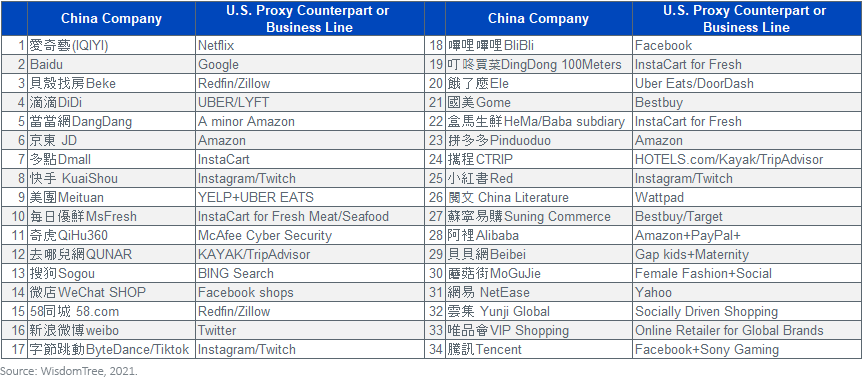
Some of the smaller retailers on this list hardly have monopoly power, which calls into question “regulatory overreach” when their mutually exclusive contracts are subject to antitrust regulation. I can’t help but wonder what the grandfather of regulatory economics, George Stigler, would say.
Speaking of George Stigler, his thoughts and research on economics of regulation merited him a Nobel prize, and I would highly recommend his humorous autobiography as general reading for those interested in the Chicago School of Economics, which has a healthy dose of skepticism of regulators.
All regulations look backward, not forward. The biggest question for Ant and Alibaba in the next five years is whether they can compete, grow and make money in a very competitive space for Chinese technology. The 34 companies on this list show the challenges and opportunities, as Ant is still the top non-state-owned financial entity with the least competition from other non-state-owned enterprises, while Alibaba’s other main businesses have plenty of strong competitors.
Related articles

China Tech Is Back—And This Time, It Built the Playbook Itself

Trump, Xi, and the Strategic Processing Reserve

India’s Market Reset: Looking Beyond the Recent Pullback
India: Between Friction and Flywheel

Beyond Market Cap: A Nearly 19-Year Case for Dividend-Driven Emerging Markets
Rethinking How to Access Emerging Markets
A Market You Probably Have Not Been Watching

The Case for Local Currency and Active Management in a Softening Dollar Environment
India and the Trade Deal: A Catalyst, but Not the Story
About the contributor

Liqian Ren
Director of Modern Alpha
Liqian Ren, Ph.D., joined WisdomTree as Director of Modern Alpha in 2018. She leads WisdomTree’s quantitative investment capabilities and serves as a thought leader for WisdomTree’s Modern Alpha® approach. Liqian was previously at Vanguard, where she worked for 12 years, most recently as a portfolio manager in the Quantitative Equity Group managing Vanguard’s active funds and conducting research on factor strategies. Prior to joining Vanguard, she was an associate economist at the Federal Reserve Bank of Chicago. Liqian received her bachelor’s degree in Computer Science from Peking University in Beijing, her master’s in Economics from Indiana University—Purdue University Indianapolis, and her MBA and Ph.D. in Economics from the University of Chicago Booth School of Business. Liqian co-hosts a podcast on China and Asian markets with Jeremy Schwartz, WisdomTree’s Global Head of Research, and she is a co-host on the Wharton Business Radio program Behind the Markets on SiriusXM 132.