
ELD
Emerging Markets Local Debt Fund

Published August 6, 2026

Director, Fixed Income
Back in February, we wrote about the strong run the WisdomTree Emerging Markets Local Debt Fund (ELD) had put together, one of the standout performers in our fixed income lineup, riding a weaker U.S. dollar and steadily improving fundamentals across emerging markets (EM). That run has continued, but the story behind it has gotten more complicated. The conflict in the Middle East has added a real jolt of volatility to oil prices, and the market has responded by pulling apart what used to be a fairly uniform EM trade into something far more country-specific. In this post, we look at how ELD has performed since our last update, why emerging markets are becoming more differentiated, and how the fund is positioned for what comes next.
Emerging markets are turning into more of a stock-picker's game again, or in this case, a bond-picker's game. Performance is increasingly driven by country-specific fundamentals rather than broad beta. Carry remains supportive across EM, but a firmer dollar and hawkish Fed expectations are weighing more heavily on the countries most tied to U.S. trade. The Iran conflict's effect on oil prices sharpens that split even further: oil-importing countries are facing renewed pressure on domestic inflation and external balances, while exporters are picking up a real tailwind from higher energy prices.
The global cyclical backdrop is still holding up reasonably well, with the consumer smoothing through the energy shock rather than buckling under it. Before the conflict began, EM fundamentals were stable and, in many cases, improving: growth had held up, monetary policy credibility was intact, inflation was trending lower, and external balances were well contained. The two swing factors now are energy prices and the Fed, and both are keeping uncertainty elevated and positioning light. We remain constructive on EM currencies, supported by that cyclical backdrop, but we're more cautious on EM rates given the increasingly two-sided risk to inflation and central bank policy. If the conflict is resolved, including a full reopening of the Strait of Hormuz, we'd expect a real risk rally as investors price in a lower-inflation environment. Until then, expect the market to stay selective.
ELD has held up well through this stretch. Year to date (as of 7/15/26), the fund is up 2.16%, outperforming its benchmark, JPMorgan GBI-EM Global Diversified Index, by 43 basis points. The outperformance has continued despite the Middle East conflict, a noteworthy result given how much volatility oil markets have thrown at EM currencies and rates.
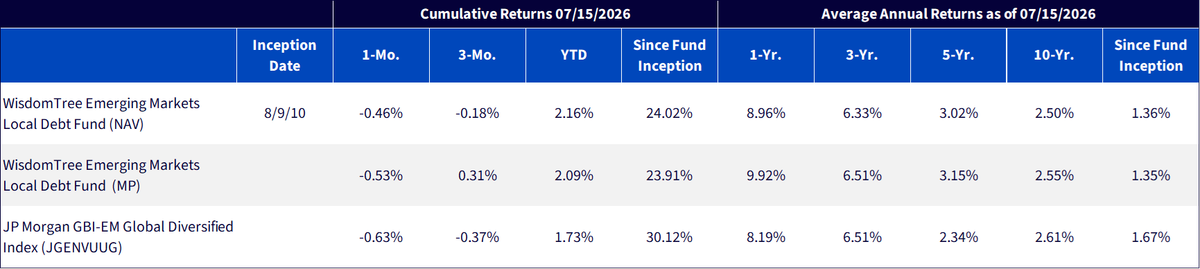
Source: WisdomTree, J.P. Morgan, as of 7/15/26. You cannot invest directly in an index. Past performance is not indicative of future results. Investment return and principal value of an investment will fluctuate so that an investor’s shares, when redeemed, may be worth more or less than their original cost. Current performance may be lower or higher than the performance data quoted. For the most recent month-end and standardized performance, click here.
We retain a strategic overweight to Latin American issuers relative to the index, with underweights in EMEA and, in particular, Asia. On average, Latin American issuers offer higher yields with better credit scores than their counterparts elsewhere in the index, and that gap has helped the fund's numbers hold up at a time when broad EM beta is telling investors less than it used to.

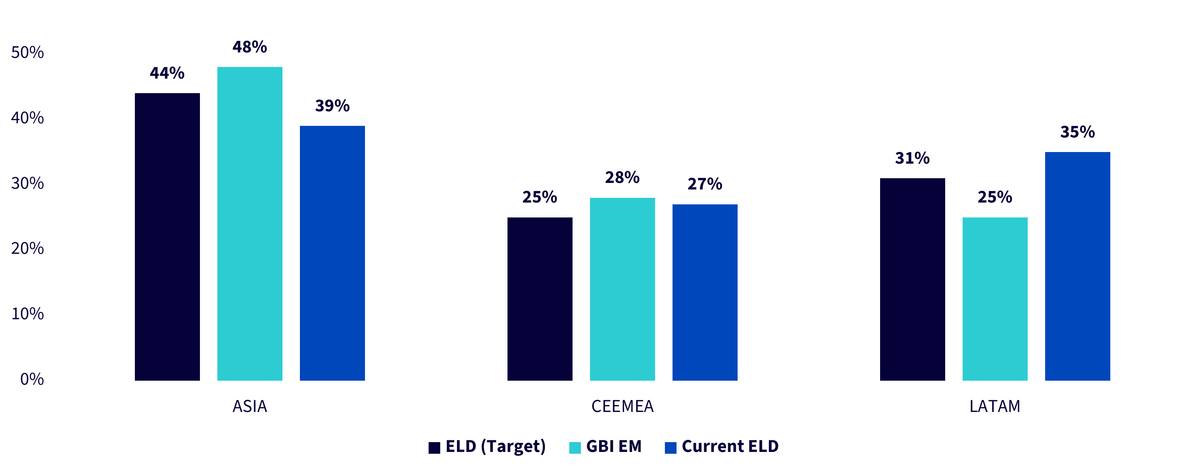
Source: WisdomTree, Bloomberg, J.P. Morgan, data as of latest rebalance on 03/09/2026. Past performance is not indicative of future results. You cannot invest directly in an index. GBI-EM GD: J.P. Morgan Government Bond Index – Emerging Markets (GBI-EM) Global Diversified. Exposures are subject to change. ASIA consists of exposure to China, India, Philippines, Thailand, Indonesia, and Malaysia. CEEMEA consists of exposure to Hungary, Poland, Romania, Russia, Turkey, and South Africa. LATAM consists of exposure to Brazil, Colombia, Mexico, Chile, Argentina, and Peru.
The easy version of the EM local debt trade, buying the index and letting a weak dollar do the work, is behind us for now. What matters going forward is which countries can absorb an oil shock and a firmer dollar without their inflation or external accounts breaking down, and which can't. ELD's overweight to Latin America and underweight to Asia and EMEA reflect exactly that judgment, and it's showing up in the numbers: outperformance that held up even through the roughest stretch of the Iran conflict so far. We think staying selective is the right call until there's real clarity on the Middle East, and ELD is built for exactly that kind of market.
There are risks associated with investing, including possible loss of principal. Foreign investing involves special risks, such as risk of loss from currency fluctuation or political or economic uncertainty. Investments in emerging, offshore or frontier markets are generally less liquid and less efficient than investments in developed markets and are subject to additional risks, such as risks of adverse governmental regulation and intervention or political developments. Derivative investments can be volatile and these investments may be less liquid than other securities, and more sensitive to the effects of varied economic conditions.
Fixed income investments are subject to interest rate risk; their value will normally decline as interest rates rise. In addition, when interest rates fall income may decline. Fixed income investments are also subject to credit risk, the risk that the issuer of a bond will fail to pay interest and principal in a timely manner, or that negative perceptions of the issuer’s ability to make such payments will cause the price of that bond to decline. Due to the investment strategy of this Fund it may make higher capital gain distributions than other ETFs. Please read the Fund’s prospectus for specific details regarding the Fund’s risk profile.
Emerging Markets Local Debt Fund


Director, Fixed Income
Behnood Noei serves as Director of Fixed Income at WisdomTree Asset Management, where he develops the firm’s suite of fixed income and currency exchange-traded funds and enhances existing investment processes. Behnood has 11 years investment experience in portfolio management and quantitative research. Prior to joining WisdomTree in 2022, Behnood was a portfolio manager and developer of some of the fixed income ETFs at J.P.Morgan Asset Management, where he was directly responsible for managing more than 7 Fixed Income ETFs and multiple SMAs with more than $13Billion in assets. He graduated from The Ohio State University with Master of Science degree in Finance and is a CFA charter holder.