


Looking back at Equity Factors in Q4 with WisdomTree
Published January 13, 2023

Pierre Debru
Head of Research, WisdomTree Europe.
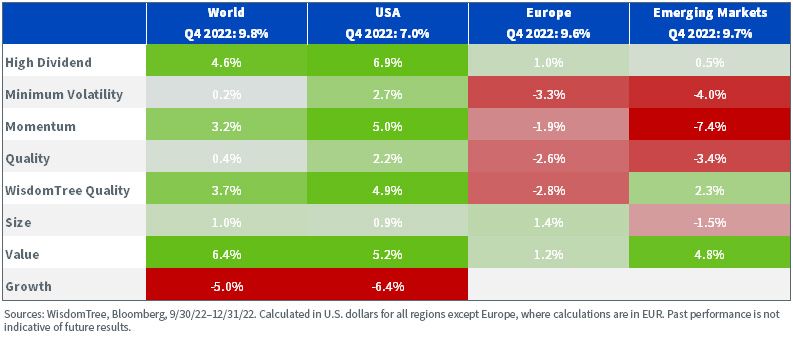
After three negative quarters, 2022 closed with a bang. Equities around the world delivered very strong returns in both October and November on the back of relatively good news on the inflation front. Therefore, despite a negative December, developed market equities gained 9.8% in Q4, and emerging market equities gained 9.7%.
This installment of the WisdomTree Quarterly Equity Factor Review aims to shed some light on how equity factors behaved in this rebound and how this may have impacted investors’ portfolios.
- Overall factors performed strongly for global and U.S. investors. Only growth delivered an underperformance in Q4
- Value, high dividend and high-quality dividend payers delivered the strongest performance in both regions
- In Europe, small-cap stocks performed the best, followed by value and high-dividend stocks
- In emerging markets, value and high-quality dividend payers delivered the strongest outperformance
Looking forward to 2023, the same issues that drove markets in 2022 remain. While inflation has shown signs of easing, we expect central banks to remain hawkish around the globe as inflation is still very meaningfully above target. In an environment where interest rates and inflation remain high, and the volatility of both equities and interest rates is increasing, we continue to tilt toward high dividend, value and high-quality dividend payers.
Performance in Focus: High Dividend and Value Finish Strong
In the fourth quarter of 2022, equity markets posted their first positive quarter of the year across regions. In October and November, markets benefited from positive inflation numbers and increased hopes for a Fed pivot or at least a pause in rate hikes leading to a sharp rebound. MSCI World gained 7.2% and 7% in those two months, respectively. However, hopes of such a pivot were dashed quickly, with the Federal Reserve Chair making clear in the December FOMC meeting that he wanted to see “substantially” more progress on inflation before the hiking would stop. This led MSCI World to lose -4.3% in December.
Overall factors performed strongly for global and U.S. investors:
- Only growth delivered an underperformance in Q4 in U.S. and global equities
- Value, high dividend and high-quality dividend payers delivered the best performance across regions but mostly in the U.S.
- In Europe, factors had a more difficult time. Small-cap stocks performed the best, followed by value and high-dividend stocks, but quality, momentum and minimum volatility delivered underperformance.
- In emerging markets, value and high-quality dividend payers delivered the strongest outperformance. In this market, quality, momentum and minimum volatility also delivered underperformance.
- In Q4, the market environment continued to discriminate strongly between quality stocks. The definition of quality and the criteria used have hugely impacted the result. Quality, left unattended, tends to tilt toward growth (investors pay for quality, after all) and would have suffered from that tilt, as illustrated with MSCI Quality (“Quality” in figures 1 and 2). Highly profitable companies and dividend growers have fared better this quarter, as illustrated by WisdomTree Quality.
Figure 1: Equity Factor Outperformance in Q4 2022 across Regions
2022, the Year of the Dividends
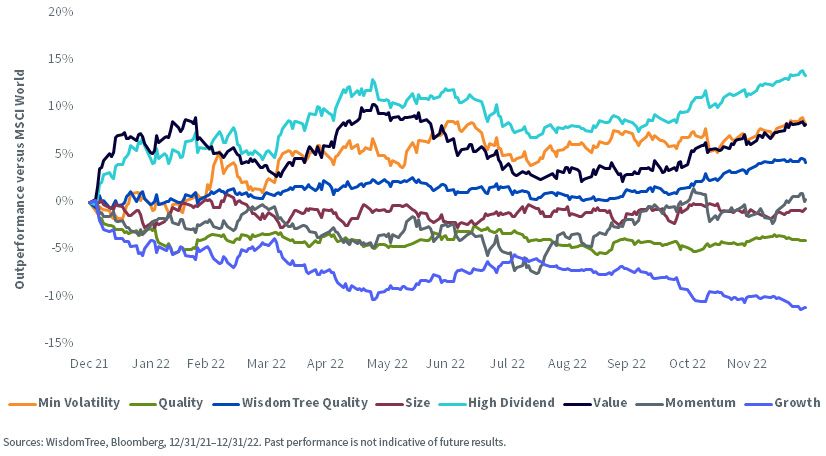
Looking back at the whole year, High Dividend has dominated the factor space consistently across the year. It delivered a 13.4% outperformance to MSCI World and a 15.2% outperformance versus MSCI USA.
In global equities, Value and Min Volatility completed the podium with 8.3% of outperformance. In the U.S., the podium is a bit different, with WisdomTree Quality (i.e., high-quality dividend payers) finishing second (+11.4%) and Minimum Volatility and Value coming third and fourth.
In both regions, Growth and Quality (with its growth tilt) were the only factors to deliver underperformance.
In Europe, High Dividend and Value also dominated the field.
Figure 2: Year-to-Date Outperformance of Equity Factors in Developed Markets
Valuations Rebounded in Q4
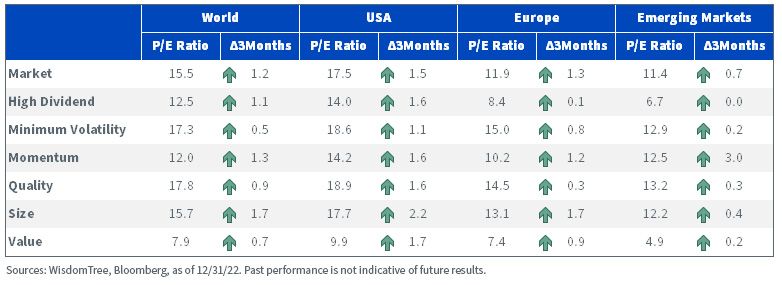
In Q4 2022, valuations rebounded across the board on the back of markets’ positive performances. Small caps saw the largest increases, with +1.7 in global and European equities and +2.2 in U.S. equities. European and emerging markets remain quite cheap, leading to factors being cheap as well. Emerging market value is currently priced at a 4.9 P/E ratio.
Figure 3: Historical Evolution of Price-to-Earnings Ratios of Equity Factors
Looking forward to 2023, recession risk is continuing to rise. The International Monetary Fund (IMF) is warning of a recession in the U.S., a deep slowdown in Europe and a drawn-out recession in the United Kingdom. While inflation has shown signs of easing, we expect central banks to remain hawkish around the globe as inflation is still very meaningfully above targets. The Federal Reserve made clear in its December meeting that “substantially” more progress will need to happen on the inflation front before hiking stops. The European Central Bank (ECB) projections show inflation is unlikely to reach the 2% target until late 2025, leading to a hawkish turn there as well. The Bank of Japan also surprised markets in December with its own hawkish move.
Overall, as we transition to 2023, three questions remain unanswered from 2022:
1. How sticky will the underlying inflation be?
2. How intense will the recession be?
3. Will we find a solution to Europe’s energy crisis?
With markets facing the same issues in 2023 that they faced in the second half of 2022, we continue to tilt toward the strategies that delivered for investors in 2022, i.e., high dividend, value and high-quality dividend payers.
“World” = MSCI World Index
“U.S.” = MSCI USA Index
“Europe” = MSCI Europe Index
“Emerging Markets” = MSCI Emerging Markets Index
“Minimum Volatility” = the relevant MSCI Min Volatility Index
“Quality” = the relevant MSCI Quality Index
“Momentum” = the relevant MSCI Momentum Index
“High Dividend” = the relevant MSCI High Dividend Index
“Size” = the relevant MSCI Small Cap Index
“Value” = the relevant MSCI Enhanced Value Index
“WisdomTree Quality” = the relevant WisdomTree Quality Dividend Growth Index
Pierre Debru is an employee of WisdomTree UK Limited, a European subsidiary of WisdomTree Asset Management Inc.’s parent company, WisdomTree, Inc.
Categories
Related articles

Two Prices, One Fund: Understanding NAV and Market Price in ETFs

When AI Leaves the Screen and Enters the Physical World

Behind the Charts: Is the Energy Trade Running Out of Fuel?

Quality as a Foundation in an Uncertain World

The Company at the Center of the AI Economy

A Dog, a Diagnosis and a Different Way to Understand AI
The Market's Pendulum May Be Swinging Back to Value
Rising Through Discipline: Why DGRW and DDWM Are Earning Their Upgrades

Strength in the Storm: Introducing the WisdomTree Adaptive Moving Average Funds
About the contributor

Pierre Debru
Head of Research, WisdomTree Europe.
Pierre Debru leads WisdomTree’s European research team and plays a pivotal role in the strategic direction of our European research efforts. His key areas of expertise extend across equity factors and quantitative strategies, portfolio construction and model portfolios, and thematic and crypto investments. Before joining the company in 2019, Pierre worked in Investment Research for DWS and the Xtrackers range for over five years. During this period, he focused on smart beta investments, model portfolio construction and thought leadership. Pierre has over 20 years of experience in investments and structured asset management. He graduated from Ecole Central Paris and obtained a Master of Science in Mathematics applied to Finance.