
WQTM
Quantum Computing Fund

Published May 26, 2026

Global Head of Research

Associate Director, Quantitative Research
Quantum Investing Is Moving from Concept to Ecosystem
Artificial intelligence taught investors that the most compelling thematic opportunities often appear first in the bottlenecks. Before every application monetizes, capital moves toward the infrastructure that makes the application possible. Quantum computing may be earlier, noisier and more technically uncertain than AI, but the logic is similar:
Find the constraints, then find the companies attempting to solve them.
Of course for quantum, the constraints are different than they are for AI. The primary issues concern qubit modality, error correction, coherence, photonic interconnects, control systems, cryogenics, quantum-safe encryption, quantum networking and software that can translate classical problems into quantum circuits.1 The investable universe is therefore not one industry. It is a stack.
That is the lens through which we approached the May 2026 rebalance. Our strategy does not attempt to declare a single winner in quantum. It broadens the portfolio around the companies and technologies that could matter as quantum moves from research milestone to commercial architecture.
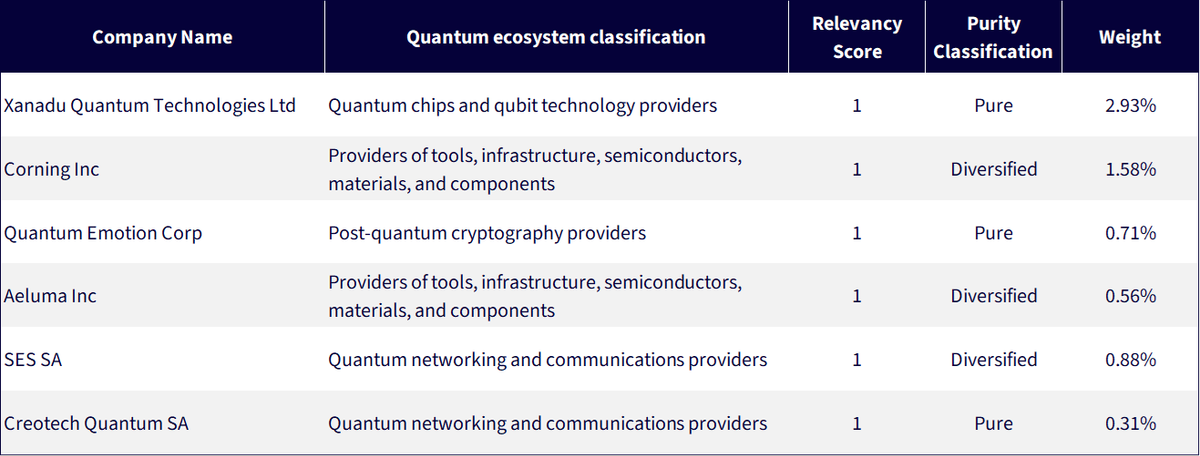
Xanadu as a Signal
This is a notable addition at 2.93%. It signals that photonic quantum computing is becoming a more explicit part of the portfolio’s quantum hardware thesis. The importance of diversification across qubit modalities is increasingly recognized even at the government level. In April 2026, the Defense Advanced Research Projects Agency (DARPA)2 launched its Heterogeneous Architectures for Quantum (HARQ) program, which draws a direct parallel to classical computing's multi-processor architecture, arguing that just as central processing units (CPUs), graphics processing units (GPUs), and application specific integrated circuits (ASICs) each serve distinct roles, future quantum systems will likely need to combine trapped ions, neutral atoms, superconducting qubits, and other modalities into integrated architectures rather than betting on a single technology.3
Photonic quantum computing is conceptually attractive because photons:
The practical challenge, as always in quantum, is turning an elegant physics concept into a reliable, manufacturable, fault-tolerant system. The WisdomTree Quantum Computing Fund’s (WQTM) rebalance does not need that outcome to be guaranteed, and as we sit in May 2026, it isn’t. It needs the public-market exposure to better represent the range of credible paths being pursued.
Figure 1: May 2026 Strategy Additions
Sources: WisdomTree, Bloomberg, FactSet and individual company websites and filings. Data is as of the May 2026 quarterly rebalance for the WisdomTree Classiq Quantum Computing Index. Holdings subject to change.
Pure Players: More Signal, but Still a Balanced Portfolio
Quantum pure players give investors the most direct sensitivity to the theme, but also the greatest volatility. Many are still pre-scale, research-heavy businesses. Revenue visibility can be limited, operating losses are common, and market prices can move more on technical milestones than on conventional earnings progression.
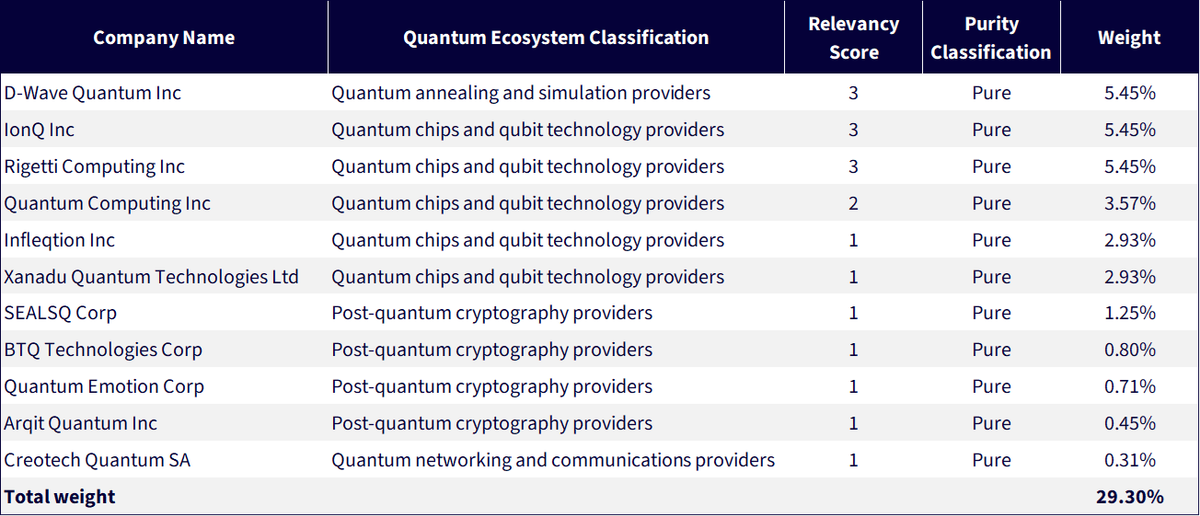
That is why we think that the pure-player block should be read as an exposure engine, not the entire portfolio. In Figure 2, D-Wave, IonQ and Rigetti remain the largest pure players at 5.45% each, Quantum Computing Inc. sits at 3.57%, and Infleqtion and Xanadu are each shown at 2.93%. This creates a portfolio that is meaningfully exposed to multiple qubit modalities rather than overly dependent on a single approach.
Figure 2: Overview of the Pure Players
Sources: WisdomTree, Bloomberg, FactSet and individual company websites and filings. Data is as of the May 2026 quarterly rebalance for the WisdomTree Classiq Quantum Computing Index. Holdings subject to change.
Not All Quantum Exposure Is the Same
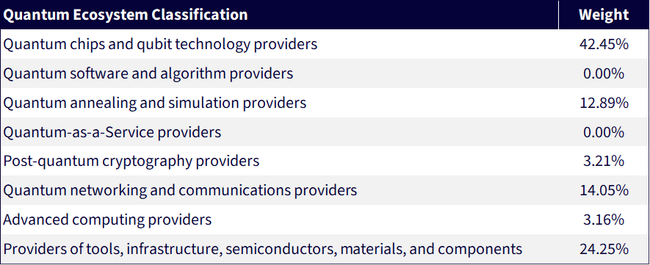
A diversified technology company with a quantum research effort is not the same as a pure-play quantum hardware company. A quantum-safe encryption provider is not the same as a trapped-ion developer. A satellite QKD company is not the same as a semiconductor materials supplier. WisdomTree’s quantum ecosystem breakdown helps clarify the portfolio’s center of gravity.
In Figure 3, we see:
One interesting feature is the zero weight in quantum software and algorithm providers and Quantum-as-a-Service providers. That should not be interpreted as a statement that software is unimportant, rather, it reflects how the index classifies companies by primary business activity. In practice, many of the hardware-focused names held in the portfolio are deeply involved in software as well. IBM, for example, developed Qiskit, one of the most widely used open-source quantum programming platforms in the world. IonQ, Quantinuum, and other hardware pure-plays similarly offer cloud access, SDKs, and algorithm libraries alongside their physical systems. The zero weight in dedicated software firms is a feature of the current public-market universe, not a signal about where value in the quantum stack ultimately resides.
Figure 3: Exposure by Specialized Quantum Function
Sources: WisdomTree, Bloomberg, FactSet and individual company websites and filings. Data is as of the May 2026 quarterly rebalance for the WisdomTree Classiq Quantum Computing Index. Holdings subject to change.
The Three Stories Embedded in the Rebalance
1. The Qubit Modality Race Is Still Open
The portfolio does not require knowing whether the winning path is trapped ions, superconducting qubits, photonics, neutral atoms, annealing or a hybrid architecture. At this stage, that humility is a feature. Quantum has not converged around a single technical architecture in the way classical computing converged around silicon complimentary metal-oxide semiconductors (CMOS). The rebalance therefore keeps exposure to several credible modalities and lets progress, not prediction, determine the next set of winners.
2. Quantum Readiness Is Becoming a Commercial Theme Before Fault Tolerance Arrives
The market often focuses on the dream of a fully fault-tolerant quantum computer. That is understandable, but it may miss the nearer-term business pressure. Organizations do not need to wait for Q Day to begin preparing for quantum-safe encryption. NIST’s finalized post-quantum standards create a concrete migration framework, and “harvest-now, decrypt-later” risk makes the timeline relevant today rather than only after quantum machines are mature.
3. Quantum Infrastructure Extends Beyond the Chip
The additions of Corning and SES, alongside names such as Creotech and Quantum Emotion, emphasize that quantum is also a networking, materials, timing, photonics and security infrastructure theme. The chip may attract the most attention, but the system has to be controlled, connected, protected and scaled. The same investor mistake repeats across technology cycles: focusing only on the glamorous endpoint and ignoring the less visible infrastructure that allows it to function.
The 2026 Horizon: Milestones Before Mass Commercialization
One risk in quantum investing is demanding AI-like monetization from a technology that is not yet in the same commercial phase. We think that is the wrong yardstick. Quantum should be evaluated by milestone density, ecosystem expansion, public-market availability, funding momentum, standards adoption and evidence that technical roadmaps are becoming more credible.
In that sense, this is not a portfolio built only for the day quantum computing becomes fully mainstream. It is a portfolio built for the transition period, and we think of that as the years in which the market begins to price the possibility that quantum moves from laboratory breakthrough to strategic capability. The investable opportunity is likely to arrive in waves:
The rebalance therefore tells a disciplined story. It raises exposure to a newly public photonic quantum pure player. It retains the largest public pure-play quantum hardware names. It keeps diversified technology and infrastructure providers in the portfolio. It acknowledges that software matters, continuing to evaluate the publicly-listed players. And it positions quantum-safe security and communications as part of the opportunity set, not as an afterthought.
Conclusion: Invest in the Stack, Not the Hype
Quantum computing is still early. That is not a weakness of the theme; it is the definition of the opportunity and the source of the risk. The most important mistake would be to treat quantum as one company, one architecture or one catalyst. The better framing is that quantum is becoming an ecosystem.
The May 2026 rebalance reflects that ecosystem view. It recognizes the pure players pushing the frontier, the diversified firms funding the infrastructure, the security providers preparing for a post-quantum world and the enabling companies supplying materials, photonics, communications and components. If quantum succeeds, it will not be because one stock was interesting. It will be because a full stack became investable.
1 Qubit modality = the type of technology used to build quantum bits (qubits), such as superconducting circuits, trapped ions or photons; error correction = methods used to detect and fix mistakes caused by noise and instability in quantum systems; coherence = the amount of time a qubit can maintain its quantum state before information is lost; photonic interconnects = light-based connections that transfer quantum information between chips or systems; control systems = the hardware and software that manage, calibrate and operate quantum computers; cryogenics = ultra-low-temperature cooling systems required for many quantum computers to function properly; quantum-safe encryption = cybersecurity methods designed to remain secure against future quantum computing attacks; quantum networking = technologies that allow quantum computers and devices to communicate with one another.
2 The Defense Advanced Research Projects Agency (DARPA) is a research and development agency of the United States Department of Defense responsible for the development of emerging technologies for use by the military.
3 Source: Defense Advanced Research Projects Agency. (2026, April 14). For quantum computing, different qubits are better together. DARPA.
There are risks associated with investing, including possible loss of principal. Growth stocks, as a group, may be out of favor with the market and underperform value stocks or the overall equity market. Growth stocks are generally more sensitive to market movements than other types of stocks. The Fund is non-diversified, as a result, changes in the market value of a single security could cause greater fluctuations in the value of Fund shares than would occur in a diversified fund. The Fund invests in the securities included in, or representative of, its Index regardless of their investment merit and the Fund does not attempt to outperform its Index. The composition of the Index is governed by an Index Committee and the Index may not perform as intended. Please read the Fund’s prospectus for specific details regarding the Fund’s risk profile.
Quantum Computing Fund

Global Head of Research
Christopher Gannatti began at WisdomTree as a Research Analyst in December 2010, working directly with Jeremy Schwartz, CFA®, Director of Research. In January of 2014, he was promoted to Associate Director of Research where he was responsible to lead different groups of analysts and strategists within the broader Research team at WisdomTree. In February of 2018, Christopher was promoted to Head of Research, Europe, where he was based out of WisdomTree’s London office and was responsible for the full WisdomTree research effort within the European market, as well as supporting the UCITs platform globally. In November 2021, Christopher was promoted to Global Head of Research, now responsible for numerous communications on investment strategy globally, particularly in the thematic equity space. Christopher came to WisdomTree from Lord Abbett, where he worked for four and a half years as a Regional Consultant. He received his MBA in Quantitative Finance, Accounting, and Economics from NYU’s Stern School of Business in 2010, and he received his bachelor’s degree from Colgate University in Economics in 2006. Christopher is a holder of the Chartered Financial Analyst Designation.

Associate Director, Quantitative Research
Elvira has been a member of the WisdomTree Research team since September 2018. With over nine years of experience in the ETF and asset management industry and an academic background in quantitative finance, Elvira combines technical expertise with thematic strategy insights to contribute to thought leadership research and the development of new innovative strategies at WisdomTree. As a lead specialist in thematic strategies, she supports the periodic review and rebalancing of thematic portfolios, delivers quantitative insights, bespoke analysis for clients, strategic thought pieces as well as commentary on market trends and thematic strategies. She also develops comprehensive product collateral designed to support client needs.
