
WQTM
Quantum Computing Fund

Published April 20, 2026

Global Head of Research
Until recently, I wasn’t paying much attention to World Quantum Day, which occurs on April 14.1
Not because quantum computing isn't important. Quite the opposite. The field has long felt early, fragmented and difficult to track in any practical sense. For most investors, it has lived somewhere between scientific curiosity and long-term optionality, rather than something tied to real-time market signals.
But that may be starting to change.
World Quantum Day was established in 2021 by a cohort of scientists and is observed every April 14th to promote awareness and progress in quantum science. In its early years, the day was largely ceremonial, with academic institutions, research labs, and policymakers using it to highlight developments in a field still finding its footing.
In 2026, the tone was different. What stood out wasn’t just enthusiasm around the technology but rather tangible corporate announcements with measurable market reactions attached to them.
We find this particularly noteworthy because emerging technologies go through a transition where progress shifts from theoretical breakthroughs to observable, incremental milestones. Markets often start reacting during those transitions, well before the end state is understood. World Quantum Day 2026 offered a clear glimpse into what that transition could look like for quantum computing.
IonQ linked two separate quantum computers — and the stock jumped 18%.2
IonQ announced what it called a "foundational technical milestone": the ability to connect two physically separate quantum computers. That may sound incremental, but it points toward a much larger ambition. Today's quantum systems mostly operate in isolation, which limits their scale and practical utility. Connecting them opens the door to distributed quantum computing, which, put simply, means networks of machines working in concert and, over time, something resembling a quantum internet.
The underlying science relies on photonic interconnects, using photons to transmit quantum information between systems. This has been an active research area for years. What IonQ demonstrated wasn’t a new theory, but real progress toward implementing that theory at the system level.3
The market noticed, and we saw IonQ's stock surge roughly 18% on the announcement.4 To us, the signal is not whether the shares hold that gain, but rather that investors are following World Quantum Day quite clearly.
Nvidia unveiled what it described as the world’s first family of open-source models designed to support quantum computing development. Rather than building quantum hardware, Nvidia focused on the surrounding ecosystem: improving how quantum systems are calibrated, controlled, and optimized.
This matters more than it might seem. One of the underappreciated challenges in quantum computing isn’t just building qubits but managing noise, errors and system instability. Nvidia's models are aimed squarely at those problems, positioning the company as a provider of the infrastructure layer that could make quantum systems actually usable.5
Nvidia's stock rose modestly on the day, but the strategic signal was clear. To us, this is not surprising, as IonQ’s primary business is in quantum computing, whereas Nvidia’s primary business and overall market capitalization is quite different.
Beyond these two, the broader quantum ecosystem moved as well. Rigetti and D-Wave both posted meaningful gains, suggesting that investor attention is spreading across the space rather than clustering around a single headline.6
Quantum computing remains one of the most complex areas in technology. The engineering challenges are real, particularly around scaling to larger, more useful systems. Progress tends to arrive in incremental steps, and the research into modular quantum architectures makes clear just how difficult it is to connect quantum systems efficiently and reliably. These problems are unlikely to resolve overnight.
That complexity shows up directly in market behavior. The space is volatile. News, whether good or bad, may produce sharp reactions, and outcomes across individual companies can vary widely. Timelines are also uncertain, and the path to commercialization may not be linear, measured at least relative to where the space is today.
But that is often exactly what can create opportunity. Technologies that are difficult to understand and slow to mature can also be the ones where early positioning matters most.
At WisdomTree, our approach to quantum computing, with the WisdomTree Quantum Computing Fund (WQTM), reflects that balance. Rather than trying to pick a single winner, the strategy is built to generate exposure across the ecosystem, capturing the range of companies contributing to advancement across the stack.
That includes firms developing quantum hardware, companies enabling progress through adjacent technologies like semiconductors, photonics, and high-performance computing, and businesses working on the software and infrastructure layers that will be essential for quantum systems to function at scale.
The logic is straightforward: in a field where the end state is still evolving, diversification across the innovation stack provides more consistent exposure to progress as it unfolds. Even so, we also believe it is important to see higher exposures in the more pure-play companies, like IonQ, D-Wave, and Rigetti, that show the capacity to respond when developments like what we saw at World Quantum Day 2026 occur. Figure 1 shows the top 20 positions in WQTM to emphasize the balance between diversified, yet still important companies alongside these more ‘pure quantum players.’
Notably, these weights are shown as of the market’s close the day before World Quantum Day 2026.
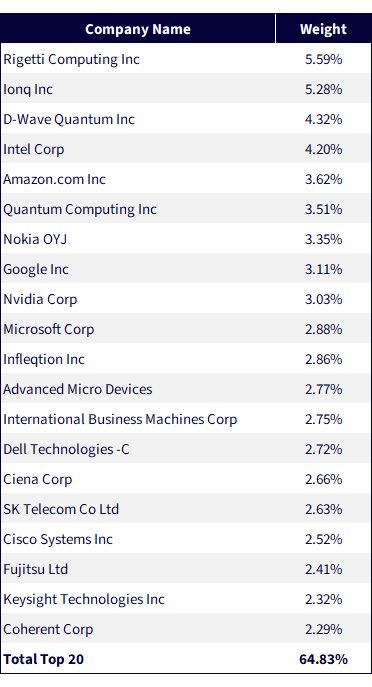
Source: WisdomTree, with data as of April 13, 2026. Holdings subject to change.
Quantum computing is still early. It’s deeply technical, highly specialized and at times genuinely difficult to interpret from an investment perspective.
But the signals are starting to emerge. Progress is becoming more visible. Milestones are becoming more tangible. Markets are starting to respond.
The key takeaway from World Quantum Day 2026 isn't that quantum computing has arrived. It's that the transition is underway, and some of the companies actively moving it forward are becoming easier to identify, at least in our opinion.
For investors following the space, that's the part worth paying close attention to.
There are risks associated with investing, including potential loss of principal. To the extent the Fund invests a significant portion of its assets in the securities of companies of a single country or region, it is more likely to be impacted by events or conditions affecting that country or region. The economic, political, regulatory, and other events and conditions that affect issuers and investments in the United States differ significantly from those associated with other countries and regions. U.S. financial markets have become increasingly globalized becoming more integrated with financial markets around the world and as a result, U.S. financial markets are increasingly vulnerable to the risks that may affect non-U.S. financial markets. The Fund’s investments in the U.S. are subject to the risk that they, and the U.S. economy more generally, will be adversely affected by a decrease in imports or exports, changes in trade regulations, inflation, and/or an economic recession in the U.S. The Fund invests primarily in the securities of quantum computing companies. Companies engaged in the development of quantum computing or machine learning technology may be significantly impacted by rapid technological advancements, product obsolescence, intense competition, consumer demand, and government regulation. Such companies are also heavily dependent upon patent and intellectual property rights. The Fund invests in the securities included in, or representative of, its Index regardless of their investment merit and the Fund does not attempt to outperform its Index. The composition of the Index is governed by an Index Committee and the Index may not perform as intended. Please read the Fund's prospectus for specific details regarding the Fund's risk profile.
Quantum Computing Fund

Global Head of Research
Christopher Gannatti began at WisdomTree as a Research Analyst in December 2010, working directly with Jeremy Schwartz, CFA®, Director of Research. In January of 2014, he was promoted to Associate Director of Research where he was responsible to lead different groups of analysts and strategists within the broader Research team at WisdomTree. In February of 2018, Christopher was promoted to Head of Research, Europe, where he was based out of WisdomTree’s London office and was responsible for the full WisdomTree research effort within the European market, as well as supporting the UCITs platform globally. In November 2021, Christopher was promoted to Global Head of Research, now responsible for numerous communications on investment strategy globally, particularly in the thematic equity space. Christopher came to WisdomTree from Lord Abbett, where he worked for four and a half years as a Regional Consultant. He received his MBA in Quantitative Finance, Accounting, and Economics from NYU’s Stern School of Business in 2010, and he received his bachelor’s degree from Colgate University in Economics in 2006. Christopher is a holder of the Chartered Financial Analyst Designation.
