
WQTM
Quantum Computing Fund

Published May 14, 2026

Global Head of Research

Director of Market Strategy
Let's start with the concept, because confusion here can be real and consequential.
Classical computers, specifically the kind in your phone, laptop, and every data center on earth, process information as bits. Each bit is either a 0 or a 1. Everything from a spreadsheet to a streaming video ultimately reduces to long strings of binary decisions, meaning they can all be represented by a strong, sometimes quite a long string, of 1’s and 0’s.
Quantum computers work differently. They use quantum bits, or qubits, which exploit the principles of quantum mechanics to exist in multiple states simultaneously, a property called superposition. They can also become entangled with one another, meaning the state of one qubit is instantly correlated with another, no matter the distance. These properties allow quantum systems to process certain types of calculations in ways that would take classical computers an impossibly long time to complete.
The key phrase there is certain types of calculations, and this deserves repeating.
Quantum computers are not simply faster classical computers. They are fundamentally different tools, suited to a narrow but potentially transformative class of problems:
For most computing tasks that we interact with daily, such as running a website, streaming a movie, or sending an email, quantum hardware offers no advantage whatsoever.
This distinction will matter enormously for investors. Quantum computing is not replacing the cloud. It is not replacing your laptop. It is being developed as a specialized capability that, when it matures, will be layered on top of the classical infrastructure we already have.
Here is the part of the quantum story that most coverage glosses over:
Quantum computers cannot function without classical computing infrastructure, and at the heart of that infrastructure are semiconductors.
Consider what it takes to run a quantum processor. Depending on the specific qubit modality, the qubits themselves may operate at temperatures near absolute zero, colder than deep space, requiring sophisticated cryogenic systems.1
In other words, the quantum future runs on a classical foundation. Semiconductors are not the old world being displaced by the new one. They are the substrate on which the new world is being built.
This is why the framing of semiconductors versus quantum computing can risk missing the point. The more accurate picture is semiconductors and quantum computing, with the classical layer providing the scaffolding that makes quantum systems possible, practical, and eventually scalable.
With that conceptual grounding in place, the ETF conversation becomes more interesting, and more precise.
On the quantum side:
Those descriptions are important, but we find it particularly impactful to immediately review the top 10 constituents of each strategy alongside them. This is the translation that effectively shows the major positions that these methodologies lead to when applied to their appropriate eligible universes. In Figure 1:
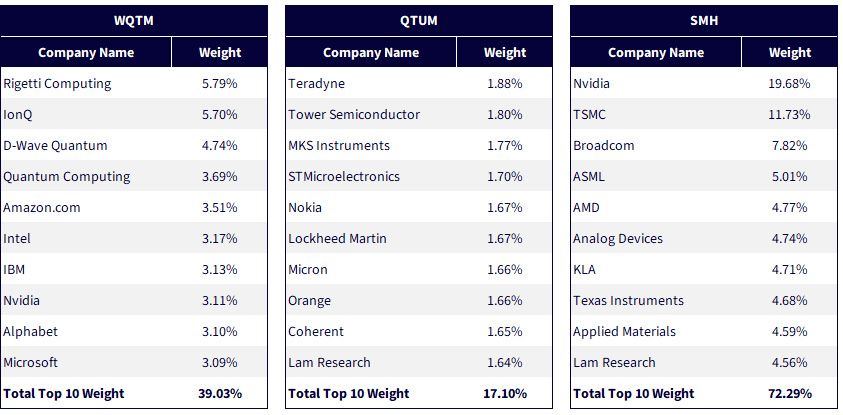
Sources: WisdomTree, Morningstar, FactSet, with data as of 3/31/2026 and source from WisdomTree’s Fund Comparison Tool within the PATH Suite of Tools. Subject to change.
WQTM only began its history October 9, 2025, an admittedly short track record. Figure 2a therefore only looks at a few relatively shorter periods even if Figure 2b does present the standardize performance picture as of March 31, 2026.
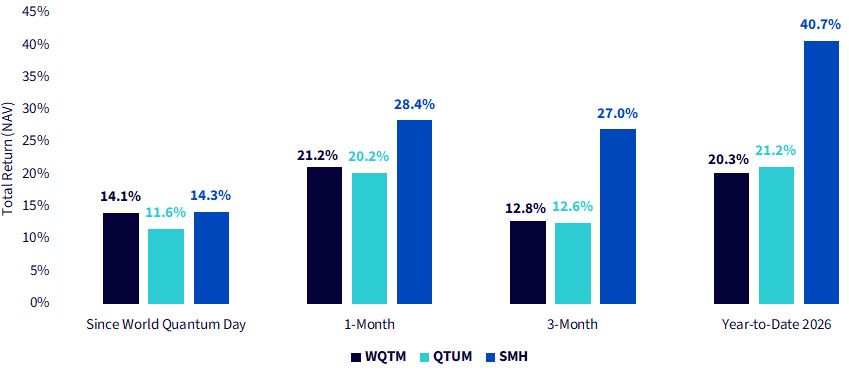
Figure 2b: Standardized Performance
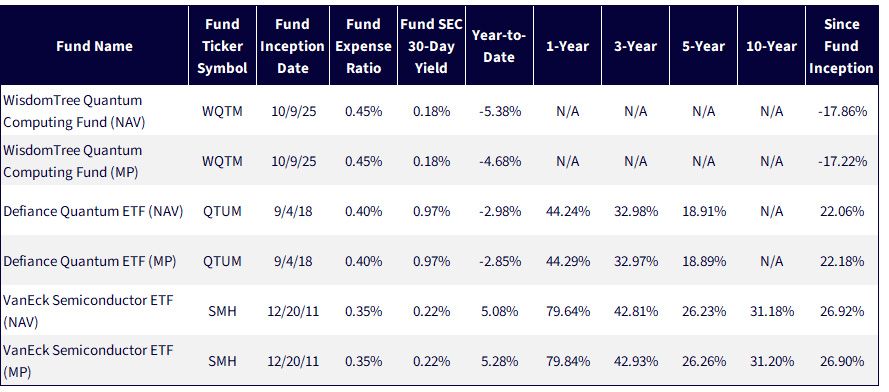
Sources: WisdomTree, FactSet and Morningstar, with data accessed on April 27, 2026 from the Fund Compare Tool within the broader set of PATH tools. Since World Quantum Day references since the close of April 13, 2026 to April 24, 2026. Each other period references that period, as of April 24, 2026. NAV denotes total return performance at net asset value. MP denotes market price performance. Past performance is not indicative of future results. Investment return and principal value of an investment will fluctuate so that an investor’s shares, when redeemed, may be worth more or less than their original cost. Current performance may be lower or higher than the performance data quoted. For the most recent month-end and standardized performance, click the relevant ticker: WQTM, QTUM, SMH.
For investors thinking seriously about combining quantum computing exposure with a core semiconductor holding, the pairing question deserves more than a cursory glance at ticker names. On three dimensions that matter, purity of quantum exposure, degree of overlap with SMH, and historical correlation of returns, WQTM presents a more compelling complement to SMH than QTUM does. Its top holdings are dominated by pure-play quantum companies, its construction methodology tilts deliberately toward quantum centrality rather than adjacency, and its return history has tracked SMH less closely than QTUM's broader, more semiconductor-infused portfolio.11
None of that is a guarantee of anything going forward. Correlation regimes shift, pure-play companies carry their own concentration risks, and the quantum timeline remains genuinely uncertain.
But for an investor who believes the future of computing is being built at the intersection of classical and quantum architecture and wants a portfolio that reflects both sides of that thesis, a thoughtful blend of SMH and WQTM may be worth the consideration.
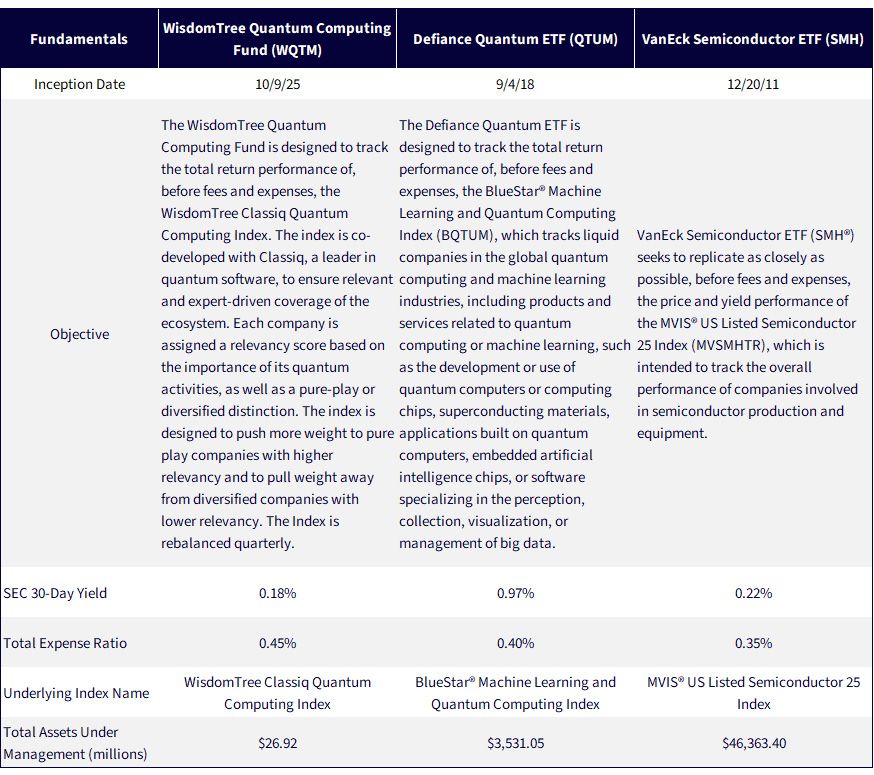
Sources: WisdomTree, Morningstar, FactSet and specific fund sponsor websites. AUM data is as of 3/31/2026. Subject to change.
Source: Aamir, M. A., Jamet Suria, P., Marín Guzmán, J. A., et al. (2025). Thermally driven quantum refrigerator autonomously resets a superconducting qubit. Nature Physics.
Source: Maurya, S., et al. (2024). Managing classical processing requirements for quantum error correction. arXiv.
As of March 31, 2026, SMH had assets under management of greater than $46.3 billion. WisdomTree maintains a thematic classification of all U.S. listed thematic ETFs. Semiconductors are a theme and SMH is the largest strategy within that theme. The sources of the AUM are Morningstar and Factset.
Source: MarketVector Indexes GmbH. (2026, February). MVIS® US Listed Semiconductor 25 Index: Index guide (Version 1.03).
As of March 31, 2026, SMH had assets under management of greater than $3.5 billion. WisdomTree maintains a thematic classification of all U.S. listed thematic ETFs. Quantum Computing is a theme and QTUM is the largest strategy within that theme. The sources for the AUM are Morningstar and Factset.
GPU stands for Graphics Processing Unit, FPGA stands for Field Programmable Gate Array, and ASIC stands for Application Specific Integrated Circuit. These are 3 distinct specific types of semiconductors.
Source: MarketVector Indexes GmbH. (2025, January). BlueStar® Machine Learning and Quantum Computing Index: Index guide (Version 1.02).
Source: World Quantum Day. (2022). Why April 14. World Quantum Day is scheduled for April 14th each year, with 2026’s date being 4/14/2026.
Source: IonQ. (2026, April 14). IonQ achieves key photonic interconnect milestone, demonstrating networked quantum systems using entanglement.
Source: Warrick, J. (2026, April 15). Quantum computing stocks: Why are D-Wave, IonQ rising again? Fast Company.
Data references as of March 31, 2026, sourced from WisdomTree, Morningstar and Factset through the Fund Compare Tool within WisdomTree’s broader set of PATH tools. Holdings and correlation of returns are subject to change.
All funds are managed differently and do not react the same to economic or market events. The investment objectives, strategies, policies or restrictions of other funds may differ and more information can be found in their respective prospectuses. Therefore, we generally do not believe it is possible to make direct fund to fund comparisons in an effort to highlight the benefits of a fund versus another similarly managed fund.
WQTM: There are risks associated with investing, including potential loss of principal. To the extent the Fund invests a significant portion of its assets in the securities of companies of a single country or region, it is more likely to be impacted by events or conditions affecting that country or region. The economic, political, regulatory, and other events and conditions that affect issuers and investments in the United States differ significantly from those associated with other countries and regions. U.S. financial markets have become increasingly globalized becoming more integrated with financial markets around the world and as a result, U.S. financial markets are increasingly vulnerable to the risks that may affect non-U.S. financial markets. The Fund’s investments in the U.S. are subject to the risk that they, and the U.S. economy more generally, will be adversely affected by a decrease in imports or exports, changes in trade regulations, inflation, and/or an economic recession in the U.S. The Fund invests primarily in the securities of quantum computing companies. Companies engaged in the development of quantum computing or machine learning technology may be significantly impacted by rapid technological advancements, product obsolescence, intense competition, consumer demand, and government regulation. Such companies are also heavily dependent upon patent and intellectual property rights. The Fund invests in the securities included in, or representative of, its Index regardless of their investment merit and the Fund does not attempt to outperform its Index. The composition of the Index is governed by an Index Committee and the Index may not perform as intended. Please read the Fund's prospectus for specific details regarding the Fund's risk profile.
For additional fund disclosures, click the respective ticker: QTUM, SMH.
Quantum Computing Fund

Global Head of Research
Christopher Gannatti began at WisdomTree as a Research Analyst in December 2010, working directly with Jeremy Schwartz, CFA®, Director of Research. In January of 2014, he was promoted to Associate Director of Research where he was responsible to lead different groups of analysts and strategists within the broader Research team at WisdomTree. In February of 2018, Christopher was promoted to Head of Research, Europe, where he was based out of WisdomTree’s London office and was responsible for the full WisdomTree research effort within the European market, as well as supporting the UCITs platform globally. In November 2021, Christopher was promoted to Global Head of Research, now responsible for numerous communications on investment strategy globally, particularly in the thematic equity space. Christopher came to WisdomTree from Lord Abbett, where he worked for four and a half years as a Regional Consultant. He received his MBA in Quantitative Finance, Accounting, and Economics from NYU’s Stern School of Business in 2010, and he received his bachelor’s degree from Colgate University in Economics in 2006. Christopher is a holder of the Chartered Financial Analyst Designation.

Director of Market Strategy
Jonathan Flynn serves as Director of Market Strategy at WisdomTree, helping bridge research, product strategy, distribution and investor engagement through data-driven market insights and thematic storytelling.
He brings more than 25 years of experience working with leading wealth management teams and advisors, with deep expertise in investor behavior, ETF trends, market flows and behavioral finance. Jonathan specializes in identifying emerging themes early, translating complex ideas into compelling investment narratives and helping investors better understand the intersection of sentiment, positioning and long-term opportunity.
His work is grounded in the belief that understanding investor behavior and crowd dynamics can help uncover tomorrow’s investment opportunities before they become consensus.
