
WQTM
Quantum Computing Fund

Published May 27, 2026

Global Head of Research
Something notable happened on May 21, 2026.
The U.S. Commerce Department announced it would award $2 billion in grants to nine quantum-computing companies, and take a minority equity stake in each one in return.1
This was not a research grant program. It was not a procurement contract. The federal government is now, structurally speaking, a venture investor in the quantum computing sector.
For investors watching the quantum space, that distinction matters.
Skin in the Game: How Washington Changed Its Relationship with Quantum
The structure of this deal breaks from how Washington has historically supported emerging technology. Traditional government support through such actions and programs as DARPA contracts, NSF grants, and SBIR awards2 keeps the government at arm's length from commercial outcomes.
In these approaches, the agency funds the work; the private sector keeps the upside.
What the Commerce Department announced is different. By taking equity stakes across nine firms, the government is now a stakeholder in their commercial success. That changes the nature of the relationship. A senior Commerce Department official acknowledged the agency spread its bets deliberately across nine companies, recognizing it could take years for any of them to deliver, a framing that sounds less like a bureaucratic grant office and more like a portfolio manager.3
Commerce Secretary Howard Lutnick, announcing the awards, described the initiative as leading the world into a new era of American innovation. The funding itself comes from the 2022 CHIPS and Science Act, specifically provisions covering earlier-stage technology projects. But the equity component is the Trump administration's own addition, which is a deliberate policy choice to treat quantum not merely as a public good to be funded, but as a strategic asset in which the government intends to participate financially.
This follows the same playbook used in August 2025 with Intel, when the administration converted a portion of that company's CHIPS Act award into an approximately 10% equity stake worth roughly $8.9 billion.4 The Intel precedent established the template. The quantum announcement is the template being applied at scale, across an entire industry segment simultaneously.
The Anderon Foundry: Infrastructure as Investment
The IBM award deserves special attention, and not just for its size ($1 billion, fully half the program), but for what it produces. Alongside the grant, IBM and the Commerce Department jointly announced the creation of Anderon, a quantum chip foundry to be based in Albany, New York. IBM will contribute an additional $1 billion of its own, with this in cash, intellectual property, assets, and talent, into the venture.5
Anderon will operate a 300-millimeter quantum wafer foundry, targeting the chip-level manufacturing infrastructure that the broader quantum ecosystem depends on. This is a meaningful structural development. One of the persistent challenges in quantum computing has been that hardware fabrication requires specialized facilities that very few organizations have built. Anderon is designed to close that gap domestically, reducing reliance on foreign manufacturing for quantum components, notably the same supply chain logic that motivated the CHIPS Act for conventional semiconductors.
IBM Chief Executive Arvind Krishna, speaking at IBM Think 2026 in early May, delivered perhaps the clearest statement yet from a major quantum CEO on the question of timing.6
"We believe quantum advantage will be reached this year," Krishna told the audience. "That's not 20 years away. That's not 10 years away. That's within this year. The gap is closing faster than most people realize or appreciate."
He went further, positioning quantum not as a successor to AI but as its complement, where AI predicts, and quantum computes. For investors who have grown accustomed to quantum being perpetually deferred, that framing from the CEO of the company receiving half of the government's $2 billion commitment carries real weight.
The Nine Recipients: A Portfolio Across Approaches
The government's selection spans the technology landscape of quantum computing, including superconducting systems, trapped ions, photonic architectures, neutral atoms, and silicon spin qubits, as well as the manufacturing supply chain. Five of the nine are publicly traded; four remain private. The table below summarizes the known terms, as reported by the Wall Street Journal.
Figure 1: The Nine Quantum Companies
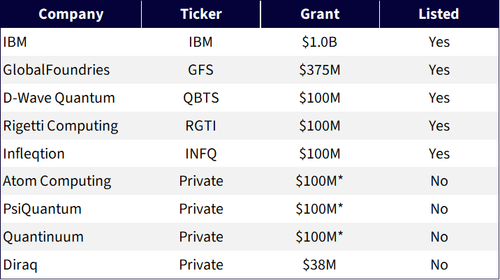
Source: Ramkumar, A., & Somerville, H. (2026, May 21). U.S. to award quantum-computing firms $2 billion and take equity stakes. The Wall Street Journal. *Grant amounts for Atom Computing, PsiQuantum, and Quantinuum not individually confirmed; WSJ reported remaining firms expected to receive $100M each. All equity stakes confirmed as minority positions; specific percentages not disclosed by the Commerce Department. Deals still subject to completion.
What the Signal Means for Investors
Government equity investment in a sector is a different kind of signal than government funding.
That signal has practical implications. These nine companies now have a stakeholder whose interests extend well beyond financial return, one with procurement power, regulatory influence, and a national security mandate. Priority use cases, intellectual property (IP) licensing decisions, and export controls all become areas where the government's new ownership position could shape outcomes. That is not necessarily negative for other investors, but it is a material change in the governance environment around these companies.
For equity investors, the more immediate question is what this says about the sector's maturation trajectory. The administration's own framing, which is to say spreading bets across approaches, and acknowledging a multi-year horizon, reflects a sophisticated understanding that quantum is not a single-winner technology race. Different qubit architectures may prove better suited to different problem types.
The government is not placing one bet; it is buying exposure to the field.
Conclusion: How Does This Relate to Quantum Computing ETFs
Importantly, we should note that while the government announcement is an important signal, it is still just a signpost on the journey from where we are today as we get closer and closer to fully fault-tolerant, gate-based machines. Government investment alone does not guarantee any of the engineering challenges are now solved immediately.
However, it does bring attention to the space. For those looking, the Defiance Quantum ETF (QTUM) is the largest on the basis of assets under management. We find that we learn a lot by looking under the hood at the exposure of QTUM against the WisdomTree Quantum Computing Fund (WQTM).
While it’s important to properly describe methodology and note that complete documents certainly exist for people to review further, we think the translation from reading words to looking at the top 20 holdings can say a lot more.
In Figure 2:
Figure 2: Comparison of Top 20 Positions
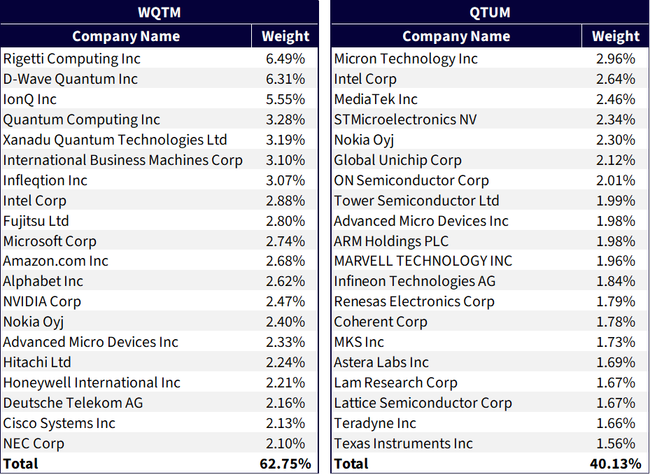
Sources: WisdomTree & Defiance, specifically the fund pages where holdings were available as of May 26, 2026. Subject to change.
If people are looking to generate exposure not to broad technology but rather to specific quantum computing, we believe that looking under the hood in this way is very important.
Figure 3: Additional Information
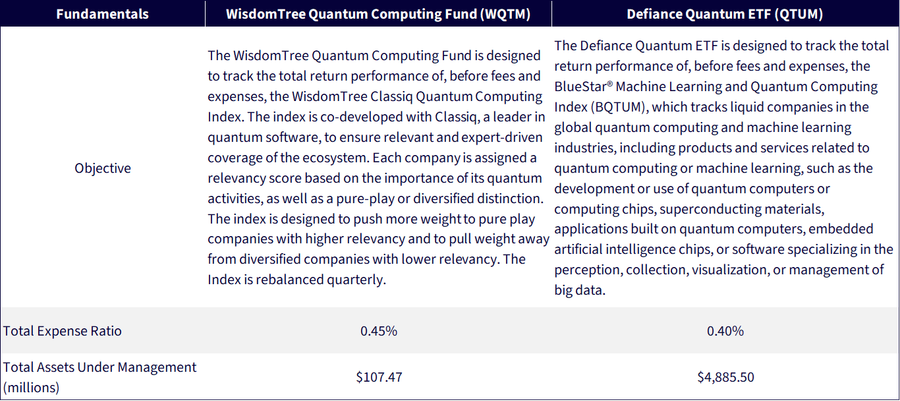
Sources: WisdomTree & Defiance, with information sourced from respective fund pages and assets under management as of May 20, 2026. QTUM was selected for comparison because it is among the largest ETFs providing exposure to quantum computing-related companies and is commonly referenced by investors seeking access to the theme. Subject to change.
1 Source: Ramkumar, A., & Somerville, H. (2026, May 21). U.S. to award quantum-computing firms $2 billion and take equity stakes. The Wall Street Journal.
2 DARPA — Defense Advanced Research Projects Agency; NSF — National Science Foundation; SBIR — Small Business Innovation Research (program)
3 Source: Ramkumar, A., & Somerville, H. (2026, May 21). U.S. to award quantum-computing firms $2 billion and take equity stakes. The Wall Street Journal.
4 Source: Intel Corporation. (2025, August 22). Form 8-K (Exhibit 99.1). U.S. Securities and Exchange Commission.
5 Source: IBM. (2026, May 21). IBM and U.S. Department of Commerce announce America's first purpose-built quantum foundry, supported by proposed $1 billion CHIPS award. IBM Newsroom.
6 Source: Krishna, A. (2026, May). IBM Think 2026 keynote address. IBM Think 2026, Boston, MA.
All funds are managed differently and do not react the same to economic or market events. The investment objectives, strategies, policies or restrictions of other funds may differ and more information can be found in their respective prospectuses. Therefore, we generally do not believe it is possible to make direct fund to fund comparisons in an effort to highlight the benefits of a fund versus another similarly managed fund.
WQTM: There are risks associated with investing, including potential loss of principal. To the extent the Fund invests a significant portion of its assets in the securities of companies of a single country or region, it is more likely to be impacted by events or conditions affecting that country or region. The economic, political, regulatory, and other events and conditions that affect issuers and investments in the United States differ significantly from those associated with other countries and regions. U.S. financial markets have become increasingly globalized becoming more integrated with financial markets around the world and as a result, U.S. financial markets are increasingly vulnerable to the risks that may affect non-U.S. financial markets. The Fund’s investments in the U.S. are subject to the risk that they, and the U.S. economy more generally, will be adversely affected by a decrease in imports or exports, changes in trade regulations, inflation, and/or an economic recession in the U.S. The Fund invests primarily in the securities of quantum computing companies. Companies engaged in the development of quantum computing or machine learning technology may be significantly impacted by rapid technological advancements, product obsolescence, intense competition, consumer demand, and government regulation. Such companies are also heavily dependent upon patent and intellectual property rights. The Fund invests in the securities included in, or representative of, its Index regardless of their investment merit and the Fund does not attempt to outperform its Index. The composition of the Index is governed by an Index Committee and the Index may not perform as intended. Please read the Fund's prospectus for specific details regarding the Fund's risk profile.
For QTUM’s risk disclosures, please click here.
Quantum Computing Fund

Global Head of Research
Christopher Gannatti began at WisdomTree as a Research Analyst in December 2010, working directly with Jeremy Schwartz, CFA®, Director of Research. In January of 2014, he was promoted to Associate Director of Research where he was responsible to lead different groups of analysts and strategists within the broader Research team at WisdomTree. In February of 2018, Christopher was promoted to Head of Research, Europe, where he was based out of WisdomTree’s London office and was responsible for the full WisdomTree research effort within the European market, as well as supporting the UCITs platform globally. In November 2021, Christopher was promoted to Global Head of Research, now responsible for numerous communications on investment strategy globally, particularly in the thematic equity space. Christopher came to WisdomTree from Lord Abbett, where he worked for four and a half years as a Regional Consultant. He received his MBA in Quantitative Finance, Accounting, and Economics from NYU’s Stern School of Business in 2010, and he received his bachelor’s degree from Colgate University in Economics in 2006. Christopher is a holder of the Chartered Financial Analyst Designation.

