


The New Rates Regime Is a Value Regime
Published May 17, 2022

Jeff Weniger, CFA
Head of Equity Strategy
We have heard a thousand times that a stock is worth the present value of its future cash flows. But I think no other period in my career has witnessed this concept become so important in the stock market’s calculus as this one.
“High growth stocks such as tech have been pummeled this year as a result of traders adjusting for the higher interest rate environment…”1
I pulled that from the first article I found in a Google search for the keywords “interest rates growth stocks.”
Rest assured, a sentence like it appears in just about every other daily write-up that discusses the day’s market action.
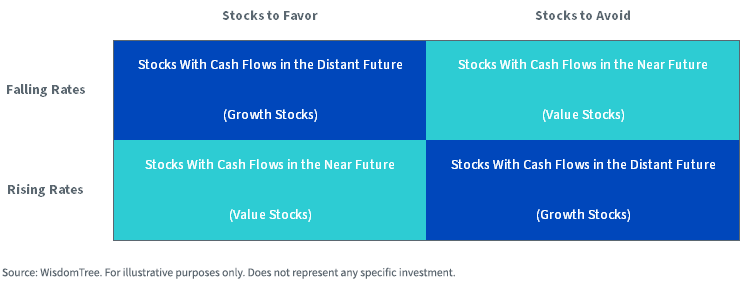
The S&P 500 Growth Index is down 25% in 2022, a loss far more harrowing than the 8% decline in the S&P 500 Value Index. In the market’s eyes, the primary driver of the performance disparity is the big spike in yields: the 10-Year Treasury note yield has run to 2.82% from 1.50% at 2021’s close.
Figure 1 shows the market’s general reaction.
Figure 1: Growth vs. Value with Interest Rate Moves
Take two hypothetical companies: ValueCo and GrowthCo.
The former pays a steady dividend, while the latter has no dividend but offers the prospect of a promising future, with rewards that may arrive down the road.
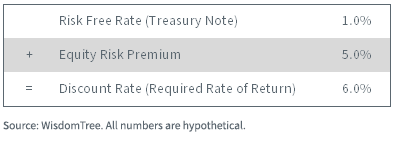
Consider how we produce a fair stock price for ValueCo. For a chunk of last year, the prevailing default risk-free Treasury yield was around 1%. Add an equity risk premium to it—we will go with 5%—and we can discount ValueCo’s cash flows at 6%.
Figure 2: Discount Rate on ValueCo
Keep it simple. Suppose we anticipate ValueCo will pay a $1 dividend each year to 2033, at which point the firm will be liquidated for $10/share. At that discount rate—6%—our “model” says ValueCo should trade for $13.63 right now.
Figure 3: Valuing ValueCo, 6% Discount Rate
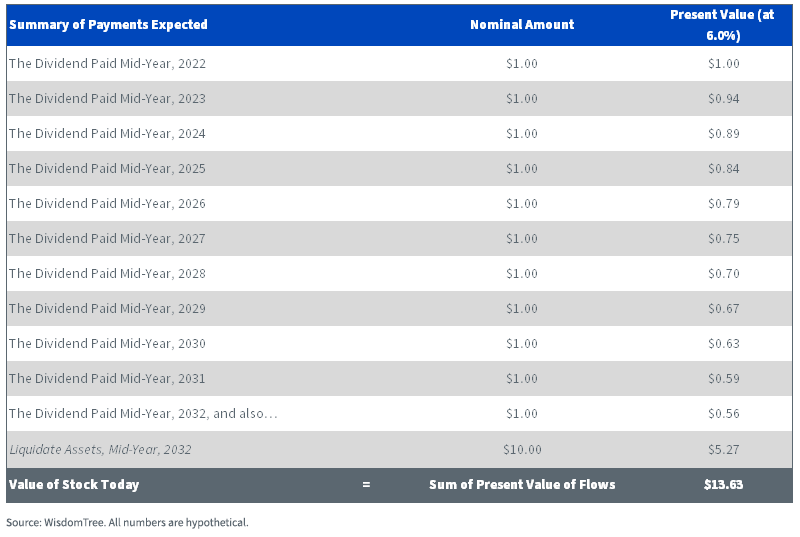
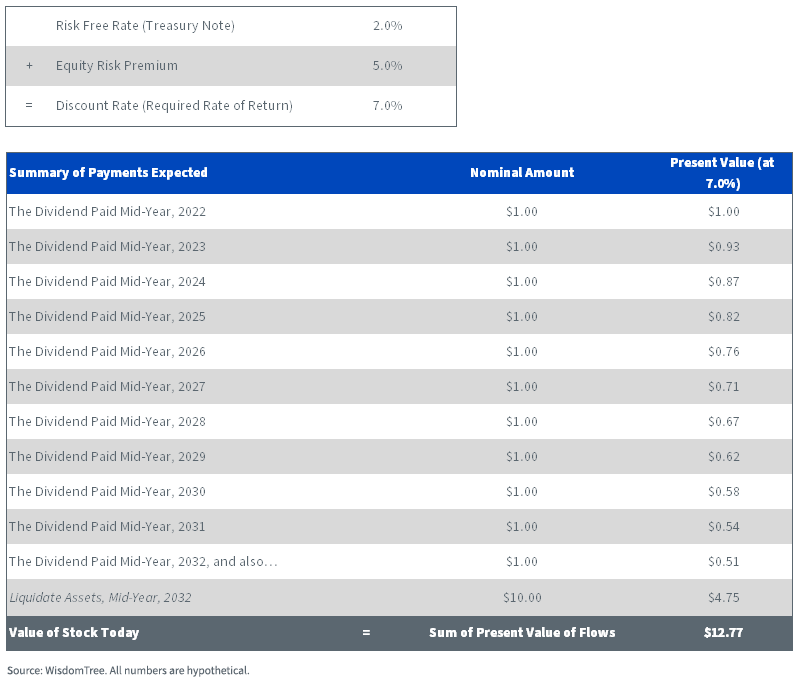
Now play around with interest rates. Say the Treasury rate increases from 1% to 2%, causing the discount rate to change from 6% to 7%. As a result, ValueCo’s stock falls from $13.63 to $12.77. The present value of ValueCo’s future dividends is worth 6.3% less right now because of the new interest rate regime.
A tough situation, but not as bad as what happens to GrowthCo.
Figure 4: Valuing ValueCo, 7% Discount Rate
For GrowthCo, let’s say we anticipate no dividends this decade (because it’s a growth stock) and a one-time event in the future: the company gets bought at a price of $100/share in 2032. Two cash flows: the purchase and the sale. Again, keeping it simple. It looks like this:
Figure 5: A GrowthCo Forecast
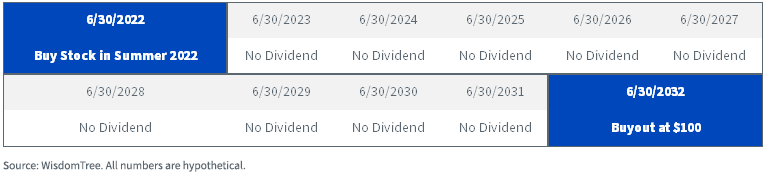
Valuing GrowthCo is easy: just discount the $100 to its present value. Using the 6% discount rate, we can say the stock is worth $55.84 today.
Figure 6: Valuing GrowthCo, 6% Discount Rate
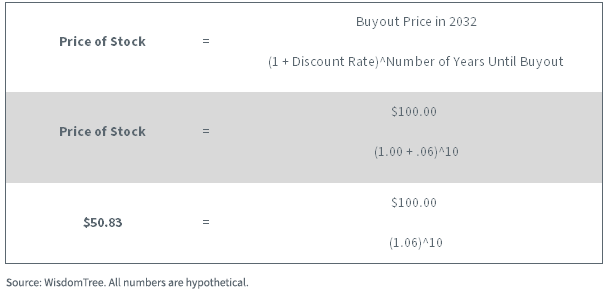
Now change the discount rate from 6% to 7% to account for the higher interest rate regime, as we did with ValueCo. The new present value for GrowthCo drops from $55.84 to $50.83, a 9.0% decline (figure 7).
Recall that when we ran the same exercise on ValueCo, the stock fell by 6.3%.
Figure 7: Valuing GrowthCo, 7% Discount Rate
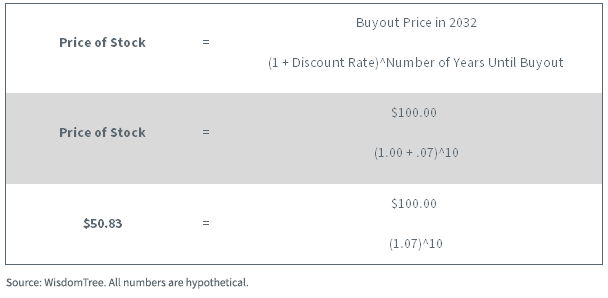
The conclusion: Rising interest rates hurt GrowthCo more than they did ValueCo.
It explains why the relentless collapse in interest rates over the last decade brought fame and fortune to growth stocks. Now that the interest rate regime has turned around, growth stocks are the market’s problem stocks, while value stocks are serving as the haven.
For investors who anticipate a continued march higher in rates, here are some of our U.S. large-cap value strategies that may help if the stock market continues to be upset about it:
- WisdomTree U.S. LargeCap Dividend Fund (DLN)
- WisdomTree U.S. High Dividend Fund (DHS)
- WisdomTree U.S. Value Fund (WTV)
For investors interested in these Funds’ performances, you can visit our Fund Compare tool.
1 David French, “Wall Street Up Before Fed Meet as Tech Buying Punctuates Volatile Trade,” Reuters, 5/2/22.
Categories
Related articles

The Market's Pendulum May Be Swinging Back to Value

The 2026 Market: A World of Constant Rotation

Are Two Complementary Strategies Continuing to Create a Better Core in 2026?

Beyond the S&P 500: From Concentration to Conviction
Value Investing That's Worked
7 Market Dislocations Too Big to Overlook
Growth vs. Value: Capturing Complementary Factor Exposure
Taming Style Rotation Whiplash
Understanding Bubble Narratives through Historical Context
About the contributor

Jeff Weniger, CFA
Head of Equity Strategy
Jeff Weniger, CFA, has been with WisdomTree since 2017 and serves as the Head of Equities. He shapes the firm’s market outlook through a combination of macroeconomic and fundamental analysis. With more than two decades in investment strategy, Jeff is known for his work on market cycles and valuations. Before joining WisdomTree, Jeff was with BMO Private Bank and BMO Global Asset Management for 11 years. At BMO, he sat on the firm’s Asset Allocation Committee and co-managed ETF model portfolios across the U.S. and Canada. In 2013, at age 32, he became the youngest member of BMO’s Global Investment Forum. When he left BMO to come to WisdomTree, his final role was Director, Senior Strategist in the Office of the CIO in 2017.
Jeff is a frequent television guest on networks such as CNBC, Bloomberg, and Schwab, with regular print appearances in The Wall Street Journal, Barron’s and Reuters. He also appears weekly on the Behind the Markets podcast and is a regular on SiriusXM’s The Business Briefing. On X, Jeff has developed one of the larger followings in financial media. He earned a B.S. in Finance from the University of Florida and an MBA from the University of Notre Dame. He has held the CFA charter since 2006.