
WTV
U.S. Value Fund

Published November 11, 2025

Associate Director, Research Content
For decades, investors have debated the merits of growth versus value investing. Growth companies offer the potential for rapid earnings expansion, often tied to innovation and long-term structural themes. Value stocks, by contrast, tend to trade at lower multiples and provide steadier returns, particularly when economic conditions or interest rates shift against richly valued sectors.
Historically, leadership has rotated between the two styles depending on the macroeconomic backdrop, with growth outperforming during periods of falling interest rates and strong innovation cycles, while value has shined in inflationary or rate-sensitive environments.
Rather than trying to time these cycles, blending growth and value can provide a more balanced exposure that captures upside potential while mitigating concentration risk.
The WisdomTree U.S. Value Fund (WTV), through its value-oriented methodology, provides exposure to companies trading at attractive multiples with stronger fundamentals than traditional value benchmarks. The Fund invests in U.S. large- and mid-capitalization companies with high total shareholder yield (dividends + share buybacks) and favorable quality metrics. To avoid value traps or cheap stocks with poor fundamentals, the methodology incorporates profitability screens using return on equity (ROE) and return on assets (ROA). With over 130 holdings and broad sector exposure, WTV offers diversification.
The WisdomTree U.S. Quality Growth Fund (QGRW), by contrast, tilts toward large-cap growth companies with persistent earnings momentum and balance sheet strength, characteristics historically rewarded in disinflationary or innovation-driven cycles. Its Index methodology emphasizes profitability, screening for companies with strong growth and quality metrics. The Fund holds a significant concentration of Magnificent Seven stocks, which have heavily driven market performance in recent years.
When combined, the two offer factor diversification. Value's mean-reversion characteristics reduce drawdown sensitivity in inflationary or rate-driven environments, while quality growth captures upside during periods of declining discount rates and secular expansion.
SPDR S&P 500 ETF Trust (SPY) remains a popular choice for investors seeking broad exposure to the U.S. equity market. However, like the index it tracks, its performance is heavily influenced by a handful of mega-cap constituents.
To assess relative effectiveness of various strategies, we evaluate the performance of SPY, WTV and QGRW on a stand-alone basis, alongside a 50/50 WTV/QGRW blend.
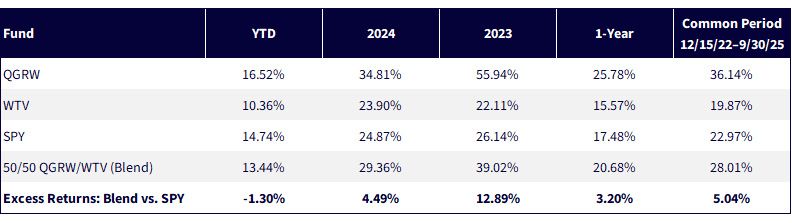
Sources: FactSet, WisdomTree, as of 9/30/25. The performance data quoted represents past performance and is not indicative of future results. Investment return and principal value of an investment will fluctuate so that an investor's shares, when redeemed, may be worth more or less than their original cost. Current performance may be lower or higher than the performance data quoted. For the most recent month-end and standardized performances, click the respective ticker: QGRW, WTV, SPY.
Beyond performance, the blended allocation offers clear fundamental advantages when compared with SPY.
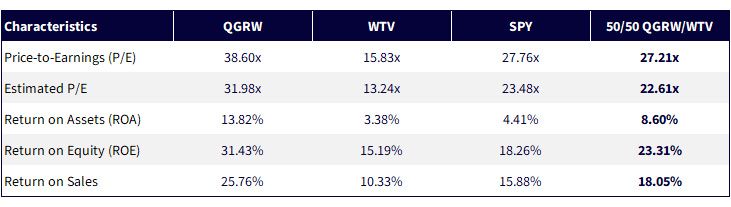
Sources: FactSet, WisdomTree, as of 9/30/25. P/E and Estimated P/E calculations exclude companies with negative earnings. For definitions of terms in the table above, please visit the glossary.
Looking Deeper into Industry Positioning and Relative Tilts
The blended portfolio broadly mirrors the industry composition of SPY and by extension, the S&P 500, which it tracks, maintaining comparable exposures across most industries.
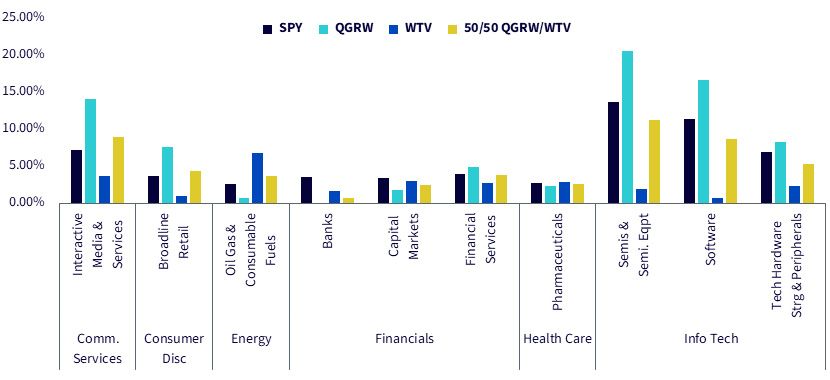
Sources: FactSet, WisdomTree. Top 10 industry weights in SPY relative to QGRW, WTV and 50/50 blend as of 9/30/25.
The 50/50 QGRW/WTV blend provides Magnificent Seven exposure similar to SPY, capturing the secular growth of the U.S. technology and communication leaders while embedding a value overlay that strengthens portfolio resilience across market cycles. This balance enables upside participation in growth-led environments and more defensive performance during valuation corrections or sector rotations.
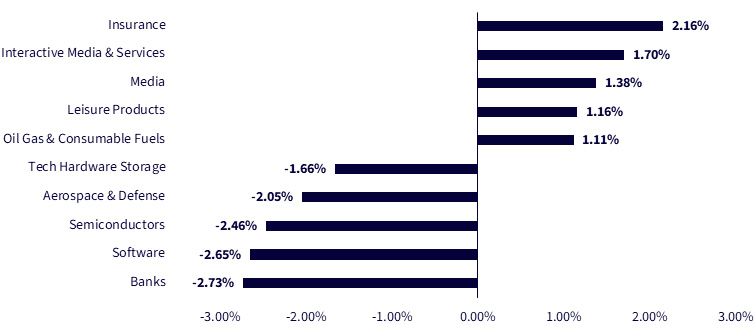
Sources: FactSet, WisdomTree. Top 5 over/under-weight industry groups as of 9/30/25.
While the neutral 50/50 blend provides balanced exposure, investors with stronger growth or value bias can rebalance to over-weight growth or value strategies, enhancing alignment with their forward-looking convictions.
The blend's balanced nature allows it to navigate different market regimes effectively. During periods favoring growth, like 2023/24, it participated in rallies. During volatile phases, like early Q2 2025, it demonstrated resilience, capturing upside potential while providing more defensive performance. Combining the two creates a style-diversified portfolio, mitigating dependence on any single market factor or trend.
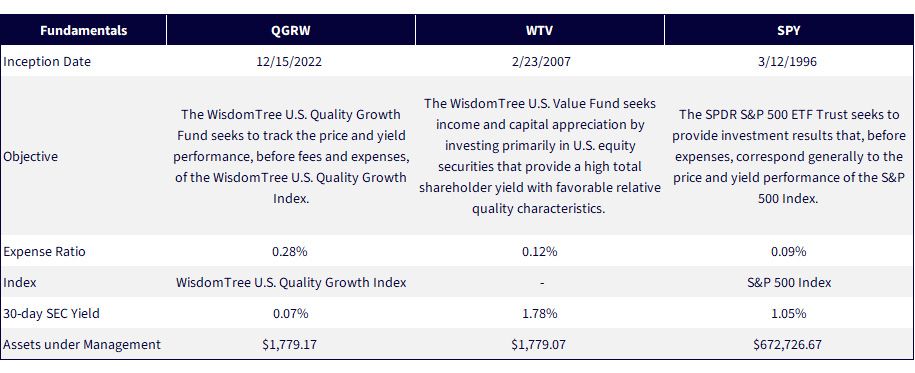
Sources: WisdomTree, FactSet, as of 09/30/25. You cannot invest directly in an index. WTV and QGRW were chosen for comparison because they represent complementary yet distinct exposures within U.S. large-cap equities. SPY, which tracks the S&P 500 Index, serves as a baseline for broad market performance.
There are risks associated with investing, including the possible loss of principal. Please read the Fund’s prospectus for specific details regarding the Fund’s risk profile.
QGRW: Growth stocks, as a group, may be out of favor with the market and underperform value stocks or the overall equity market. Growth stocks are generally more sensitive to market movements than other types of stocks. The Fund is non-diversified and, as a result, changes in the market value of a single security could cause greater fluctuations in the value of Fund shares than would occur in a diversified fund. The Fund invests in the securities included in, or representative of, its Index regardless of their investment merit. The Fund does not attempt to outperform its Index or take defensive positions in declining markets and the Index may not perform as intended.
WTV: Funds focusing their investments on certain sectors increase their vulnerability to any single economic or regulatory development. This may result in greater share price volatility. While the Fund is actively managed, the Fund’s investment process is expected to be heavily dependent on quantitative models and the models may not perform as intended.
SPY: The fund is subject to risk, including possible loss of principal. The fund seeks to track the performance of the S&P 500 Index and does not attempt to outperform it. Equity securities may fluctuate in value in response to the activities of individual companies and general market and economic conditions. The fund is subject to general market risk, equity investing risk and passive investment risk. ETFs may trade at prices above or below their net asset value (NAV) and are subject to brokerage commissions and trading costs.
Before investing, consider the fund’s investment objectives, risks, charges and expenses. For more information, obtain a prospectus or summary prospectus at www.ssga.comor call 1-866-787-2257. Read it carefully.

Associate Director, Research Content
Lonnie S. Jacobs joined WisdomTree in August 2006 as Senior Index Analyst overseeing creation, maintenance and reconstitution of the firm’s passive indexes and actively managed ETFs. In her current role as Associate Director, Research Content, she is focused on supporting the research pipeline and analyzing the impact of global markets on WisdomTree strategies. Lonnie has B.A. in Economics and M.S. in Information Systems.
