


Complementary Strengths: A Better Core for a Volatile Market
Published August 14, 2025

Christopher Gannatti, CFA
Global Head of Research
Key Takeaways
- Despite April’s tariff-induced sell-off, U.S. equities have roared back with surprising strength, and the 50/50 blend of QGRW and WTV has outpaced the S&P 500 year-to-date.
- The QGRW-WTV strategy has proven resilient across volatile regimes, capturing tech-driven growth while cushioning downside with high-quality value exposure.
- With macro risks still looming, the blended allocation offers investors a structurally balanced core that mitigates concentration risk and adapts to style rotation.
A Year That Shouldn't Have Worked—But Did
The story of U.S. equities in 2025 reads like financial fiction. As spring began, the S&P 500 was reeling from the shock of "Liberation Day" tariffs—President Trump's surprise barrage of import levies that upended sentiment in early April. Stocks cratered, recession forecasts proliferated and some global investors began shifting allocations out of the U.S. en masse.1 The sell-off was brutal, swift and psychologically jarring. Yet, within weeks, not only had markets stabilized, they began ascending with an almost unnatural force. Today, just three months later, many of those same indexes stand at or near record highs.2
The Rally Nobody Believed In—Until It Happened
This rebound was not merely a case of markets "climbing the wall of worry"—it was a defiance of the entire wall. Investors who bought the dip in April, despite widespread doubts, now find themselves with 25%-plus gains.3 Earnings resilience, AI-fueled tech optimism and consumer tenacity have outgunned macroeconomic headwinds, at least for now. Nvidia's valuation soared past $4 trillion, helping pull the broader tech sector skyward.4 The Magnificent Seven are once again earning their name. More interestingly, even the broader S&P 500 showed strength, notching 6.4% gains year-to-date (YTD) despite ongoing tariff uncertainty and cautious guidance from corporate leaders.5
Tariffs, Confusion and the Persistence of the "Taco Trade"
The contradiction between political chaos and equity performance has only sharpened. Markets absorbed wave after wave of Trump tariff threats—on China, Brazil, even pharmaceuticals—yet the VIX index6 ("fear gauge") steadily declined.7 Analysts began joking about the "Taco trade"—short for "Trump Always Chickens Out"—to describe the now-baked-in assumption that aggressive policy posturing will ultimately be walked back.8 As Katie Martin notes, the April panic now looks like a defining contrarian opportunity. This dynamic has created a strange feedback loop: the more erratic the policy, the more convinced investors are that markets will simply look through it.
Narratives in Flux: From Macro Panic to Micro Conviction
What makes 2025 so compelling is how quickly investor narratives have flipped. In April, the dominant story was political risk and recession. By July, the focus had shifted to micro drivers—corporate earnings, tech adoption, financial efficiency. Amid macro ambiguity, the market's performance has become a litmus test for resilience.9 The earnings season now underway could mark the next inflection point: either confirming the optimism embedded in current multiples or reminding everyone how thin the margin of safety has become. Either way, the battle between skepticism and momentum will define the back half of the year.
WisdomTree's Value and Quality Growth Strategies
After such a dramatic first half to 2025, defined by geopolitical shocks, AI-driven rallies and surprising earnings resilience—investors face a familiar but pressing question: should they lean into the growth style that has powered recent gains or pivot toward value in anticipation of volatility and mean reversion? Growth stocks, especially in tech, have clearly benefited from momentum and narrative. Yet, with interest rates staying higher for longer and global policy risks intensifying, the case for durable cash flows and discounted valuations is strengthening. In an environment where clarity is elusive, perhaps the most strategic posture is balance. A 50/50 blend of value and growth may offer both participation in innovation and protection through fundamental resilience.
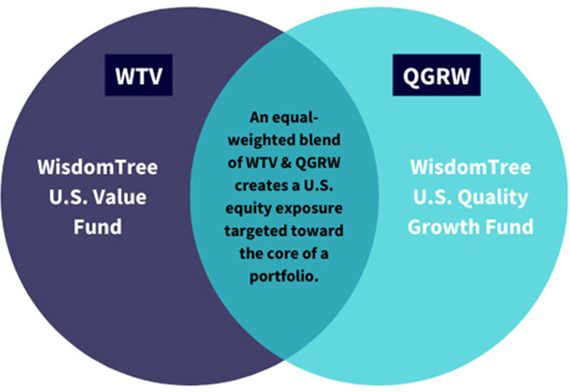
To create the 50/50 core blend, we look to two specific WisdomTree strategies:
- WisdomTree U.S. Quality Growth Fund (QGRW): The strategy seeks to track the total return performance, before fees and expenses, of the WisdomTree U.S. Quality Growth Index. This market capitalization-weighted strategy focuses on 100 companies that deliver particularly strong earnings growth and quality fundamental metrics. There is overlap between this strategy and the Nasdaq 100, but we believe in our more disciplined focus on selecting consistent quality growers instead of the venue where the stock has a primary listing for trading.
- WisdomTree U.S. Value Fund (WTV): The strategy seeks income and capital appreciation by investing primarily in U.S. equity securities that provide a high total shareholder yield with favorable relative quality characteristics. The Fund's objective changed effective December 18, 2017. Prior to December 18, 2017, Fund performance reflects the investment objective of the Fund when it tracked the performance, before fees and expenses, of the WisdomTree U.S. LargeCap Value Index.
The combination of these two strategies leads to a strong balance of sector exposures, attractive fundamental metrics and, while limited, a nice performance history.
Figure 1: Envisioning the 50/50 Blend
Source: WisdomTree.
Figure 2: Standardized Performance
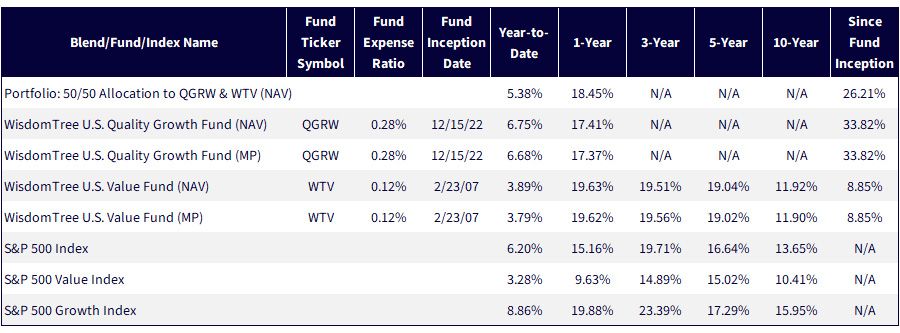
Sources: WisdomTree, Morningstar, FactSet, specifically data from the Fund Comparison Tool in the PATH suite of tools, accessed 8/12/25 with returns as of 6/30/25. NAV denotes total return performance at net asset value. MP denotes market price performance. In the case of WTV, the Fund's objective changed effective 12/18/17. Prior to 12/18/17, Fund performance reflects the investment objective of the Fund when it tracked the performance, before fees and expenses, of the WisdomTree U.S. LargeCap Value Index. The performance data quoted represents past performance and is not indicative of future results. Investment return and principal value of an investment will fluctuate so that an investor's shares, when redeemed, may be worth more or less than their original cost. Current performance may be lower or higher than the performance data quoted. For the most recent month-end and standardized performance, click the relevant ticker: QGRW, WTV.
Riding the Tailwinds of Strong Equity Markets
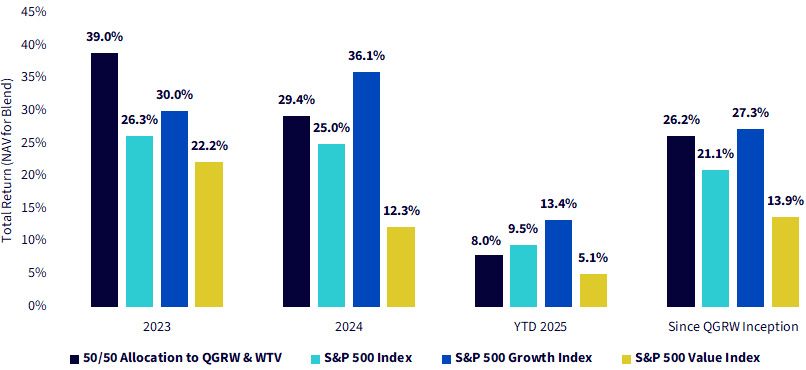
The period spanning 2023 and 2024 was defined by powerful equity market returns, with risk appetite favoring growth-oriented exposures. The S&P 500 Growth Index led the charge—with a 30.03% return in 2023 and another 36.07% in 2024—benefiting from both earnings resilience and expanding multiples, particularly among the mega-cap names. During these high-beta, pro-growth periods, the 50/50 allocation to QGRW (growth) and WTV (value) delivered strong absolute performance—up 39.0% and 29.4% in 2023 and 2024, respectively—effectively capturing much of the upside while maintaining structural balance. Notably, the blend also outperformed the S&P 500 Index in both years, signaling its capacity to participate in rallies without relying too heavily on the concentration risk embedded in growth.
Testing the Blend—Does It Deliver What It Promises?
YTD in 2025, when dispersion has been tighter, the blended approach remains competitive. The longer-term takeaway is even more telling: since QGRW's inception, the 50/50 mix has generated 26.2%, beating the S&P 500's 21.1% and crushing value's 13.9%—while avoiding the concentration risk of an all-growth allocation. This reinforces the strategic merit of blending styles: participate in upside leadership, buffer through rotations and maintain exposure to both cyclical recovery and secular innovation.
Figure 3: Resilience through Regimes: A Balanced Edge in Shifting Markets
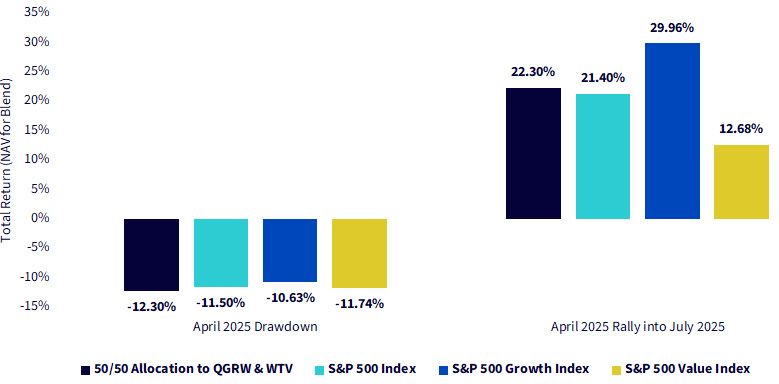
The April 2025 tariff shock—and the rapid re-pricing that followed—offered a real-time stress test of market adaptability. Within weeks, markets flipped from defensive mode to recovery rally, underscoring how quickly the investment landscape can pivot from risk-off to risk-on. During the initial drawdown, all major indexes sold off in unison, but the 50/50 QGRW-WTV allocation experienced a slightly deeper decline (−12.3%)—a function of broad equity exposure rather than overconcentration in any single style. The recovery from the April 2025 drawdown was both swift and powerful, with the 50/50 QGRW-WTV blend rebounding 22.3%—outpacing the S&P 500's 21.4% but trailing the surge in the S&P 500 Growth Index. This highlights how a balanced allocation can effectively harness upside momentum without the concentration risk of more significant growth exposure. Notably, value lagged during the rally with just a 12.68% gain, reinforcing the blend's role in capturing leadership while retaining broader diversification.
Figure 4: The Equity-Market Whipsaw That Came from the Tariff Announcements
Sources: WisdomTree, Morningstar, FactSet, specifically data from the Fund Comparison Tool in the PATH suite of tools, accessed 8/12/25 with returns as of 8/8/25. QGRW inception is 12/15/22. NAV denotes total return performance at net asset value. In the case of WTV, the Fund's objective changed effective 12/18/17. Prior to 12/18/17, Fund performance reflects the investment objective of the Fund when it tracked the performance, before fees and expenses, of the WisdomTree U.S. LargeCap Value Index. The performance data quoted represents past performance and is not indicative of future results. Investment return and principal value of an investment will fluctuate so that an investor's shares, when redeemed, may be worth more or less than their original cost. Current performance may be lower or higher than the performance data quoted. For the most recent month-end and standardized performance, click the relevant ticker: QGRW, WTV.
Rolling Returns Reveal Leadership Rotations—and the Value of Balance
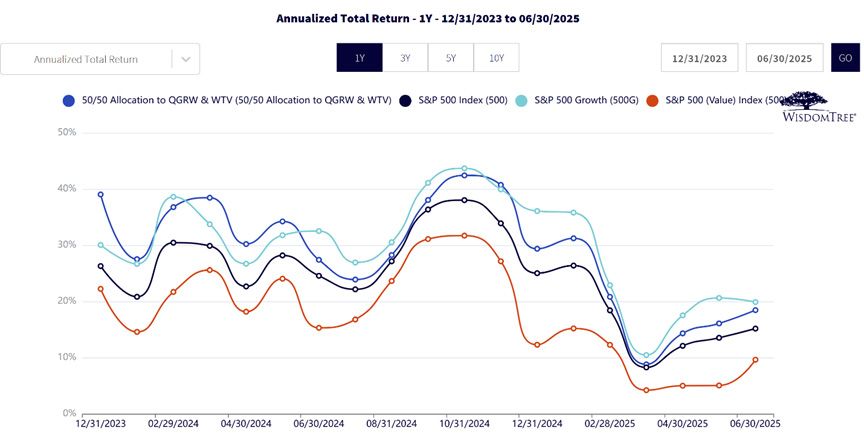
The one-year rolling return chart illustrates a compelling case for the 50/50 QGRW-WTV blend, particularly in the most recent period. While the S&P 500 Growth Index led during the more risk-on phases, its performance proved more volatile and susceptible to drawdowns. In contrast, the blend has delivered more stable performance, rising consistently alongside growth but with visibly smoother drawdowns and faster recovery trajectories. Notably, since the April 2025 correction, the blend has moved ahead of the S&P 500 and narrowed the gap with growth, signaling an attractive trade-off between upside participation and downside protection. For investors seeking resilient exposure without overcommitting to either extreme of the style spectrum, the recent trend in rolling returns clearly favors the blended approach.
Figure 5: Rolling with the Market: Why Blended Equity May Be Built to Last
A Sector-Level Expression of Strategic Balance
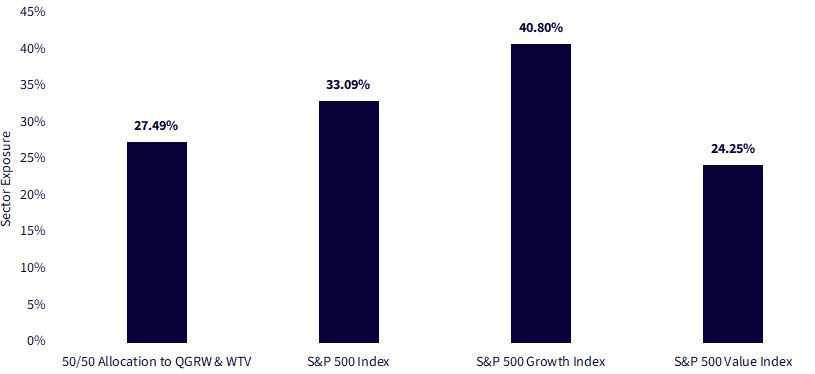
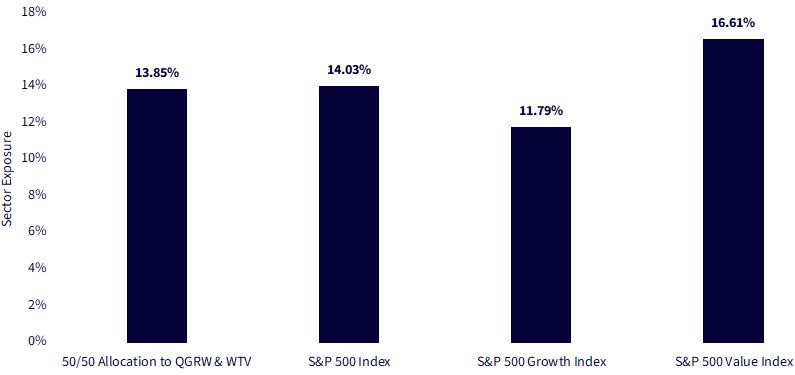
Figures 6 and 7 underscore how a 50/50 allocation to QGRW and WTV strikes a more balanced sector profile—particularly when it comes to Information Technology and Financials. The S&P 500 Growth Index has a heavier 40.8% tilt toward tech, a classic over-weight to growth, while the S&P 500 Value Index leans into Financials at 16.61%, reflecting its value character. In contrast, the 50/50 blend delivers moderate exposure to both: 27.49% in tech and 13.85% in Financials. This positioning offers investors participation in innovation and earnings momentum without sacrificing the ballast and cyclicality that Financials bring. Rather than betting on one style regime to dominate, the blend offers structural diversification across the growth-value spectrum.
Figure 6: Exposure to the Information Technology Sector
Sources: WisdomTree, Morningstar, FactSet, specifically data from the Fund Comparison Tool in the PATH suite of tools, accessed 8/12/25 with exposures as of 6/30/25. Subject to change.
Figure 7: Exposure to the Financials Sector
Sources: WisdomTree, Morningstar, FactSet, specifically data from the Fund Comparison Tool in the PATH suite of tools, accessed 8/12/25 with exposures as of 6/30/25. Subject to change.
Long-Term Investing Demands a Dual Lens: Valuation and Quality
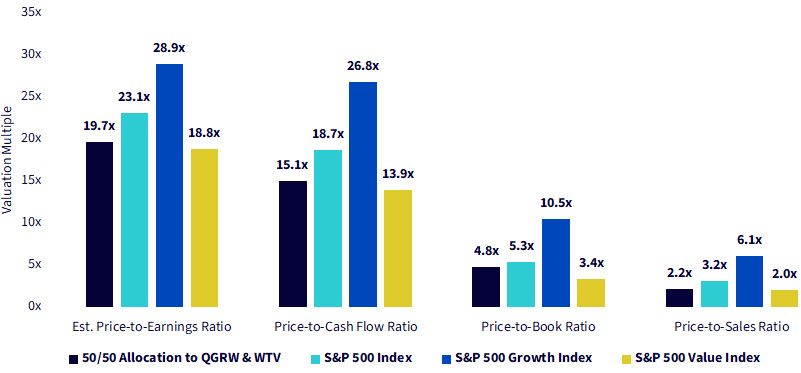
Figures 8 and 9 lay bare the classic trade-off between valuation and fundamentals across investment styles. Value stocks, as represented by the S&P 500 Value Index, offer the most attractive valuation multiples—lowest on price-to-earnings, price-to-book and price-to-sales—but that affordability comes with compromised quality and lower expected growth, as seen in their markedly lower returns on equity and assets and projected earnings growth. On the flip side, the S&P 500 Growth Index commands premium multiples—particularly with a lofty 28.9 times price-to-earnings and 26.8 times price-to-cash flow—justified in part by stronger profitability and long-term growth potential, but leaving little room for error. The 50/50 QGRW-WTV blend carves out a middle ground, moderating valuation risk while preserving a healthy fundamental profile. With above-average return on equity (24.2%) and a balanced valuation footprint, the blend reflects an intentional diversification of style risk—positioning investors to benefit from both cyclical mean reversion and structural innovation.
Figure 8: Not Overpaying for Growth: A Balanced Valuation Advantage
Sources: WisdomTree, Morningstar, FactSet, specifically data from the Fund Comparison Tool in the PATH suite of tools, accessed 8/12/25 with metrics as of 6/30/25. Subject to change.
Figure 9: Balanced Doesn't Mean Compromised: Strong Growth and Quality Metrics
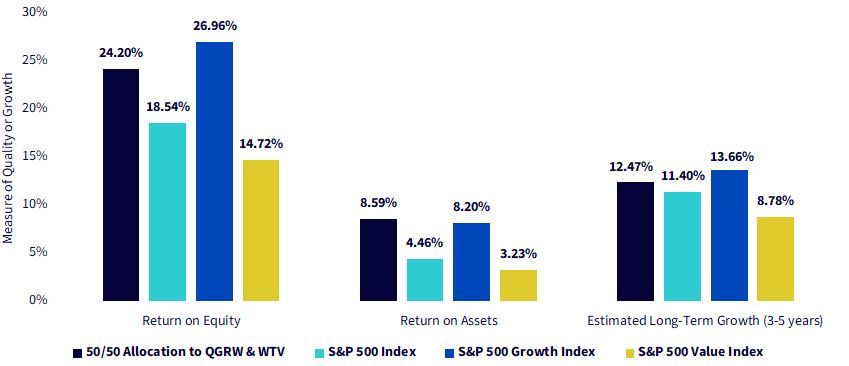
Sources: WisdomTree, Morningstar, FactSet, specifically data from the Fund Comparison Tool in the PATH suite of tools, accessed 8/12/25 with metrics as of 6/30/25. Subject to change.
Conclusion: A Blueprint for Durable Equity Exposure
In a market defined by shifting regimes, concentration risk and narrative-driven extremes, the 50/50 allocation to QGRW and WTV offers something rare: structural balance without sacrificing upside. Across multiple lenses—total return, rolling performance, valuation discipline, sector neutrality and fundamental strength—the blend has demonstrated the ability to navigate both offense and defense. In a world where timing factor rotation is increasingly futile, durable portfolio construction starts with a blend that's built to respond in different environments.
1 Source: "How America's Economy Is Dodging Disaster," The Economist, 7/6/25.
2 Source: K. Martin, "Tidings from My Stock Market Humble Pie," Financial Times, 7/12/25.
3 Source: Martin, 2025.
4 Source: A. Edgecliffe-Johnson & R. Smith, "Market Volatility Recedes as Brush of Tariffs Proves Short Lived," Financial Times, 7/8/25.
5 Source: A. Otani & P. Grant, "Earnings season poses new test for stock records," The Wall Street Journal, 7/8/25.
6 VIX Index refers to Chicago Board Options Exchange Volatility Index.
7 Source: Edgecliffe-Johnson & Smith, 2025.
8 Source: Martin, 2025.
9 Source: Otani & Grant, 2025.
Important Risks Related to this Article
There are risks associated with investing, including the possible loss of principal. Please read the Fund’s prospectus for specific details regarding the Fund’s risk profile.
QGRW: Growth stocks, as a group, may be out of favor with the market and underperform value stocks or the overall equity market. Growth stocks are generally more sensitive to market movements than other types of stocks. The Fund is non-diversified and, as a result, changes in the market value of a single security could cause greater fluctuations in the value of Fund shares than would occur in a diversified fund. The Fund invests in the securities included in, or representative of, its Index regardless of their investment merit. The Fund does not attempt to outperform its Index or take defensive positions in declining markets and the Index may not perform as intended.
WTV: There are risks associated with investing, including the possible loss of principal. Funds focusing their investments on certain sectors increase their vulnerability to any single economic or regulatory development. This may result in greater share price volatility. While the Fund is actively managed, the Fund’s investment process is expected to be heavily dependent on quantitative models and the models may not perform as intended.

About the contributor

Christopher Gannatti, CFA
Global Head of Research
Christopher Gannatti began at WisdomTree as a Research Analyst in December 2010, working directly with Jeremy Schwartz, CFA®, Director of Research. In January of 2014, he was promoted to Associate Director of Research where he was responsible to lead different groups of analysts and strategists within the broader Research team at WisdomTree. In February of 2018, Christopher was promoted to Head of Research, Europe, where he was based out of WisdomTree’s London office and was responsible for the full WisdomTree research effort within the European market, as well as supporting the UCITs platform globally. In November 2021, Christopher was promoted to Global Head of Research, now responsible for numerous communications on investment strategy globally, particularly in the thematic equity space. Christopher came to WisdomTree from Lord Abbett, where he worked for four and a half years as a Regional Consultant. He received his MBA in Quantitative Finance, Accounting, and Economics from NYU’s Stern School of Business in 2010, and he received his bachelor’s degree from Colgate University in Economics in 2006. Christopher is a holder of the Chartered Financial Analyst Designation.