
WTV
U.S. Value Fund

Published January 8, 2026

Global Head of Research
When investors talk about the S&P 500, they often imagine a broad reflection of the U.S. economy, but in reality, the Index's behavior is increasingly dictated by a small cluster of mega-cap firms. Today, just seven companies, NVIDIA, Microsoft, Apple, Alphabet, Amazon, Meta and Tesla, account for nearly 40% of its total market capitalization. This level of concentration rivals or exceeds any prior period in modern market history, amplifying both returns and risk. In essence, the S&P 500 has become less a diversified portfolio and more a proxy for the world's most dominant technology platforms.
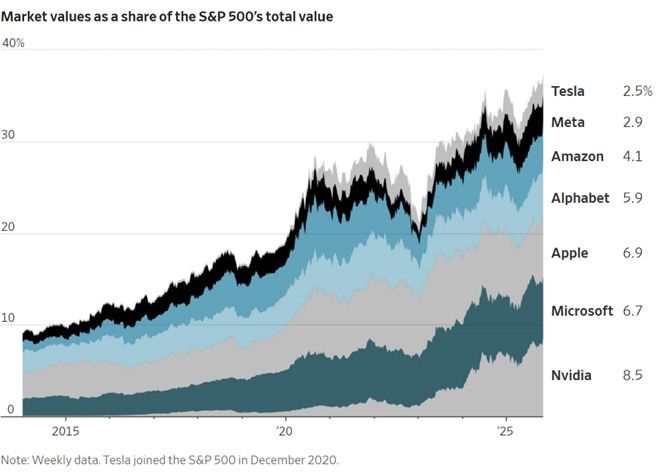
Source: FactSet, as seen in: M. Bobrowsky, "Big Tech Is Spending More Than Ever on AI and It's Still Not Enough," The Wall Street Journal, 10/30/25. Subject to change.
Many investors that we speak to are thinking about ways to de-emphasize this concentration. A simple approach is to look at the S&P 500 Equal Weight Index. The weights in the Magnificent 7 here were:1
These weights make sense in that weighting 500 stocks equally would anchor at 0.20% per stock on the date of rebalancing. However, treating 500 companies exactly the same by way of weighting may be too strong a reaction to concentration risk. People may not want the weight in seven stocks to approach 40%, but they may also recognize that some companies are stronger than others.
Performance, Where the Rubber Meets the Road
Under its current methodology,2 the WisdomTree U.S. Value Fund (WTV) has consistently outperformed the Invesco S&P 500 EqualWeight ETF (RSP)3 across multiple time horizons. WTV's fundamental weighting, focusing on companies reducing share counts and providing strong total shareholder yield, has proven more effective. By uniting diversification, valuation discipline and quality, WTV has turned its design into sustained outperformance.
Bottom Line: Both WTV and RSP sidestep the current concentration in very large companies that many see when they look at the S&P 500 Index. RSP is tracking a strategy that simply applies diversification by equalweighting;WTV, on the other hand, is focusing on a measure of investment fundamentals.
Figure 2a: How WTV Has Delivered beyond Equal Weight
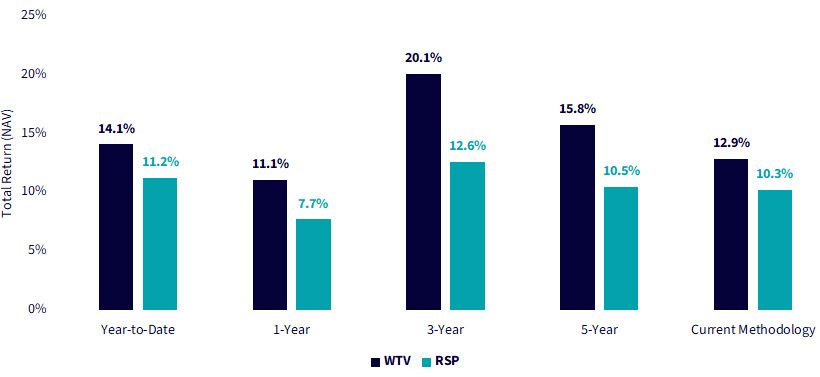
Sources: WisdomTree, Morningstar, FactSet; specifically, data from the Fund Comparison Tool in the PATH suite of tools, accessed 12/17/25, with returns as of 12/16/25.
Figure 2b: Standardized Performance
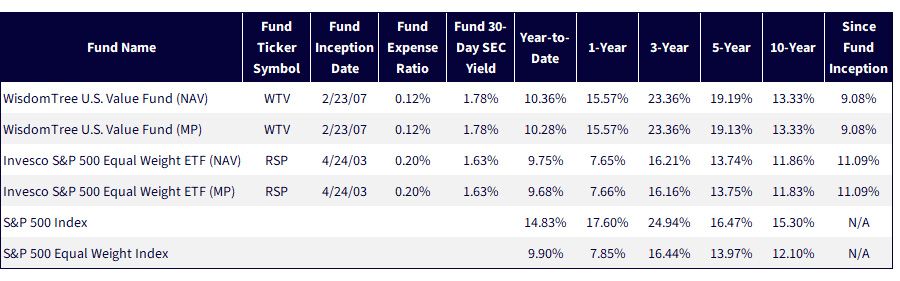
Sources: WisdomTree, Morningstar, FactSet; specifically, data from the Fund Comparison Tool in the PATH suite of tools, accessed 10/27/25, with returns as of 9/30/25. NAV denotes total return performance at net asset value. MP denotes market price performance. In the case of WTV, the Fund's objective changed effective 12/18/17. Prior to 12/18/17, Fund performance reflects the investment objective of the Fund when it tracked the performance, before fees and expenses, of the WisdomTree U.S. LargeCap Value Index. Past performance is not indicative of future results. Investment return and principal value of an investment will fluctuate so that an investor's shares, when redeemed, may be worth more or less than their original cost. Current performance may be lower or higher than the performance data quoted. For the most recent month-end and standardized performances, click the relevant ticker: WTV, RSP.
It is natural to want to remove concentration in a small subset of stocks. That's the premise of the S&P 500 Equal Weight Index, where each company holds roughly the same 0.2% weight. The result is a more balanced and democratic version of the S&P 500, but with trade-offs.
In figure 3, we see that quality, measured by return on equity (ROE), declines sharply. The share of firms earning more than 30% ROE falls from 43.6% to 22.4%, while exposure to sub-10% or negative ROE companies doubles. Equal weighting removes concentration but also dilutes quality, spreading exposure across strong and weak businesses alike.
Figure 4 shows the valuation shift: the Index becomes cheaper, with exposure to high P/E names (30x–35x) dropping from 30% to about 8% and weight in single-digit P/E stocks tripling. Yet that value improvement comes at the cost of the efficiency that made large firms dominant in the first place.
In short, the equal-weight approach broadens diversification, but at the expense of quality. The question remains: can we reduce concentration without abandoning excellence?
WTV seeks to answer that question. Instead of equal weighting every company or following market cap, WTV weights primarily based on a fundamental concept: a company's ability to return cash to shareholders—in other words, the concept of total shareholder yield.
Buybacks, when done sustainably, are one of the clearest signals of capital discipline. They reflect management teams confident in their balance sheets and long-term prospects. By prioritizing firms that are consistently shrinking their share bases, WTV builds a portfolio that is both quality-conscious and valuation-aware.
Figure 3: The Hidden Quality Trade-off in Equal-Weight Indexing
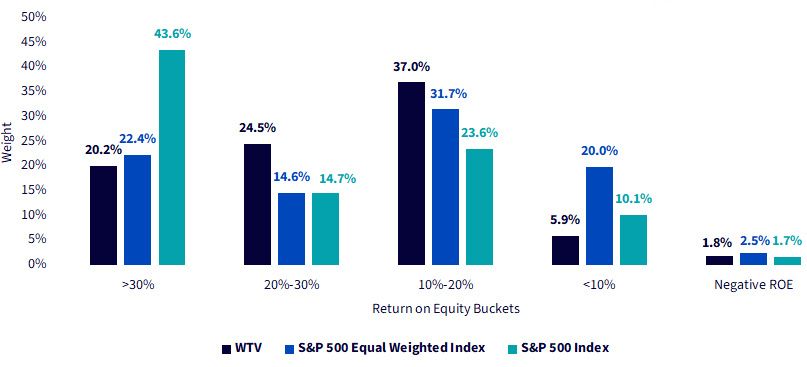
Sources: WisdomTree, FactSet, S&P. Data is as of 10/24/25. Subject to change.
Conclusion: Valuation Discipline Without Sacrificing Fundamentals
Turning to valuation, WTV pushes the improvement further than the Equal Weight Index, adding valuation discipline while preserving the quality profile seen earlier. As shown in figure 4, more than 50% of WTV's weight is in stocks trading below 15x earnings, compared to just 3% in the S&P 500. High-multiple exposure (above 30x) is nearly eliminated.
The result is valuation compression without quality loss: WTV owns companies that are cheap for good reasons, those using their earnings power to repurchase shares and reinvest productively, not firms that are merely inexpensive because they're weak.
Figure 4: How WTV Anchors Exposure in Fundamentally Priced Stocks
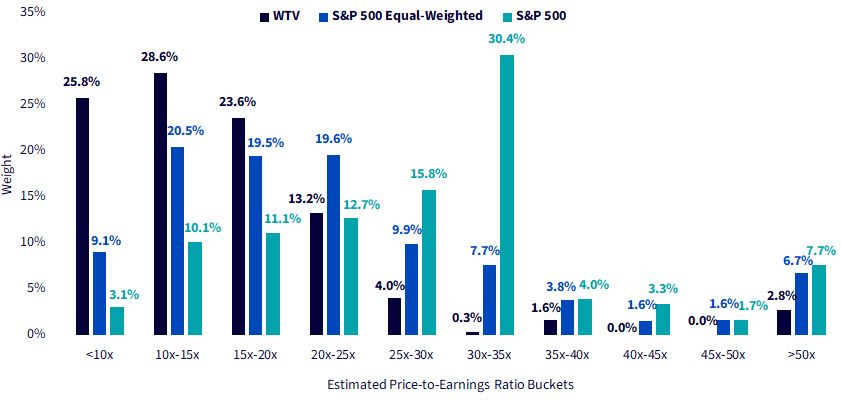
Sources: WisdomTree, FactSet, S&P. Data is as of 10/24/25. Subject to change.
Figure 5: Additional Information
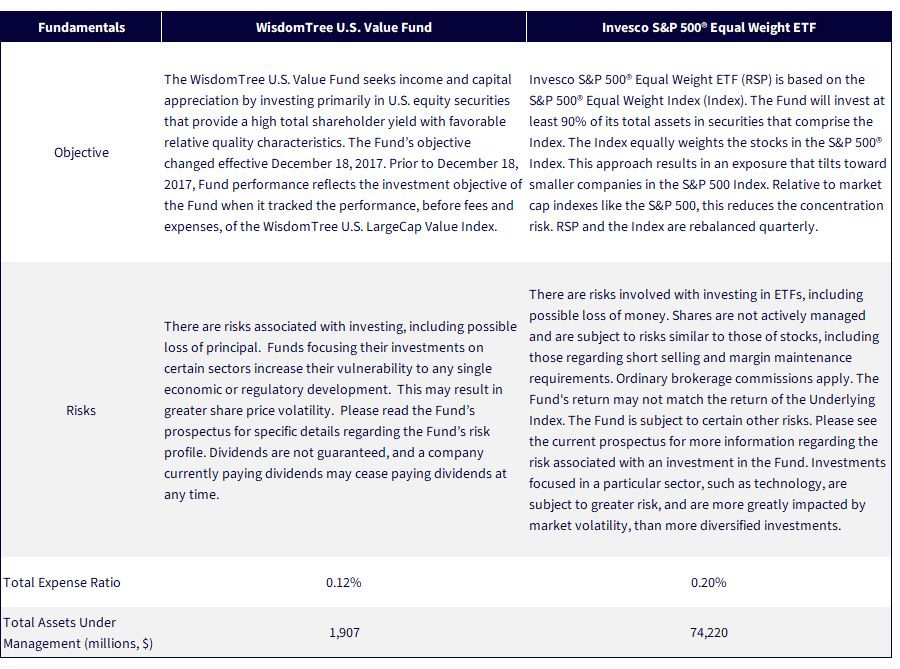
Sources: Fund sponsor web pages at WisdomTree and Invesco. Assets under management data is as of 10/27/25.
1 Sources: FactSet, S&P, with data as of 10/30/25.
2 WTV's current methodology has been in place since 12/18/17, and references the direct focus on total shareholder yield. Prior to that date, WTV was tracking a different investment strategy that was defined by the WisdomTree U.S. LargeCap Value Index.
3 RSP is designed to track the total return performance, before fees and expenses, of the S&P 500 Equal Weight Index.
There are risks associated with investing, including the possible loss of principal. Funds focusing their investments in certain sectors increase their vulnerability to any single economic or regulatory development. This may result in greater share price volatility. While the Fund is actively managed, the Fund’s investment process is expected to be heavily dependent on quantitative models, and the models may not perform as intended. Please read the Fund’s prospectus for specific details regarding the Fund’s risk profile.
U.S. Value Fund

Global Head of Research
Christopher Gannatti began at WisdomTree as a Research Analyst in December 2010, working directly with Jeremy Schwartz, CFA®, Director of Research. In January of 2014, he was promoted to Associate Director of Research where he was responsible to lead different groups of analysts and strategists within the broader Research team at WisdomTree. In February of 2018, Christopher was promoted to Head of Research, Europe, where he was based out of WisdomTree’s London office and was responsible for the full WisdomTree research effort within the European market, as well as supporting the UCITs platform globally. In November 2021, Christopher was promoted to Global Head of Research, now responsible for numerous communications on investment strategy globally, particularly in the thematic equity space. Christopher came to WisdomTree from Lord Abbett, where he worked for four and a half years as a Regional Consultant. He received his MBA in Quantitative Finance, Accounting, and Economics from NYU’s Stern School of Business in 2010, and he received his bachelor’s degree from Colgate University in Economics in 2006. Christopher is a holder of the Chartered Financial Analyst Designation.


