


Everyone Talks about “Quality” Funds, but What Does That Even Mean?
Published July 20, 2021

Jeff Weniger, CFA
Head of Equity Strategy
Our industry likes to toss around terms that strike different thoughts in different people.
Just look at the “growth” and “value” investing styles. What are we growing these days? Earnings? Revenues? The customer base?
For valuations, some may want low P/E ratios, others high dividend yields, while maybe the “right” answer is some combination—or different measures altogether.
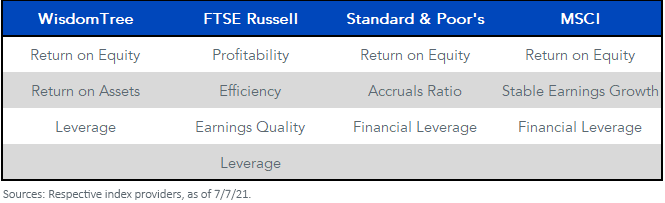
As it applies to stocks, what does that word mean? To boil it down: a smart beta quality screen is for investors who want highly profitable companies that manage to pull it off without a mountain of debt.
The oft-cited profitability metric is return on equity (ROE), while the debt part is sometimes found by checking how the company stacks up in the context of return on assets (ROA). If ROA is low and ROE is high, we know how the firm achieves it: management gooses the balance sheet with debt. You can minimize the goosing by explicitly incorporating ROA into a smart beta screen, which is something we do in a bunch of our Funds.
Figure 1: Definition of Quality, by Index Provider
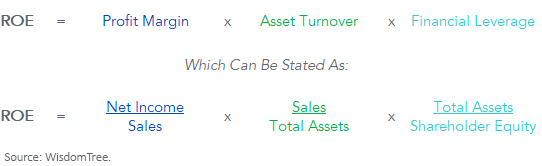
The intellectual framework for ROE is intuitive. Look for three things: business strength, stability and operational efficiency. Each is in the DuPont equation, which shows how quality—or ROE—is simply the interaction between profit margins, business efficiency and balance sheet risk (figure 2).
Ideally, achieving high ROE with low leverage is the way to go.
Figure 2: DuPont Equation for ROE
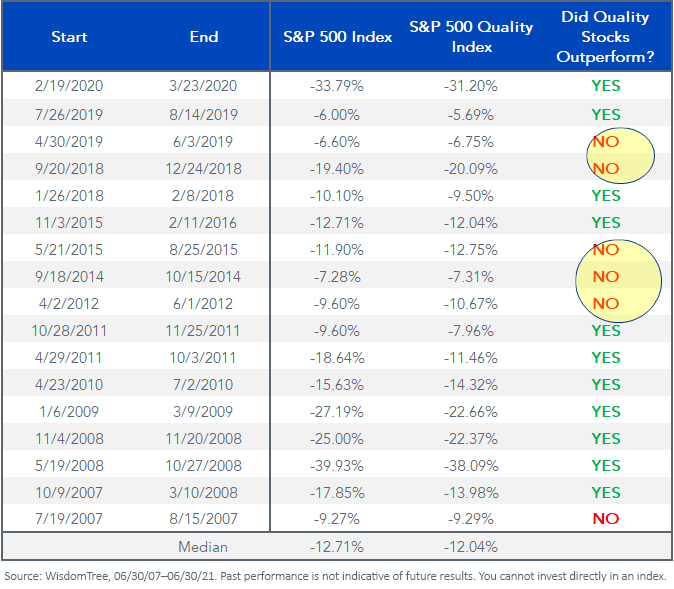
The problem: while this is great in theory, quality strategies have been disappointing in recent market declines. Take a look at what happened in five of the last nine swoons in the S&P 500 (figure 3).
Figure 3: Quality Stocks’ Struggles
For definitions of terms in the table, please visit the glossary.
Not only that, but quality has been lagging in this 15+ month market moon shoot. Sure, you could have bigger problems in life than watching the S&P 500 Quality index go up “only” 95.6% since March 23, 2020. Nevertheless, that is 4 percentage points short of the 99.7% run in the S&P 500 off the COVID-19 lows.
It’s showing up in valuations. According to Bank of America’s quant team, we have not seen high quality stocks this cheap relative to low quality peers in over a decade (figure 4).
Figure 4: High Quality (B+ or better) S&P Quality Ranks vs. Low Quality (B or worse) Fwd. P/E Relative to BofA Universe (1986–5/31/21)
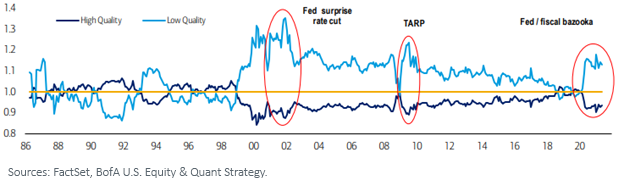
Though low quality has been running higher as the COVID-19-inspired economic depression transitioned to early recovery, one of these days we will enter the middle of the economic cycle—if that stage is not already here. The impulse to buy anything and everything, with little regard for operational efficiency, should seemingly fade as the clock ticks. That environment would enable quality concepts to claw out of this tunnel of frustration.
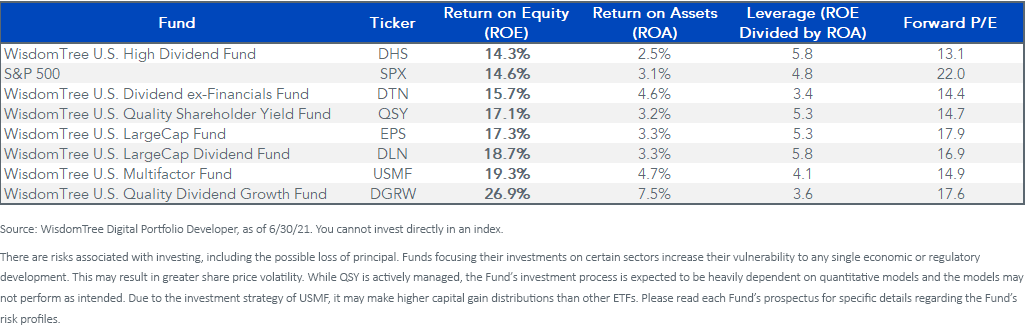
Here is a sample of our U.S. equity mandates, sorted by ROE. Many of them are clocking in higher than the S&P, with lower P/E ratios. Use this as a hunting ground for upping portfolio quality metrics.
Figure 5: Quality Spectrum
Categories
Related articles

Built for Any Market: How Blending Growth and Value Creates a Stronger Core

The Company at the Center of the AI Economy

A Dog, a Diagnosis and a Different Way to Understand AI

Are Two Complementary Strategies Continuing to Create a Better Core in 2026?
December 2025 Rebalance: WisdomTree U.S. Quality Growth Index
Growth vs. Value: Capturing Complementary Factor Exposure

Introducing Global ex-U.S. Quality Growth
Taming Style Rotation Whiplash
Big Tech's Relentless Momentum Continues
About the contributor

Jeff Weniger, CFA
Head of Equity Strategy
Jeff Weniger, CFA, has been with WisdomTree since 2017 and serves as the Head of Equities. He shapes the firm’s market outlook through a combination of macroeconomic and fundamental analysis. With more than two decades in investment strategy, Jeff is known for his work on market cycles and valuations. Before joining WisdomTree, Jeff was with BMO Private Bank and BMO Global Asset Management for 11 years. At BMO, he sat on the firm’s Asset Allocation Committee and co-managed ETF model portfolios across the U.S. and Canada. In 2013, at age 32, he became the youngest member of BMO’s Global Investment Forum. When he left BMO to come to WisdomTree, his final role was Director, Senior Strategist in the Office of the CIO in 2017.
Jeff is a frequent television guest on networks such as CNBC, Bloomberg, and Schwab, with regular print appearances in The Wall Street Journal, Barron’s and Reuters. He also appears weekly on the Behind the Markets podcast and is a regular on SiriusXM’s The Business Briefing. On X, Jeff has developed one of the larger followings in financial media. He earned a B.S. in Finance from the University of Florida and an MBA from the University of Notre Dame. He has held the CFA charter since 2006.