


From Momentum to Discipline: Navigating Volatility in Emerging Markets
Published January 9, 2026

Christopher Gannatti, CFA
Global Head of Research
Key Takeaways
- After China’s 33% year-to-date equity surge in 2025, investors are reminded that emerging market rallies can be fleeting without a risk-conscious framework.
- Despite ongoing volatility, the WisdomTree Emerging Markets High Dividend Fund (DEM) has delivered consistent long-term returns by emphasizing dividend yield, valuation discipline and lower volatility.
- For investors seeking stability amid cyclical bursts, DEM offers a durable alternative to momentum-driven exposure, compounding through market noise rather than reacting to it.
Emerging markets have a way of attracting investors with the allure of momentum. In 2025, few stories have shone brighter than China's equity resurgence, a rally that seemed to defy skepticism and rekindle long-dormant optimism. But history whispers a warning: emerging markets can take back as quickly as they give. The real challenge isn't identifying when these markets will surge; it's surviving the cycles in between. For investors seeking something more enduring than adrenaline, the question becomes not "where are the returns?" but "how do we keep them?"
Volatility has been among the most dependable companions in emerging markets. Political shifts, currency swings and liquidity droughts are not bugs in the system; they are the system. China's recent performance has reminded investors how quickly sentiment can pivot from despair to euphoria. The ability to participate in the upside while maintaining resilience through the downturns is about design rather than clairvoyance. Portfolios that explicitly account for risk, valuation discipline and income durability tend to compound quietly while others oscillate loudly.
That's where long-term frameworks like the WisdomTree Emerging Markets High Dividend Index, tracked by the WisdomTree Emerging Markets High Dividend Fund (DEM), come into play. In a landscape dominated by narratives—AI in China, reforms in India, reshoring in Mexico—DEM's focus on fundamentals serves as a ballast. Over cycles, its design has shown that risk mitigation isn't about sitting out the volatility. It's about harvesting income exposure and valuation discipline within it. As we enter the next phase of the emerging market cycle, the conversation might shift from chasing shorter-term beta rallies to compounding over longer time horizons.
Figure 1: Standardized Performance
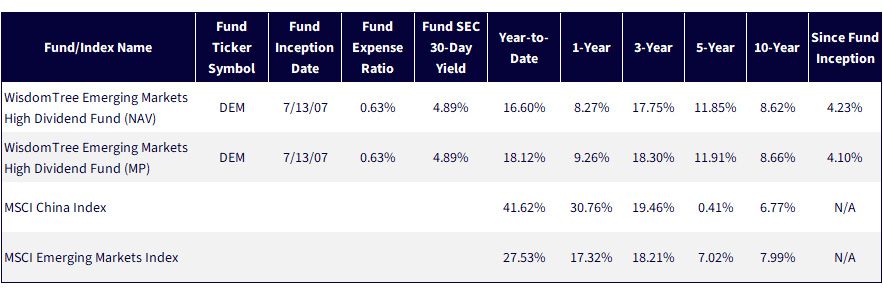
Sources: WisdomTree, FactSet, specifically data from the Fund Comparison Tool in the PATH suite of tools, accessed 10/26/26 with returns as of 9/30/25. NAV denotes total return performance at net asset value. MP denotes market price performance. Past performance is not indicative of future results. Investment return and principal value of an investment will fluctuate so that an investor's shares, when redeemed, may be worth more or less than their original cost. Current performance may be lower or higher than the performance data quoted. For the most recent month-end and standardized performance, click here.
Turning Volatility into Endurance
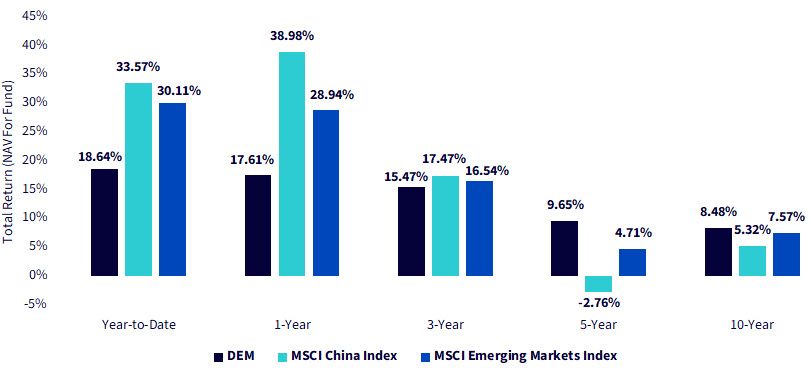
The numbers, shown in figure 2, tell a story of two very different games being played. In 2025, China's equity market (the MSCI China Index) has roared back to life, up over 33% year-to-date, capturing headlines and reigniting investor enthusiasm. Yet, as we step back, the rhythm changes. Over one-, three-, five- and ten-year periods, DEM has demonstrated something rarer in emerging markets: staying power. While China and the broader MSCI Emerging Markets Index have oscillated between bursts of performance and retrenchment, DEM's design, anchored in dividend discipline, valuation sensitivity and dividend stream weighting, has compounded more quietly, with less drama and greater consistency. The lesson isn't that investors should ignore rallies like China's. Rather, it's that they should contextualize them. Short-term winners often reflect cyclical recoveries or policy-driven optimism. Long-term outperformers reflect process. In a world where volatility remains the constant, strategies like DEM remind us that compounding through stability and income is the more sustainable route to capturing emerging market opportunity, without being captive to its turbulence.
Figure 2: Cycles Come and Go, Discipline Compounds: DEM's Long-Term Edge across Market Horizons
Sources: WisdomTree, FactSet, specifically data from the Fund Comparison Tool in the PATH suite of tools, accessed 11/28/25 with returns as of 11/26/25. NAV denotes total return performance at net asset value. Past performance is not indicative of future results. Investment return and principal value of an investment will fluctuate so that an investor's shares, when redeemed, may be worth more or less than their original cost. Current performance may be lower or higher than the performance data quoted. For the most recent month-end and standardized performance, click here.
Context Is the True Measure of Consistency
Figure 3 extends the conversation from static snapshots to dynamic cycles. Rolling five-year annualized returns reveal not just who wins, but how often. By visualizing performance in this manner, we can see the rhythm of emerging markets over time. China and the MSCI Emerging Markets Indexes have moved in powerful surges, followed by equally dramatic reversals. These are markets defined by bursts of opportunity and long stretches of digestion. DEM, by contrast, has displayed a steadier cadence. It doesn't dominate every inning, but its design, anchored in income, valuation and quality, keeps it within striking distance through peaks and troughs alike. What emerges is a picture of consistency, not constant outperformance. Context matters. Investors who anchor on recent strength often overlook the cyclical nature of emerging markets. DEM's edge has been in mitigating the drawdowns that erase years of gains, converting volatility from a source of anxiety into a foundation for long-term compounding.
Figure 3: Rolling Proof of Resilience: DEM's Steady Cadence across Market Cycles
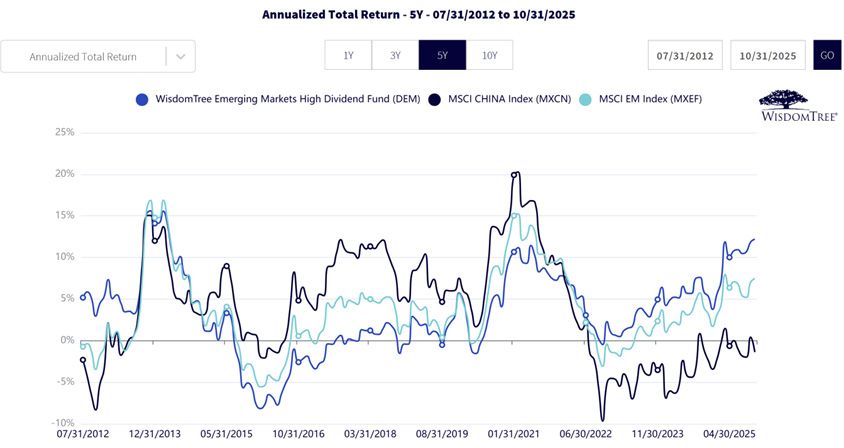
Sources: WisdomTree, FactSet, specifically data from the Fund Comparison Tool in the PATH suite of tools, accessed 11/28/25 with 5-Year annualized returns as of 10/31/25. The first 5-Year period is 7/31/07–7/31/12. NAV denotes total return performance at net asset value. Past performance is not indicative of future results. Investment return and principal value of an investment will fluctuate so that an investor's shares, when redeemed, may be worth more or less than their original cost. Current performance may be lower or higher than the performance data quoted. For the most recent month-end and standardized performance, click here.
Volatility Has Been the Real EmergingMarket Constant
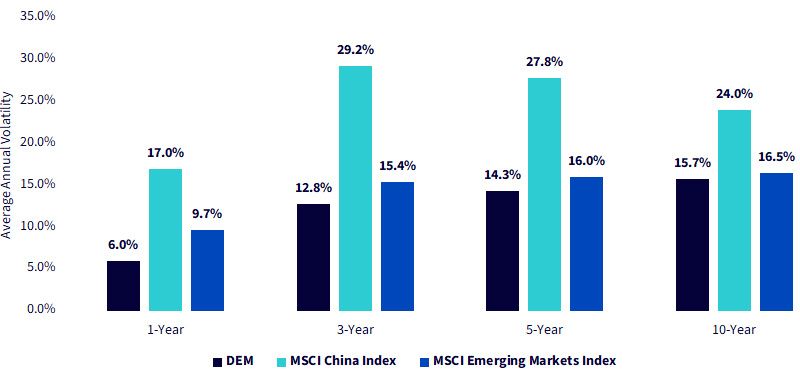
If return is one side of the coin, risk is the other, and volatility is how we measure that cost. The picture here is striking. Across every major time frame, China's equity market has been more volatile than both the broader MSCI Emerging Markets Index and DEM. By weighting toward companies with sustainable dividends, attractive valuations and often more mature balance sheets, DEM naturally dampens the noise that defines much of emerging market investing. Volatility doesn't just test conviction; it compounds against investors through behavioral mistakes and forced timing decisions. Reducing that volatility is about preserving the ability to stay invested through full cycles more than playing defense. The result is a steadier experience that allows compounding to work where emotion so often interrupts it.
Figure 4: Redefining Risk: DEM's Lower Volatility across 1-, 3-, 5- and 10-Year Horizons
Sources: WisdomTree, FactSet, specifically data from the Fund Comparison Tool in the PATH suite of tools, accessed 11/28/25 with average annual volatility of returns calculated as of 10/31/25. NAV denotes total return performance at net asset value. Past performance is not indicative of future results. Investment return and principal value of an investment will fluctuate so that an investor's shares, when redeemed, may be worth more or less than their original cost. Current performance may be lower or higher than the performance data quoted. For the most recent month-end and standardized performance, click here.
Valuation as Risk Management
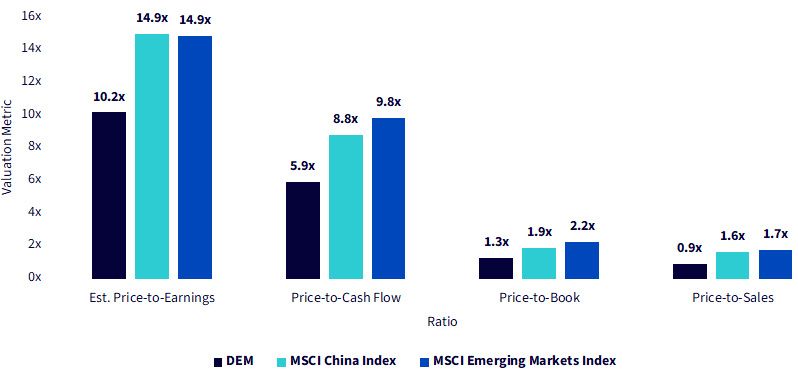
Another dimension of risk mitigation comes from valuation itself, or the price investors pay for exposure. Here, DEM's advantage becomes quantifiable. Across the different ratios shown in figure 5, DEM traded at meaningfully lower valuations than both the MSCI China Index and the broader MSCI Emerging Markets Index. The estimated P/E ratio in single-digit territory certainly stands out. Lower valuations aren't merely about buying "cheap." They're also about reducing the risk of multiple contraction and protecting downside when sentiment reverses. In markets as volatile as these, valuation is a cushion rather than a static measure.
Figure 5: How DEM Converts Valuation Discipline into Potential Risk Mitigation
Sources: WisdomTree, FactSet and Morningstar. Data as of 10/31/25, based on underlying strategy exposure data. Subject to change.
The Balance between Income and Growth
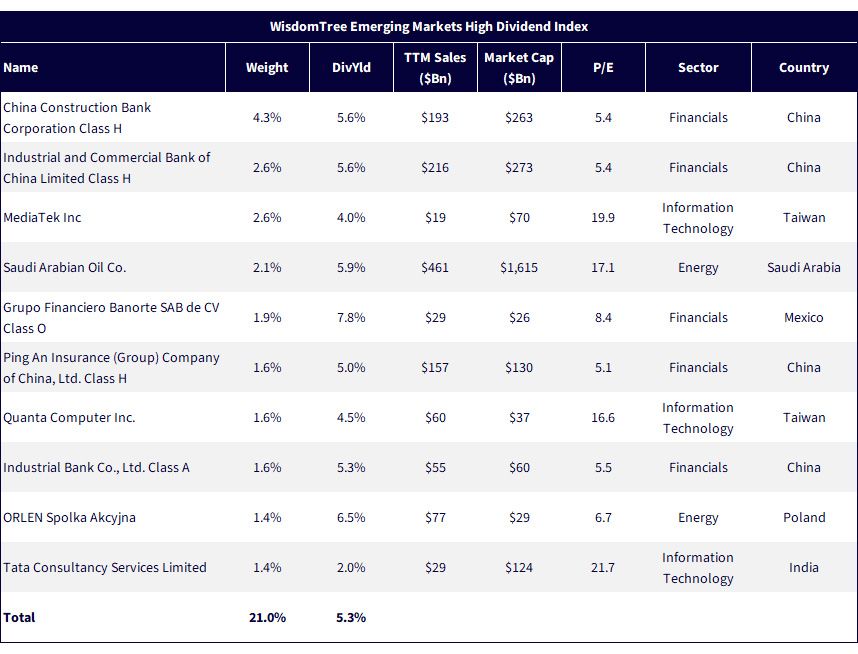
Comparing the top holdings of the WisdomTree Emerging Markets High Dividend Index and the MSCI Emerging Markets Index in figures 6a and 6b reveals a fundamental difference in philosophy. The WisdomTree Emerging Market High Dividend Index's largest constituents, such as China Construction Bank, Industrial and Commercial Bank of China, MediaTek and Grupo Banorte, are income-generating, dividend-paying franchises that combine profitability with tangible cash returns. Dividend yields across these top names often range from 5%–7%, supported by dividend cash flows and more modest valuations. By contrast, the MSCI Emerging Markets Index tilts heavily toward mega-cap growth champions like Taiwan Semiconductor, Tencent, Alibaba and Samsung, all companies that have delivered strong recent performance but carry richer valuations and minimal dividend income. These are engines of innovation, but they also embed greater sensitivity to sentiment and cyclical risk.
Positioning for Cycles, Not Moments
This contrast encapsulates two different ways to access emerging market potential. The MSCI index is positioned for what's working now: growth, scale and optimism in technology and consumer platforms. The WisdomTree Emerging Markets High Dividend Index, in turn, is built for what endures: valuation discipline, higher dividend-yield support and the compounding effect of reinvested dividends. If the 2025 cycle of technology-led recovery continues, DEM may lag in the near term. But the real insight lies in balance. When valuations compress or market leadership rotates, the characteristics that define DEM—cash flow, dividends and lower volatility—tend to provide resilience. In essence, this is a study in trade-offs: chasing momentum versus owning durability, accepting cyclicality versus anchoring in income. Over full cycles, the latter has historically proven to be the more stable and repeatable path to long-term returns.
Figure 6a: Top 10 Constituents of the WisdomTree Emerging Markets High Dividend Index
Sources: WisdomTree, FactSet, with data as of 9/30/25. Subject to change.
Figure 6b: Top 10 Constituents of the MSCI Emerging Markets Index
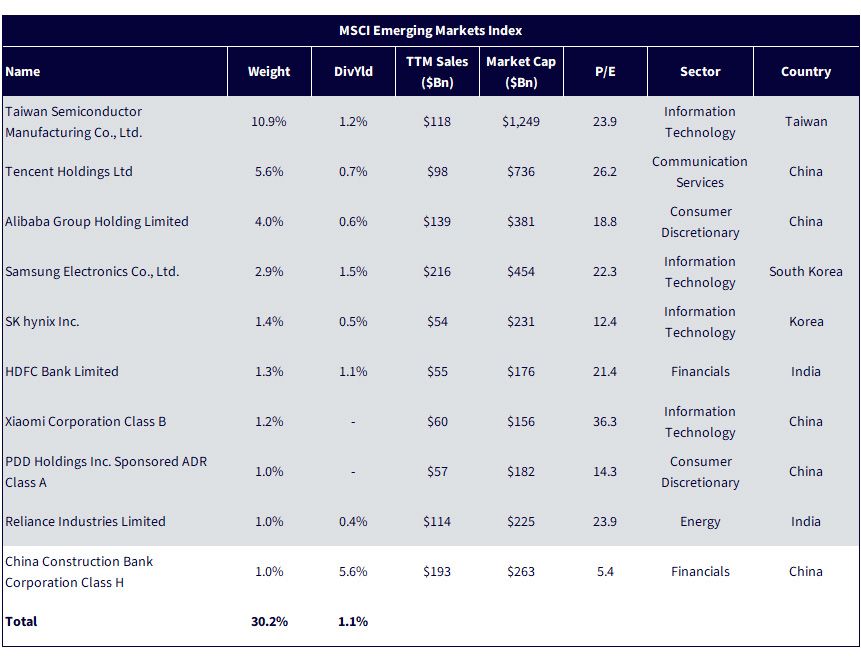
Sources: WisdomTree, FactSet, MSCI with data as of 9/30/25. Subject to change. Darker grey shading indicates the companies not included in figure 6a to show the contrast.
The Enduring Edge of Discipline
Emerging markets will always offer moments that captivate, including explosive rallies, compelling growth stories and the occasional sense that a "new era" has arrived. China's equity resurgence in 2025 has been exactly that kind of moment, a reminder of both the opportunity and the unpredictability embedded in these markets. But successful investing in this space is less about predicting the next surge and more about enduring through the ones that don't last. Volatility, liquidity shocks and valuation extremes are constants. What matters most is having a framework that converts those constants into advantages, and one that can compound through noise, not in spite of it.
That is precisely what the WisdomTree Emerging Markets High Dividend Index (tracked by DEM) represents: a design that translates risk management into long-term performance potential. Its lower volatility, disciplined valuations and income-centric construction create a margin of safety that's both mathematical and behavioral, reducing the chances of being forced out of markets when they turn against you. In a world where emerging markets will always oscillate between euphoria and anxiety, DEM's approach is about compounding through cycles rather than chasing them. The enduring edge belongs not to those who predict the next rally, but to those positioned to stay the course when others can't.
Important Risks Related to this Article
There are risks associated with investing, including the possible loss of principal. Foreign investing involves special risks, such as risk of loss from currency fluctuation or political or economic uncertainty. Funds focusing on a single sector generally experience greater price volatility. Investments in emerging, offshore or frontier markets are generally less liquid and less efficient than investments in developed markets and are subject to additional risks, such as risks of adverse governmental regulation, intervention and political developments. Due to the investment strategy of this Fund it may make higher capital gain distributions than other ETFs. Dividends are not guaranteed, and a company currently paying dividends may cease paying dividends at any time. Please read the Fund’s prospectus for specific details regarding the Fund’s risk profile.
Categories

About the contributor

Christopher Gannatti, CFA
Global Head of Research
Christopher Gannatti began at WisdomTree as a Research Analyst in December 2010, working directly with Jeremy Schwartz, CFA®, Director of Research. In January of 2014, he was promoted to Associate Director of Research where he was responsible to lead different groups of analysts and strategists within the broader Research team at WisdomTree. In February of 2018, Christopher was promoted to Head of Research, Europe, where he was based out of WisdomTree’s London office and was responsible for the full WisdomTree research effort within the European market, as well as supporting the UCITs platform globally. In November 2021, Christopher was promoted to Global Head of Research, now responsible for numerous communications on investment strategy globally, particularly in the thematic equity space. Christopher came to WisdomTree from Lord Abbett, where he worked for four and a half years as a Regional Consultant. He received his MBA in Quantitative Finance, Accounting, and Economics from NYU’s Stern School of Business in 2010, and he received his bachelor’s degree from Colgate University in Economics in 2006. Christopher is a holder of the Chartered Financial Analyst Designation.