
EPI
India Earnings Fund

Published August 28, 2025

Global Head of Research

Macro Strategist, Model Portfolios
India is on the cusp of a policy move that could redefine its consumption cycle. Prime Minister Narendra Modi, in his August 15 Independence Day address, announced "next generation GST reforms" to be implemented before Diwali 2025.1 The Finance Ministry has since outlined a plan for a two-tier GST system—5% for essentials and 18% for standard goods.2
The change is more than just administrative simplification. It has teeth: Small cars and many SUVs, currently taxed effectively at 29%–31% or higher, may fall to 18%. That is a direct reduction in household outlay on India's most aspirational consumer good—the passenger vehicle.
It's possible that this could deliver a 0.5%–0.6% of gross domestic product (GDP) equivalent fiscal stimulus, trimming consumer price index (CPI) inflation by ~40 basis points (bps) and lifting GDP growth by 50–70 bps.3 These are macro numbers with corporate balance sheet implications. In particular, they might set up India's two most important automakers—Maruti Suzuki and Mahindra & Mahindra—as outsized beneficiaries.
Autos are a politically and economically visible sector. They employ millions directly and indirectly, and they sit at the edge of affordability for households. That makes them hyper-sensitive to tax changes.
A GST cut rewires the industry's demand curve. Small cars, once affordable entry points, were squeezed by regulatory costs and higher levies. Sport utility vehicles (SUVs), increasingly dominant in the consumer preference mix, were stuck in the punitive 28%+ tax bucket. Both could benefit under a new 18% standard rate.
In effect, autos may provide investors with the cleanest, most levered way to play GST reform. And within autos, Maruti Suzuki and Mahindra & Mahindra represent two complementary strategies—the former tied to affordability and first-time buyers, the latter to SUVs, electric vehicles (EVs) and rural farm equipment.
For years, Maruti has been challenged by the shrinking of India's hatchback market. From 46% of sales in FY19, hatchbacks are now just 21%.4 First-time buyer affordability has been under siege.
Yet Maruti still has more thanhalf of its sales tied to small cars. What was a liability potentially becomes a weapon under GST reform. A drop from 29%–31% effective taxation to 18% could reset price points by double digits. That, coupled with rate cuts and rising real wages, is a powerful catalyst for reviving the entry-level market.
Operating leverage could magnify the benefit. We have seen recently raised FY26–FY28 earnings per share (EPS) forecasts for Maruti by 5%–7% on SUV launches and softer input costs—before even baking in GST reform.5 With volumes recovering in small cars, the earnings power looks stronger still.
Timing helps. On September 3, 2025, Maruti will launch a new five-seater SUV between the Brezza and Grand Vitara.6 Deliveries could begin in the festive season—just as tax cuts are expected. It is the rare case where policy and product calendars align.
If Maruti is the affordability reset story, Mahindra & Mahindra (M&M)could be the scale-up story.
M&M is India's SUV powerhouse. In Q1 FY26, auto revenues rose 32% YoY, with SUV volume growth guidance in the mid-to-high teens for FY26.7 Its SUVs—Scorpio, XUV700, Thar—are precisely in the tax bracket that would fall from 28% to 18%. For Mahindra, GST reform is gasoline on an already burning fire.
Unlike Maruti, Mahindra is not constrained to small cars. It straddles SUVs, EVs and farm equipment, giving it a hedge across urban aspirational demand and rural income growth.
Together, these drivers make Mahindra less dependent on a single segment and more insulated from policy or cyclical shocks. If GST is the tide, M&M is positioned with multiple boats in the water.
Watch the U.S.–India track. In April 2025, Washington and New Delhi set "terms of reference" for a bilateral trade agreement, reviving the possibility of a limited deal that could restore preferences or carve out supply-chain tariff relief. Indian officials said in mid-July that talks were "progressing," yet it was reported in early August that the negotiations stalled after new U.S. tariff moves, even as both sides left the door open to salvage an agreement. If a narrow package materializes, it would layer an external tailwind atop GST reform—helpful for export lines (components, select models) and input costs.15
Both Maruti and Mahindra now see exports as a structural leg of growth.
Exports provide both companies with diversification and an additional multiplier effect when domestic demand surges under the GST reform.
GST reform isn't a solo act; it lands in the middle of a tailwind stack that's already nudging India toward a stronger consumption pulse. Households have a little more cash in their pockets from recent tax relief. Borrowing costs are easing, and if inflation cools further, the cost of money can drift lower still. Hiring is broadening beyond tech into the everyday economy, and pay packets are stretching a bit farther as prices stabilize. Out in the hinterland, a cooperative monsoon and healthy sowing season are doing what they always do—quietly underwriting rural demand.
Put together, that's not just noise around the edges; it's a tone change. This is the kind of backdrop where a price-level reset like GST doesn't merely trim the sticker, it changes the psychology of buying. First-time buyers who've been on the fence suddenly see the numbers pencil out. That's Maruti's sweet spot. At the same time, aspirational upgrades don't feel like a stretch when credit is easier and incomes feel less fragile. That's where Mahindra's SUVs and even tractors on the rural side find fresh fuel.
In short, policy is meeting momentum. GST is the spark, but the tinder (cash flow, credit, confidence and countryside) is already dry. That's why this doesn't read as a one-quarter blip. It reads like the opening chapter of the next consumption leg.
GST reform could be India's most significant consumption reset in a decade. For investors, the clearest expression lies in autos.
Together, they offer two complementary exposures to India's consumption surge. One revives the first-time buyer; the other monetizes aspirational upgrades and rural strength. Both reflect the potential multiplier power of tax cuts.
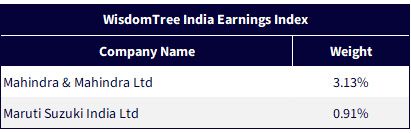
In 2008, the WisdomTree India Earnings Fund (EPI) was launched, and it is designed to track the total return performance of the WisdomTree India Earnings Index. This strategy seeks to include the profitable companies of India across the market capitalization spectrum, and these companies are weighted by earnings. As of August 18, 2025, both Maruti Suzuki and Mahindra & Mahindra were constituents, as is visible in figure 1.
Figure 1: Riding into Potential Tax Relief—Maruti Suzuki andM&M Exposure in the WisdomTree India Earnings Index
Source: WisdomTree, with data as of 8/18/25. Holdings subject to change.
1 N. Modi, "English rendering of the text of Prime Minister Shri Narendra Modi's address from the ramparts of Red Fort on the occasion of 79th Independence Day" [speech transcript], Press Information Bureau, Prime Minister's office, 8/15/25.
2 Source: N. Ohri, "India's complex GST tax and how Modi's reform will make goods cheaper," Reuters, 8/19/25.
3 Source: U. Chachra and B. Gambhir, "Ecoview: Fiscal policy steps in to boost consumption" (India Economics | Asia Pacific) [research report], Morgan Stanley India Company Private Limited, 8/17/25.
4 Source: "Q1 FY26 earnings conference call" [transcript]. Maruti Suzuki India Limited, 7/31/25.
5 Source: C. Muthiah, K. Yuzawa and R. Rathi, "Maruti Suzuki India (MRTI.BO): Adding upcoming 5 seater SUV to our estimates" [equity research report], Goldman Sachs Global Investment Research, 8/18/25.
6 Source: Muthiah et al., 2025.
7 Sources: B/ Singh and S. Ghalsashi, "F1Q26—In-line quarter; 2026 & beyond pipeline in focus" [research update], Morgan Stanley India Company Private Limited, 7/30/25; C. Muthiah, K. Yuzawa and R. Rathi, "Mahindra & Mahindra (MAHM.BO): 1Q beat—Pricing power + EV margins fortify setup into next launch phase; Buy (on CL)" [equity research report], Goldman Sachs Global Investment Research, 7/31/25.
8 MEAL stands for Mahindra Electric Automobile Limited.
9 EBITDA stands for earnings before interest, taxes, depreciation and amortization.
10 BEV stands for battery electric vehicles.
11 Source: Singh & Ghalsashi, 2025.
12 Source: Muthiah et al., 2025.
13 EBIT stands for earnings before interest and taxes.
14 Source: Muthiah et al., 2025; Chachra & Gambhir, 2025.
15 Sources: "FACT SHEET: U.S.–India establish terms of reference on bilateral trade agreement," Office of the U.S. Trade Representative , April 2025; "India–US trade deal progressing as per terms of reference, says govt official," New Indian Express, 7/15/25; "Missed signals, lost deal: How India–US trade talks collapsed," Reuters, 8/6/25.
16 Source: Maruti Suzuki India Limited, 2025.
17 Source: Singh & Ghalsashi, 2025.
For current holdings of EPI, please click here. Holdings are subject to risk and change.
You cannot directly invest in an index.
There are risks associated with investing, including the possible loss of principal. Foreign investing involves special risks, such as risk of loss from currency fluctuation or political or economic uncertainty. This Fund focuses its investments in India, thereby increasing the impact of events and developments associated with the region that can adversely affect performance. Investments in emerging, offshore or frontier markets such as India are generally less liquid and less efficient than investments in developed markets and are subject to additional risks, such as risks of adverse governmental regulation and intervention or political developments. As this Fund has a high concentration in some sectors, the Fund can be adversely affected by changes in those sectors. Due to the investment strategy of this Fund, it may make higher capital gain distributions than other ETFs. Please read the Fund’s prospectus for specific details regarding the Fund’s risk profile.
India Earnings Fund

Global Head of Research
Christopher Gannatti began at WisdomTree as a Research Analyst in December 2010, working directly with Jeremy Schwartz, CFA®, Director of Research. In January of 2014, he was promoted to Associate Director of Research where he was responsible to lead different groups of analysts and strategists within the broader Research team at WisdomTree. In February of 2018, Christopher was promoted to Head of Research, Europe, where he was based out of WisdomTree’s London office and was responsible for the full WisdomTree research effort within the European market, as well as supporting the UCITs platform globally. In November 2021, Christopher was promoted to Global Head of Research, now responsible for numerous communications on investment strategy globally, particularly in the thematic equity space. Christopher came to WisdomTree from Lord Abbett, where he worked for four and a half years as a Regional Consultant. He received his MBA in Quantitative Finance, Accounting, and Economics from NYU’s Stern School of Business in 2010, and he received his bachelor’s degree from Colgate University in Economics in 2006. Christopher is a holder of the Chartered Financial Analyst Designation.

Macro Strategist, Model Portfolios
Samuel Rines is a Macro Strategist at WisdomTree, where he extends the firm's custom model portfolio management capabilities. Before joining WisdomTree in 2024, he was the Managing Director at CORBU, LLC, leading the PolyMacro advisory product. With over a decade of experience in economics and finance, Samuel has held significant roles such as Chief Economist at Avalon Investment & Advisory and Economist and Portfolio Manager at Chilton Capital Management LLC. He is also the author of "After Normal: Making Sense of the Global Economy," and holds a Master’s degree in Economics from the UNH Peter T. Paul College of Business and Economics, as well as having studied Economics at the University of Oxford.


