
DEM
Emerging Markets High Dividend Fund

Published October 30, 2025

Research Analyst
Emerging markets (EM) have been on a tear in 2025.
The MSCI Emerging Markets Index is up nearly 27% compared to the 14% year-to-date returns for the S&P 500. A lot of those gains have come from China—and China tech in particular, which is riding the wave of AI enthusiasm.
WisdomTree's Emerging Market Dividend Indexes—grounded in fundamentals—can help mitigate potential frothiness that appears to be a top investor concern across risk assets globally.
In October, WisdomTree's Emerging Markets Dividend Index family—including the Emerging Markets Dividend Index, Emerging Markets SmallCap Dividend Index and Emerging Markets High Dividend Index—completed their annual rebalances.
Unlike traditional market cap-weighted benchmarks such as the MSCI EM Index, these WisdomTree Indexes base constituent weights on cash dividends. This approach rewards companies that return more capital to shareholders, aligning weights with what companies pay, not what investors bid up.
Figure 1: WisdomTree and MSCI Index Dividend Yields
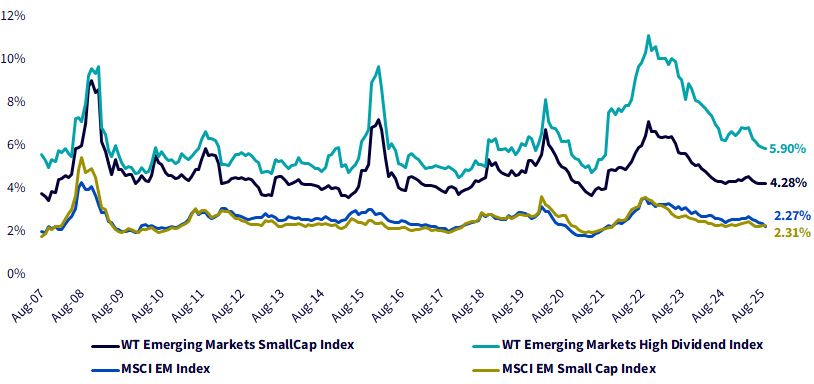
Sources: WisdomTree, FactSet, MSCI. Data 8/31/07–9/30/25. Past performance is not indicative of future results. You cannot invest directly in an index.
Dividend investing in EM can feel counterintuitive—after all, many investors view EM as a pure growth story. Yet, WisdomTree's research shows that a dividend-weighted approach captures both the income and total return potential of these regions.
As global capital flows shift across regions, these qualities can help investors participate in the growth of EM with a margin of quality and dividend income.
In the more inefficient markets within EM, WisdomTree's rules-based approach has had some of its best long-run relative performance versus traditional market cap-weighted benchmarks.
Figure 2: Cumulative Total Returns
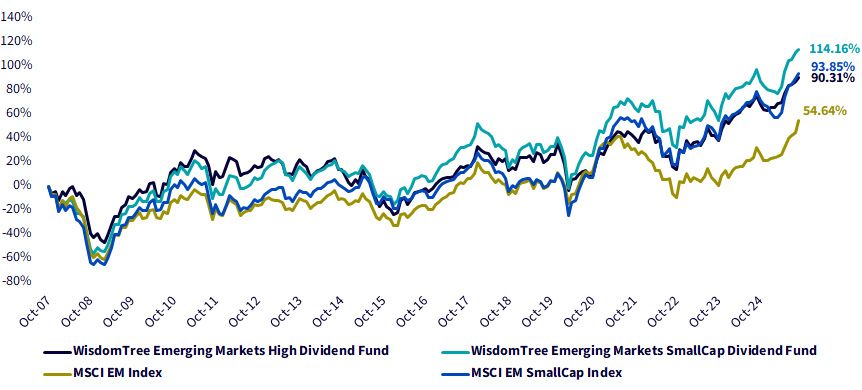
Sources: WisdomTree, FactSet, MSCI. Data 10/31/07–9/30/25. Time period coincides with launch of the WisdomTree Emerging Markets SmallCap Dividend Fund. You cannot invest directly in an index. Past performance is not indicative of future results. The performance data quoted represents past performance and is not indicative of future results. Investment return and principal value of an investment will fluctuate so that an investor's shares, when redeemed, may be worth more or less than their original cost. Current performance may be lower or higher than the performance data quoted. For the most recent month-end and standardized performances, click the respective ticker: DEM, DGS.
This year's rebalance brought notable improvements across multiple metrics.
These characteristics highlight the benefit of systematically reweighting toward fundamentals rather than chasing momentum.
Figure 3: Rebalance Fundamentals Changes
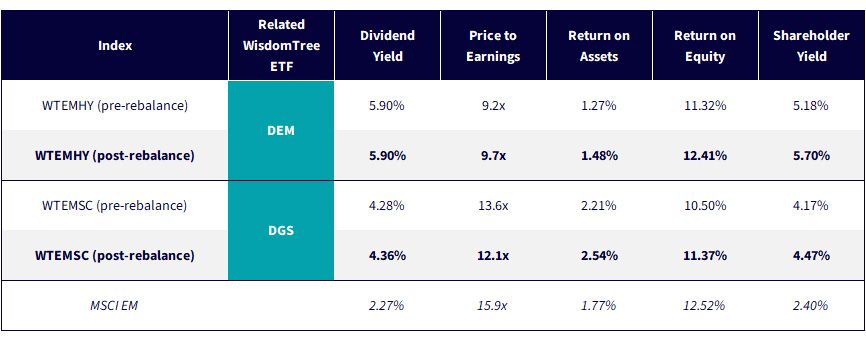
Sources: WisdomTree, FactSet, MSCI. Data as of 9/30/25. Past performance is not indicative of future results. You cannot invest directly in an index. All fundamentals shown (including Dividend Yield) reflect index characteristics only and do not represent the characteristics or yields of the related WisdomTree ETFs.
For the High Dividend Index, sector changes were modest but important. Weight was reduced across certain cyclical sectors—Energy, Financials, Materials—while increased to Consumer Staples and Information Technology. This tradeoff explains the characteristics we saw with a slightly higher P/E ratio, unchanged dividend yield and improved profitability.
Figure 4: WisdomTree Emerging Markets High Dividend Index Sector Changes
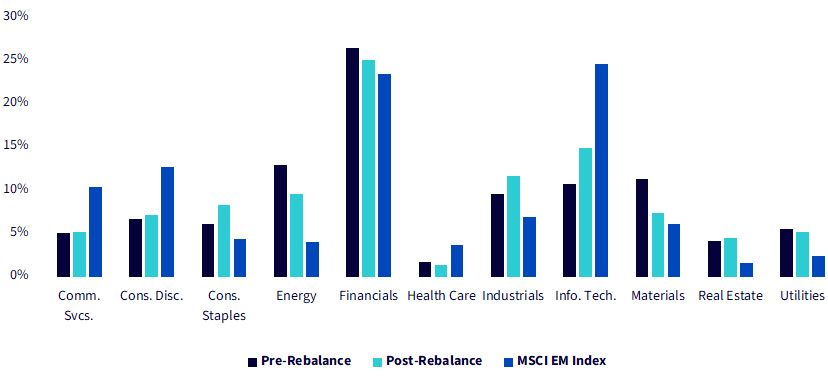
Sources: WisdomTree, FactSet, MSCI. Data as of 9/30/25. You cannot invest directly in an index.
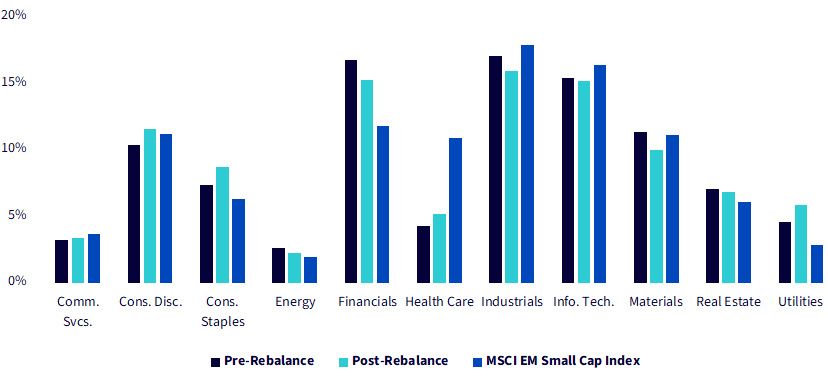
For the SmallCap Index, sector changes were negligible.
Figure 5: WisdomTree Emerging Markets SmallCap Dividend Index Sector Changes
Sources: WisdomTree, FactSet, MSCI. Data as of 9/30/25. You cannot invest directly in an index.
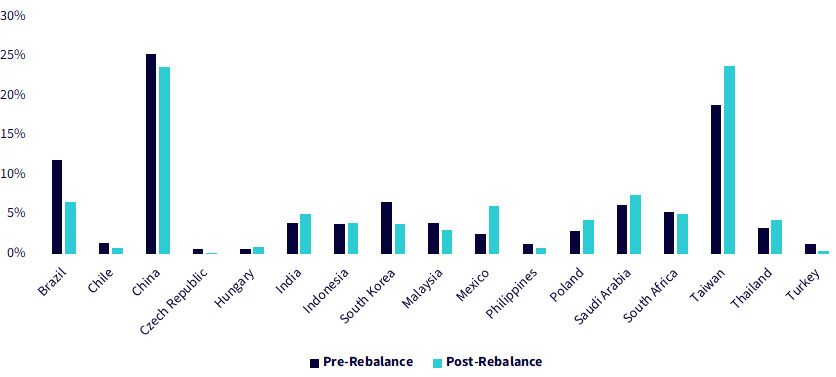
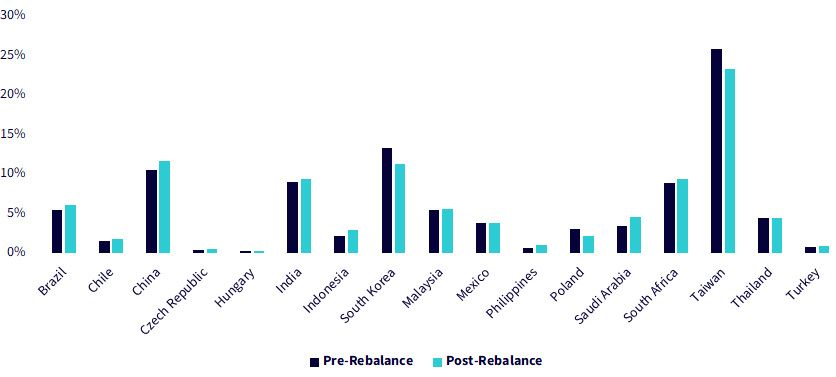
Country changes were also muted across both Indexes. For the High Dividend Index, notable changes were decreases to Brazil, Korea and China and increases to Mexico and Taiwan.
Figure 6: WisdomTree Emerging Markets High Dividend Index Select Country Changes
Sources: WisdomTree, FactSet, MSCI. Data as of 9/30/25. You cannot invest directly in an index.
Figure 7: WisdomTree Emerging Markets SmallCap Dividend Index Select Country Changes
Sources: WisdomTree, FactSet, MSCI. Data as of 9/30/25. You cannot invest directly in an index.
For additional detail on the rebalance of each of the Indexes, please go to their respective Index page on the WisdomTree website:
There are risks associated with investing, including the possible loss of principal. Foreign investing involves special risks, such as risk of loss from currency fluctuation or political or economic uncertainty.
DEM: Funds focusing on a single sector generally experience greater price volatility. Investments in emerging, offshore or frontier markets are generally less liquid and less efficient than investments in developed markets and are subject to additional risks, such as risks of adverse governmental regulation, intervention and political developments. Due to the investment strategy of this Fund it may make higher capital gain distributions than other ETFs. Dividends are not guaranteed, and a company currently paying dividends may cease paying dividends at any time.
DGS: Funds focusing on a single sector and/or smaller companies generally experience greater price volatility. Investments in emerging, offshore or frontier markets are generally less liquid and less efficient than investments in developed markets and are subject to additional risks, such as risks of adverse governmental regulation, intervention and political developments. Due to the investment strategy of this Fund it may make higher capital gain distributions than other ETFs. Dividends are not guaranteed, and a company currently paying dividends may cease paying dividends at any time.
Please read the Fund’s prospectus for specific details regarding the Fund’s risk profile.

Research Analyst
Hyun Kang joined WisdomTree in July 2022 as a Research Analyst. As a part of the Index team, he assists with the creation and maintenance of the firm’s indexes and supports the group’s research initiatives across various strategies. Hyun graduated from Carnegie Mellon University, with a B.S. in Business Administration and an additional major in Statistics and Machine Learning.