


Buffett Back for More in Japan
Published April 26, 2023

Hyun Kang
Research Analyst
The Oracle of Omaha is upping the stakes in his bet on Japan, bringing his investments in each of Japan’s five largest trading companies from 5% to 7.4%.
Berkshire Hathaway revealed in August 2020 that it had invested over $6 billion in major Japanese general trading companies Sumitomo, Marubeni, Mitsui & Co., Mitsubishi and Itochu; establishing a 5% stake in each.
These trading companies, or sogo sosha, are household names not only in Japan but around the world, and their myriad business activities range from trading natural gas to manufacturing cruise ships.
Buffett already went for seconds (or more) following his initial plunge and had increased his ownership to between 6.2% and 6.8% across the companies by November last year. And the billionaire investor is showing no signs of slowing down.
We previously discussed Buffett’s strategy to issue yen-denominated bonds to hedge against unfavorable yen-dollar movements: a goal shared by the WisdomTree Japan Hedged Equity Index.
Since then, the yen slid further as the Index and Buffett’s Japanese basket saw greater returns, having put to full use their currency hedging mechanisms.
Total Returns, 8/28/20–4/10/23
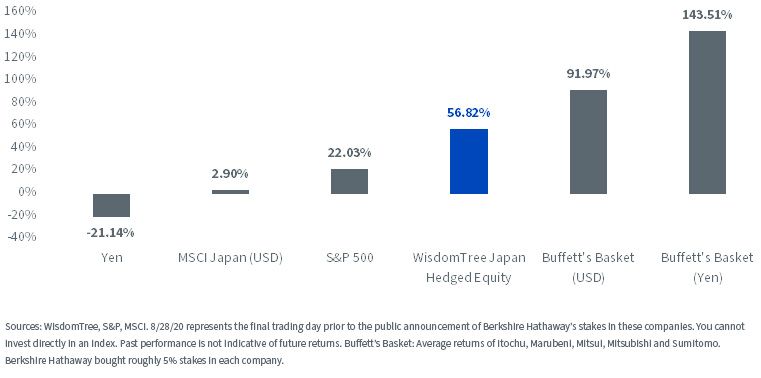
For definitions of terms in the chart above, please visit the glossary.
In an interview during his April trip to Japan, Buffett told Nikkei, “We would love if any of the five [companies] would come to us ever and say, ‘We’re thinking of doing something very big or we’re about to buy something and we would like a partner or whatever.’”
Fundamentals
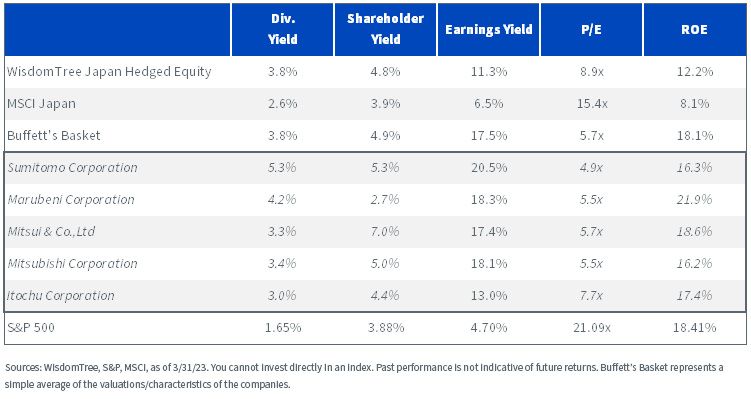
In another interview with CNBC’s Becky Quick during his Tokyo trip, Buffett effectively said he was putting his stamp of approval on investing in Japan. He went on to describe how the five companies he had acquired had 14% earnings yields at the time of his purchase when interest rates were effectively zero.
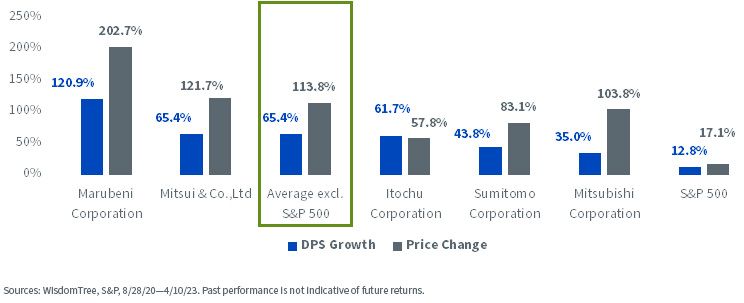
Buffett said the companies reportedly grew dividends by 70%. “It has worked out even better than expected,” he said. Japan is now Berkshire’s largest country in terms of investments outside the U.S.
Marubeni Corporation grew its dividends by a whopping 120% since August 2020. Mitsubishi Corporation saw a modest growth of 35%. By comparison, the S&P 500 increased its dividends by 12.8% through the same period.
Dividends per Share and Price Increase of Buffett’s Japanese Stocks Since Initial Investment
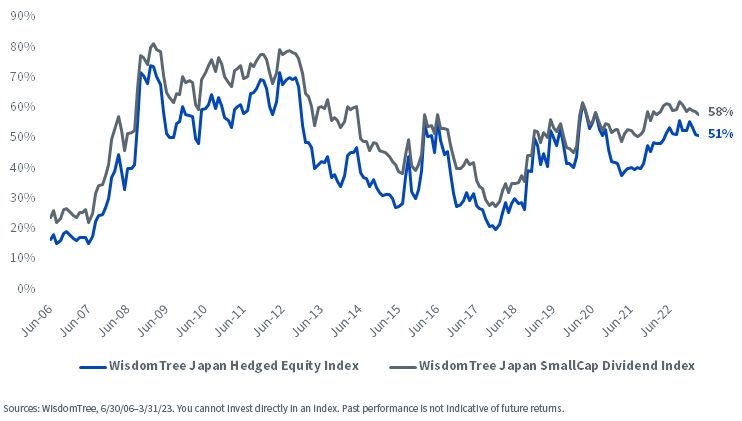
These five trading companies raising their dividends is emblematic of what is happening across Japan as pressures to improve shareholder returns pile on, as we discussed in this blog about actions the Tokyo Stock Exchange is taking on companies trading at prices below their book values.
Percentage of WisdomTree Index Constituents with a Price-to-Book under 1.0
Japanese companies have some of the highest levels of cash on their balance sheets, which depresses returns on equity compared to companies in the U.S. This cash, however, is also the driving force behind sustained dividend growth.
The aggregate dividend yield on the WisdomTree Japan Hedged Equity Index is almost 4%—close to that of the highest-dividend subset of the U.S. market–while the S&P 500 Index currently has an aggregate dividend yield of around 1.6%.
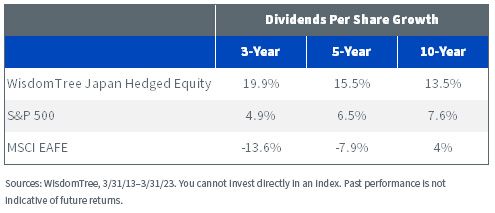
Over the last decade, the WisdomTree Japan Hedged Equity Index’s dividends per share increased by 13.5% annually, compared to more modest increases for the S&P 500 and the MSCI EAFE index.
The WisdomTree Japan Hedged Equity Index’s dividends surged ahead of the S&P 500’s in the last three years and in the last five years, while developed markets saw significant aggregate decreases.
Index Dividends Per Share Growth Over the Last 10 Years, Annualized
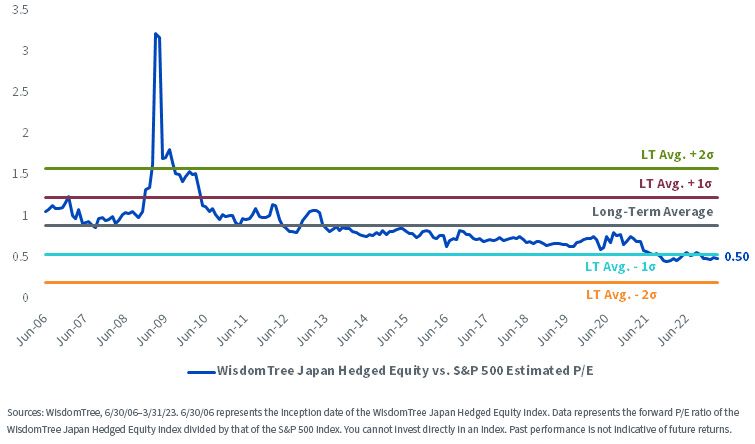
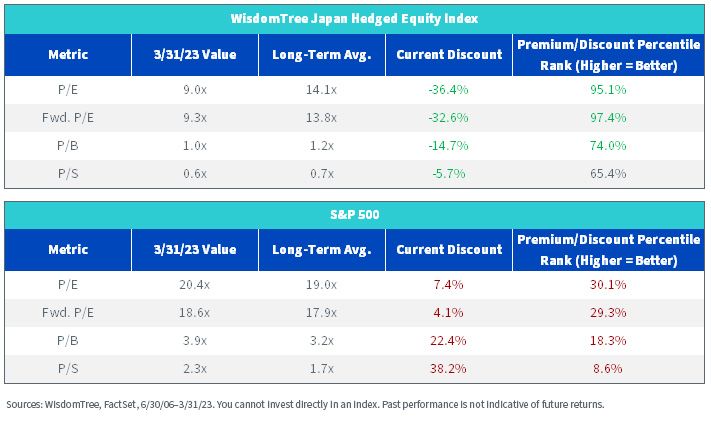
The WisdomTree Japan Hedged Equity Index has also been trading at a discount to the S&P 500 for the last decade and currently trades at half of the S&P 500’s forward P/E.
WisdomTree Japan Hedged Equity vs. S&P 500 Forward P/E Since Inception
WisdomTree Japan Hedged Equity vs. S&P 500 Valuation Discounts
Categories
Related articles

From Trading Houses to Tokio Marine: Buffett’s Expanding Bet on Japan

A Playbook for the Currency Opportunity in Today’s Market

Tariffs Are (Sort of) Done: What the Supreme Court Ruling Means for Markets
Japan’s Moment: Elections, Flows & Global Opportunities
An Update on the Japan Opportunities
The Power of Hedging in a Year of Yen Swings
The Power of Framing a Story in Investing
Japan's Equities Are Seeing a Performance Acceleration
Japan's Turning Point: From Value Trap to Leadership Opportunity
About the contributor

Hyun Kang
Research Analyst
Hyun Kang joined WisdomTree in July 2022 as a Research Analyst. As a part of the Index team, he assists with the creation and maintenance of the firm’s indexes and supports the group’s research initiatives across various strategies. Hyun graduated from Carnegie Mellon University, with a B.S. in Business Administration and an additional major in Statistics and Machine Learning.