


Wings of Change
Published August 14, 2025

Christopher Gannatti, CFA
Global Head of Research

Samuel Rines
Macro Strategist, Model Portfolios
Key Takeaways
- Europe Accelerates Drone Development: In response to the Ukraine war and changing global alliances, the EU and NATO are investing heavily in sovereign drone capabilities for ISR and strike missions, aiming to reduce reliance on U.S. and Israeli systems.
- Saab Leads in Drone Autonomy: Sweden’s Saab is advancing drone swarm tech and “loyal wingman” combat drones, supported by powerful C2 software—placing it among the global leaders in autonomous UAVs.
- Leonardo’s Strategic Partnership: Italy’s Leonardo and Turkey’s Baykar have formed a joint venture blending Baykar’s TB2 drones with Leonardo’s EU presence, creating a major transcontinental drone force in Europe.
- Anduril-Rheinmetall Alliance: U.S.-based Anduril and Germany’s Rheinmetall are co-developing NATO-ready, modular drones. The partnership reflects a shift toward rapid, locally controlled production—giving U.S. investors strategic exposure to Europe’s defense buildout.
Drones and Deterrence
Drones have proven their worth from Ukraine to the Middle East, where coordinated UAV swarms have emerged. Small, intelligent flying machines can spot targets, overwhelm defenses and link seamlessly with ground and air units—capabilities once confined to superpower arsenals. For Europe, which watched improvised drone tactics halt armor advances in Ukraine, investing in indigenous UAV technology is not optional; it's imperative and comparatively cheap. Against this backdrop, two companies—Saab and Leonardo—stand out as champions of Europe's drone evolution, each in its own way
Saab Swarming Ahead
From turbocharged sedans to AI-powered drone swarms—Sweden's defense takes giant steps into the autonomous era.
When most U.S. investors hear "Saab," they think of a discontinued line of turbocharged sedans, not cutting-edge military swarms. But the Saab that made cars is long gone—divested in the early 2000s. What remains, and has quietly flourished, is a high-performance defense company deeply embedded in Europe's military-industrial backbone. Saab AB today is not just about Gripen fighter jets and coastal defense radars; it's now positioning itself at the frontier of autonomous warfare, investing heavily in AI-enabled systems and multi-domain integration.1
Rather than churning out large numbers of small drones, Saab's approach is to make drones smarter, more autonomous and better integrated. A recent milestone underscores this: In early 2025, the Swedish Armed Forces unveiled a Saab-developed drone swarm program enabling one operator to control up to 100 UAVs simultaneously.2 In trials scheduled during Arctic exercises, these swarms are expected to autonomously adapt to missions ranging from reconnaissance to payload delivery in complex environments.
Figure 1: Saab's Multi-Domain Push into Next-Gen Defense
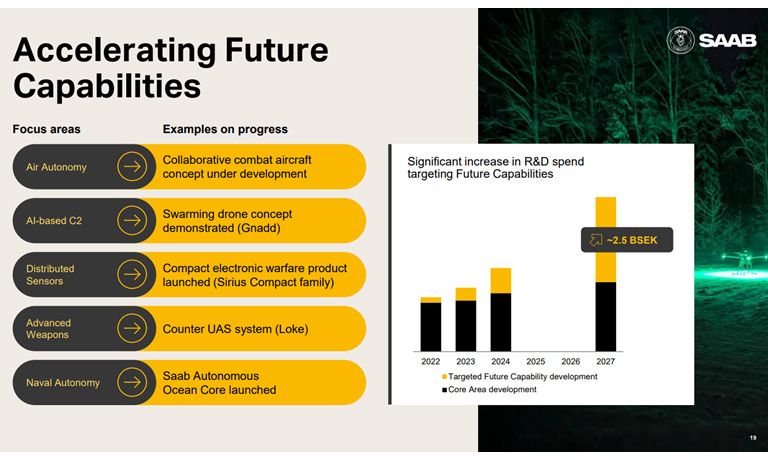
Source: Saab Capital Markets presentation, as of 5/28/25. "C2" stands for command and control. "UAS" stands for unmanned aircraft system. "2.5 BSEK" stands for 2.5 billion Swedish kronor.
Saab's leadership openly emphasizes this autonomy-first ethos. "It's a lot about the autonomy," CEO Micael Johansson noted at Saab's Capital Markets Day, explaining that Saab is platform-agnostic about drone airframes—the real value is in the AI-driven command and control.3 Indeed, Saab is already working on a "collaborative combat aircraft"—effectively a loyal wingman drone to fly alongside piloted fighters. And for the smaller UAVs, Saab's focus is on the brains: In demonstrations, young conscripts with a tablet can simply draw a patrol route, and a drone swarm will execute it, self-organizing and rerouting if some drones are lost. This high level of autonomy means minimal training and manpower are needed to deploy advanced drones—a key advantage for European militaries facing personnel constraints.
Leonardo: Forging the Future with Partnerships and Firepower
In the sunny Italian skies, Leonardo S.p.A. is taking a more expansive route to drone dominance—one that leverages its broad product portfolio and pan-European ties. As one of Europe's largest aerospace and defense firms, Leonardo has its hands in everything from helicopters to cybersecurity. When it comes to UAVs, that means both developing drones in-house and teaming up with partners to fill capability gaps quickly. This twin-track strategy is evident in two major moves: the launch of Leonardo's new Falco Astore armed drone and a landmark joint venture with Turkey's famed drone maker Baykar.4
First, the homegrown effort. The Astore (Italian for "goshawk"5) is Leonardo's latest medium-altitude long-endurance (MALE) UAV—essentially a beefed-up, weaponized iteration of its earlier Falco EVO.6 With a 650-kilogram maximum takeoff weight, 16-hour endurance and newly added underwing pylons, the Astore can carry around 70 kilograms of cargo.7 The Astore gives Italy a measure of self-reliance in unmanned strike capability, showing how European states are looking to their domestic industry to increase readiness now, rather than waiting years for pan-European projects. It's a gentle reminder that Europe's quest for strategic autonomy extends to having homegrown "eyes in the sky." Leonardo's Falco line, which started as unarmed surveillance drones, has now evolved into a combat UAS—a narrative of adaptation that mirrors Europe's own shift from peacekeeping posture to defense.
Figure 2: Building Europe's Drone Sovereignty—One Baykar–Leonardo System at a Time
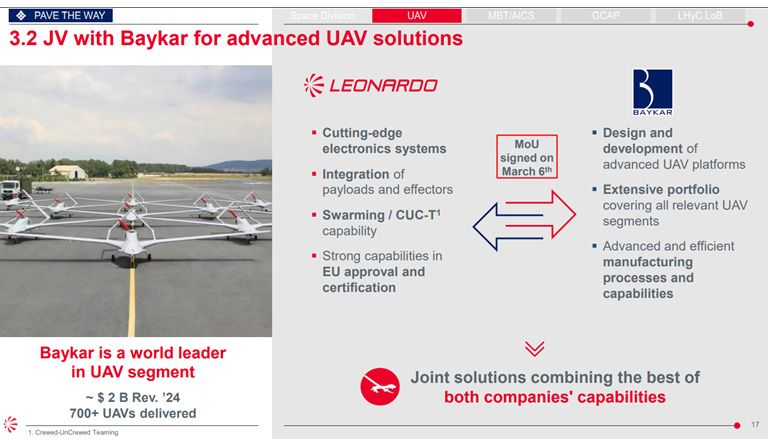
Source: Leonardo SpA Industrial Plan Update. "JV" stands for joint venture. "UAV" stands for unmanned autonomous vehicle. "$2 B" stands for $2 billion. "CUC-T" stands for Crewed-UnCrewed Teaming. "MoU" stands for memorandum of understanding.
Leonardo's unprecedented 50:50 joint venture for unmanned systems, named LBA Systems and based in Italy, aims to be a "key player in unmanned technologies" by combining forces: Baykar brings its world-class drone platforms (like the battle-proven TB2 and the jet-powered Kızılelma8) while Leonardo contributes its expertise in sensors, electronics and system integration. The logic is compelling. Europe's militaries have an insatiable demand for capable drones—a market valued at more than $100 billion in the next decade9—and Baykar's combat-tested UAVs are among the best. By partnering, Leonardo essentially shortcuts the R&D cycle, gaining access to a portfolio covering "all relevant UAS segments" from tactical mini-drones to high-end combat drones. In return, Baykar gets a production foothold in the EU and the benefit of Leonardo's integration and certification know-how (crucial for selling to Western militaries).
From California to the Frontlines of Europe: Anduril's Drones Go NATO
Anduril Industries—arguably the most recognizable U.S. defense tech startup in 2025—is now embedding its high-speed innovation model inside Europe's defense industrial base. In June, Anduril announced a strategic partnership with Germany's Rheinmetall to co-develop and manufacture European variants of its Barracuda and Fury autonomous drones, along with a push into solid rocket motor production.10 While early in execution, the venture signals a critical shift: American-born software-defined weapons systems are now being localized for NATO's European theaters, with sovereign production, modular design and rapid deployment at the core of the collaboration.
This isn't just another export deal—it's a transatlantic fusion of industrial scale and AI-first defense architecture. Anduril's systems, once known primarily for border surveillance and counter-UAS roles, are now evolving into interoperable platforms tailored to the operational demands and regulatory constraints of Europe. Rheinmetall brings manufacturing scale and deep NATO alignment; Anduril brings autonomy, modularity and digital adaptability. If you're watching how autonomous warfare is industrializing globally, this partnership is not just worth noting—it's worth tracking.
Conclusion: A New Era of European Defense—Narrative and Numbers Alike
It is often said that necessity breeds innovation. Europe's present necessity—to bolster its defense amid war on its doorstep—is breeding a new wave of innovation in drones, with Saab and Leonardo at the vanguard. These two firms offer a fascinating contrast in approach that also happens to be complementary. Saab, hailing from a non-aligned-now NATO nation of modest size, plays to its strengths by making systems smarter rather than larger. Its narrative is one of qualitative edge: a swarm that can reroute itself, a drone that can think like a pilot's teammate, a network of sensors that can confound a much bigger foe. Leonardo, by contrast, comes from one of Europe's big defense spenders and embraces a scale and scope strategy: covering every market segment through a mix of indigenous development and strategic partnerships, ensuring that Europe has ready access to the full spectrum of unmanned tech.
From a geopolitical perspective, these advancements feed into Europe's broader strategic autonomy. Drones are eyes and ears, but also increasingly shields and spears. A Europe equipped with its own high-end drones can better monitor its borders, deter aggression and operate independently when needed.
A few years ago, European defense firms were often seen as stodgy value plays, reliant on slow procurement cycles. That is no longer the narrative. Now it is one of urgency, growth and technological leapfrogging. And drones are a critical part of the story of European defense. In a world of growing complexity, Europe's defense industry is not just responding to change—it's helping drive it, one drone at a time.
For U.S. investors seeking to capitalize on the modernization of Europe's defense architecture, the WisdomTree Europe Defense Fund (WDEF) offers focused exposure to the companies shaping this transformation from the ground up. Names like Saab, Leonardo and Rheinmetall aren't just regional champions; they're critical suppliers in NATO's evolving force posture, beneficiaries of sharply rising defense budgets and innovators in next-generation military technologies. WDEF provides a systematic, transparent gateway into these developments, aligning portfolio exposure with the geopolitical realities of a more contested world. In essence, it turns a transatlantic challenge into a transatlantic opportunity—bridging narrative and capital across borders.
Figure 3: Exposure in WDEF to the Companies Discussed in This Piece
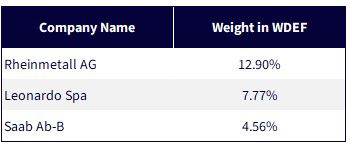
Source: WisdomTree, with data as of the market's open on 7/17/25, the first day of trading for WDEF. Subject to change.
1 Source: "Saab CEO Micael Johansson on the future of warfare and why Europe needs its own ‘Golden Dome,'" Time, 7/6/25.
2 Source: J. Osborne, "Saab unveils secret drone swarming capability for Swedish military," Aviation Week Network, 1/14/25.
3 Source: "Saab's Capital Markets Day 2025: Wellpositioned for future growth" [press release], Saab AB, 5/27/25.
4 Sources: "Italy to acquire Leonardo Astore armed drones" [news release], Defence Industry Europe, 1/14/24; "Leonardo and Baykar sign a partnership for unmanned technologies" [press release], Leonardo S.p.A, 3/6/25.
5 A goshawk is a bird of prey.
6 EVO is short for "evolution" and typically references a particular platform iteration for a piece of hardware, such as a drone.
7 Source: "Italy to acquire Leonardo Astore armed drones," Defence Industry Europe, 1/14/24.
8 Kızılelma is Baykar's jet-powered, carrier-capable unmanned combat aerial vehicle (UCAV)—Turkey's first of its kind.
9 Source: B. Finch, "Leonardo chief says Trump has given Europe ‘unprecedented' urgency on defence," Financial Times, 3/6/25.
10 Source: "Anduril, Rheinmetall partner to build military drones for Europe," Reuters, 6/18/25.
Important Risks Related to this Article
There are risks associated with investing, including the potential loss of principal. Foreign investing involves specific risks, such as risk of loss from currency fluctuation or political or economic uncertainty. Funds focusing their investments on certain sectors increase their vulnerability to any single economic or regulatory development. This may result in greater share price volatility. This Fund focuses its investments in Europe, thereby increasing the impact of events and developments in Europe that can adversely affect performance. Europe has and may continue to experience security concerns, war, threats of war, aggression and/or conflict, terrorism, economic uncertainty, sanctions or the threat of sanctions, natural and environmental disasters, the spread of infectious illness, widespread disease or other public health issues and/or systemic market dislocations that lead to increased short-term market volatility and have adverse long-term effects on European and world economies and disrupt the orderly functioning of securities markets generally, which may negatively impact the Fund’s investments. Many countries within Europe are closely connected, and their economies and markets are largely interdependent. As such, economic and political events in one European country, including monetary exchange rates between European countries and armed conflicts among two or more European countries, may have adverse effects across Europe. European countries that are members of the European Union (“EU”) and the European Economic and Monetary Union (“EMU”) are subject to certain economic and monetary policies and controls and the risks associated with such coordinated economic and fiscal policies. Because the Fund invests primarily in the securities of companies in Europe, the Fund’s performance is expected to be closely tied to social, political and economic conditions within Europe and to be more volatile than the performance of more geographically diversified funds. Investments in non-U.S. securities involve political, regulatory and economic risks that may not be present in investments in U.S. securities. The securities of small-capitalization companies generally trade in lower volumes and are subject to greater and more unpredictable price changes than larger-capitalization stocks or the stock market as a whole. The Fund invests in the securities included in, or representative of, its Index. The Index may not perform as intended. Please read the Fund’s prospectus for specific details regarding the Fund’s risk profile.
Categories

About the contributors

Christopher Gannatti, CFA
Global Head of Research
Christopher Gannatti began at WisdomTree as a Research Analyst in December 2010, working directly with Jeremy Schwartz, CFA®, Director of Research. In January of 2014, he was promoted to Associate Director of Research where he was responsible to lead different groups of analysts and strategists within the broader Research team at WisdomTree. In February of 2018, Christopher was promoted to Head of Research, Europe, where he was based out of WisdomTree’s London office and was responsible for the full WisdomTree research effort within the European market, as well as supporting the UCITs platform globally. In November 2021, Christopher was promoted to Global Head of Research, now responsible for numerous communications on investment strategy globally, particularly in the thematic equity space. Christopher came to WisdomTree from Lord Abbett, where he worked for four and a half years as a Regional Consultant. He received his MBA in Quantitative Finance, Accounting, and Economics from NYU’s Stern School of Business in 2010, and he received his bachelor’s degree from Colgate University in Economics in 2006. Christopher is a holder of the Chartered Financial Analyst Designation.

Samuel Rines
Macro Strategist, Model Portfolios
Samuel Rines is a Macro Strategist at WisdomTree, where he extends the firm's custom model portfolio management capabilities. Before joining WisdomTree in 2024, he was the Managing Director at CORBU, LLC, leading the PolyMacro advisory product. With over a decade of experience in economics and finance, Samuel has held significant roles such as Chief Economist at Avalon Investment & Advisory and Economist and Portfolio Manager at Chilton Capital Management LLC. He is also the author of "After Normal: Making Sense of the Global Economy," and holds a Master’s degree in Economics from the UNH Peter T. Paul College of Business and Economics, as well as having studied Economics at the University of Oxford.