


Wages Pose a Threat to 2022 Profit Margins
Published November 11, 2021

Jeff Weniger, CFA
Head of Equity Strategy
For something we were told would be “transitory,” inflation sure is hanging around a long time.
Not since the commodities supercycle that preceded the global financial crisis has the issue of rising prices at the supermarket and gas station been on so many radars. With the S&P 500 now around 4,700 and Refinitiv’s consensus estimate for 2021 operating earnings of $208, it is fair to question whether broad market earnings growth can persist in an unwavering inflation environment.
The Street’s S&P 500 earnings projection for next year is $222, a 7.8% increase from 2021. To achieve it, S&P component companies will need to pass wage and input cost inflation to end customers.
Thus far, much of the discourse has focused on compensation bumps for younger workers, as they tend to work in the low-skilled roles that have experienced wage pressure of late (figure 1).
Figure 1: Atlanta Fed Wage Growth
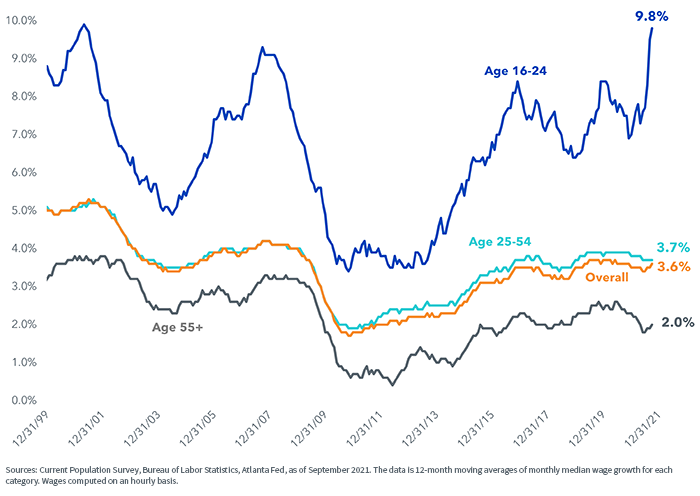
The big question is whether the age 25–54 cohort—workers in their prime earning years—will follow along the pay bump route, an outcome that has not yet appeared.
Still, not a day goes by that we do not hear about big compensation surges at law firms, for example.
In financial services, news of junior bankers getting salaries bumped up from $85,000 to $110,000 has been making the rounds for months. In the meantime, many analysts are pointing to wage pressures in both the tech and health care sectors.
Nevertheless, the Wall Street consensus is for S&P 500 profit margins to expand into next summer, with non-financial net margins in the mid-12% range. For context, margins only broke above 10% in 2017, according to BofA strategists.
How do companies keep firing on all profitability cylinders if inflation continues to roar? Something may have to give.
For investors crossing their fingers that the supply chain issues will end, alleviating price pressures, there are a few considerations.
First, about one in every 92 people in this country—including children, retirees and people not in the labor force—was a truck driver in 2019. But in 2020, the industry kicked 40,000–60,000 drivers out after launching a database that culled those with drug or alcohol violations.
Young drivers are hard to come by, especially when they see a potential future of autonomous trucks putting them in the unemployment line. No wonder there is a trucker shortage—and no wonder Wal-Mart is willing to pay $87,500 plus an $8,000 sign-on bonus for newly hired drivers.
Second, I’ve posited that the next chapter in “50 Shades of Inflation” is labor action. With workers at agricultural equipment maker John Deere and Hollywood film production lots going on strike, it is not a leap of faith to expect more labor action in 2022 than in 2021.
That raises the risk of inflation as a self-fulfilling prophecy: prices go up, so you demand higher wages, so prices go up, so you demand higher wages.
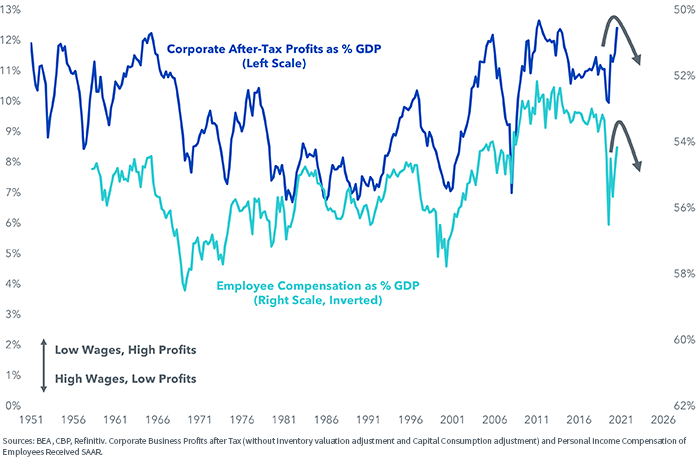
If so, figure 2 comes into focus as a particular issue for corporate earnings prospects.
Figure 2: U.S. Labor Costs & Corporate Profits (% GDP)
We have several ETFs that explicitly screen for profitability, identifying companies that may be better able to absorb an inflationary push. Take a look at our quality dividend growth concepts, which typically register highly on return on equity (ROE). The flagship is our WisdomTree U.S. Quality Dividend Growth Fund (DGRW).
Important Risks Related to this Article
Past performance is no guarantee of future results and the opinions presented cannot be viewed as an indicator of future performance. Forecasts contained herein are for illustrative purposes only, may be based upon proprietary research and are developed through analysis of historical public data.
Indexes are unmanaged, do not incur management fees, costs and expenses and cannot be invested in directly. For more information on indexes please see
There are risks associated with investing, including the possible loss of principal. Funds focusing their investments on certain sectors increase their vulnerability to any single economic or regulatory development. This may result in greater share price volatility. Please read the Fund’s prospectus for specific details regarding the Fund’s risk profile.
Categories
Related articles

Dividend Growth Is Not One Strategy
Quality as a Foundation in an Uncertain World
Rising Through Discipline: Why DGRW and DDWM Are Earning Their Upgrades
The Long Game of Dividend Growth Investing
From Lagging to Leading? The Case for a Small-Cap Inflection Point
Don’t Mistake Speculation for Strength: The Mirage of Small-Cap “Junk” Outperformance
U.S. Quality Dividend Growth: Rebalance Summary
The Paradox of Strength and Risk
7 Market Dislocations Too Big to Overlook
About the contributor

Jeff Weniger, CFA
Head of Equity Strategy
Jeff Weniger, CFA, has been with WisdomTree since 2017 and serves as the Head of Equities. He shapes the firm’s market outlook through a combination of macroeconomic and fundamental analysis. With more than two decades in investment strategy, Jeff is known for his work on market cycles and valuations. Before joining WisdomTree, Jeff was with BMO Private Bank and BMO Global Asset Management for 11 years. At BMO, he sat on the firm’s Asset Allocation Committee and co-managed ETF model portfolios across the U.S. and Canada. In 2013, at age 32, he became the youngest member of BMO’s Global Investment Forum. When he left BMO to come to WisdomTree, his final role was Director, Senior Strategist in the Office of the CIO in 2017.
Jeff is a frequent television guest on networks such as CNBC, Bloomberg, and Schwab, with regular print appearances in The Wall Street Journal, Barron’s and Reuters. He also appears weekly on the Behind the Markets podcast and is a regular on SiriusXM’s The Business Briefing. On X, Jeff has developed one of the larger followings in financial media. He earned a B.S. in Finance from the University of Florida and an MBA from the University of Notre Dame. He has held the CFA charter since 2006.