
DXJ
Japan Hedged Equity Fund

Published April 16, 2025

Global Chief Investment Officer

U.S. Head of Research

Equity Strategist
April is recognized as Financial Literacy Month in the U.S., a time to empower investors with the knowledge needed to make more informed, confident decisions. One of the most misunderstood elements of investing is valuation: how much are you paying for a dollar of earnings, and is it worth it?
With tech stocks leading again, many investors are asking whether we're reliving the bubble of 2000. But a closer look at the data reveals a much different picture—and highlights global opportunities that may be overlooked without a solid grasp of valuation fundamentals.
Understanding valuation is a cornerstone of financial literacy. It's what separates hype from opportunity.
In 2000, companies like Cisco and AOL were trading at valuations that assumed unrealistic future growth—often with price-to-earnings (P/E) ratios north of 100.
Today's "Magnificent 7"—Apple, Microsoft, Nvidia and others—trades at an average forward P/E of 24. Elevated? Yes. But they also have the earnings to back it up. Over the past five years, they've delivered 24% annualized earnings growth, with forward expectations near 16%. That compares to the broader S&P 500, which trades at 21x earnings with growth closer to 13%.
The lesson: high valuations can be justified—but only if earnings growth is real and sustainable.
Figure 1: Price-to-Earnings of the "Magnificent 7"
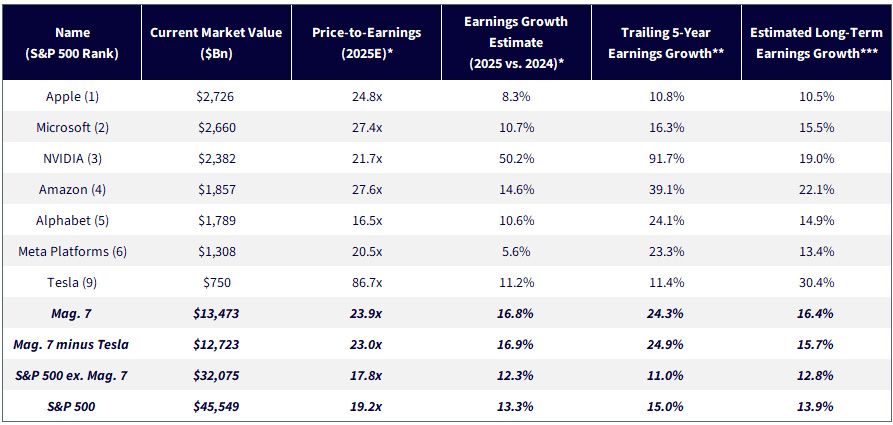
Sources: WisdomTree, FactSet, S&P. *Calendar year price-to-earnings and earnings growth based on median analyst estimates. **Trailing 3-year where 5-year is not available. Growth is annualized. ***Estimated Long-Term Earnings Growth is annualized and based on median analyst earnings growth estimates over the next three years. Trailing 5-Year Earnings Growth and Estimated Long-Term Earnings Growth as of 3/31/25. All other data as of 4/7/25. Aggregate metrics in italics shown as weighted averages. You cannot invest directly in an index. See the glossary for definitions of terms and indexes.
Another key concept for investors to understand is relative value. Where can your capital potentially go further?
International equities are still trading at a 36% discount to the S&P 500, far wider than the historical median of 17%. Even after a recent rebound, there's room for international stocks to re-rate higher.
Take Japan, for example. Warren Buffett has built a substantial position in Japanese trading firms, which continue to trade at reasonable valuations (~9x–10x earnings) despite delivering strong earnings and dividend growth.
The WisdomTree Japan Hedged Equity Fund (DXJ) is designed to capture similar exposure while reducing the risk of a weaker yen eroding returns—mirroring the currency-conscious approach Buffett employed by issuing yen-denominated debt.
U.S. small-cap stocks also offer discounts—but without a near-term catalyst. Tariff concerns, weaker earnings momentum and higher economic sensitivity have held them back.
While valuation metrics look appealing, this is a reminder that price alone doesn't equal opportunity. Investors must pair valuation with fundamental and macroeconomic awareness.
Valuation-aware investors may benefit from reallocating toward global strategies with more attractive pricing and structural support.
Consider these examples:
These tools offer diversified ways to balance growth potential with valuation discipline and make informed choices grounded in data, not headlines.
Financial Literacy Month can be used as a reminder that investing isn't about chasing trends; it's about understanding them.
Today's market isn't 2000. The "Magnificent 7" have real earnings behind their valuations. At the same time, undervalued international markets, especially in Japan and emerging economies, offer compelling alternatives.
A strong grasp of valuation principles can help investors navigate this environment with greater clarity and confidence. It's not just what you invest in, but why and how, that builds lasting success.
There are risks associated with investing, including the possible loss of principal. Foreign investing involves special risks, such as risk of loss from currency fluctuation or political or economic uncertainty. Dividends are not guaranteed, and a company currently paying dividends may cease paying dividends at any time. Due to the investment strategy of these Funds, it may make higher capital gain distributions than other ETFs. Please read the Funds' prospectus for specific details regarding the Funds' risk profile.
DXJ: The Fund focuses its investments in Japan, thereby increasing the impact of events and developments in Japan that can adversely affect performance. Investments in currency involve additional special risks, such as credit risk, interest rate fluctuations and derivative investments, which can be volatile and may be less liquid than other securities and more sensitive to the effect of varied economic conditions. As this Fund can have a high concentration in some issuers, the Fund can be adversely impacted by changes affecting those issuers.
DEM: Foreign investing involves special risks, such as risk of loss from currency fluctuation or political or economic uncertainty. Funds focusing on a single sector generally experience greater price volatility. Investments in emerging, offshore or frontier markets are generally less liquid and less efficient than investments in developed markets and are subject to additional risks, such as risks of adverse governmental regulation, intervention and political developments.

Global Chief Investment Officer
Jeremy Schwartz has served as Global Chief Investment Officer since November 2021 and leads WisdomTree’s investment strategy team in the construction of WisdomTree’s equity Indexes, quantitative active strategies and multi-asset Model Portfolios. Jeremy joined WisdomTree in May 2005 as a Senior Analyst, adding Deputy Director of Research to his responsibilities in February 2007. He served as Director of Research from October 2008 to October 2018 and as Global Head of Research from November 2018 to November 2021. Before joining WisdomTree, he was a head research assistant for Professor Jeremy Siegel and, in 2022, became his co-author on the sixth edition of the book Stocks for the Long Run. Jeremy is also co-author of the Financial Analysts Journal paper “What Happened to the Original Stocks in the S&P 500?” He received his B.S. in economics from The Wharton School of the University of Pennsylvania and hosts the Behind the Markets podcast. Jeremy is a member of the CFA Society of Philadelphia.

U.S. Head of Research
Bradley Krom joined WisdomTree as a member of the research team in December 2010. He is involved in creating and communicating WisdomTree’s thoughts on global markets, as well as analyzing existing and new fund strategies. Prior to joining WisdomTree, Bradley served as a senior trader on a proprietary trading desk at TransMarket Group. Bradley is a graduate of the Wharton School, University of Pennsylvania.

Equity Strategist
Brian Manby is an Equity Strategist at WisdomTree and part of the Investment Strategy team.
He is responsible for developing and communicating equity market insights, investment themes, and portfolio strategies that support the firm’s ETF and investment solutions platform. He evaluates sectors, valuations, fundamentals and equity styles to identify investment opportunities and provide actionable perspectives to clients and advisors. He also helps investors understand how WisdomTree’s equity strategies can be used to achieve long-term investment objectives in evolving market environments.
Brian joined WisdomTree in October 2018 as an Investment Strategy Analyst after a few years as a Consultant for FactSet Research Systems, Inc. He earned a B.A. in Economics and Political Science from the University of Connecticut in 2016 and has been a Chartered Financial Analyst since 2022.


