


September U.S. Dividend Update
Published October 8, 2021

Matt Wagner, CFA
Director, Research
We suggested in last month’s dividend update that bloated cash balances and strong earnings could bolster dividend and share buyback increases and support gains for U.S. equities.
While a choppy month for price returns, September didn’t disappoint, with a flurry of dividend growth from some of the largest payers.
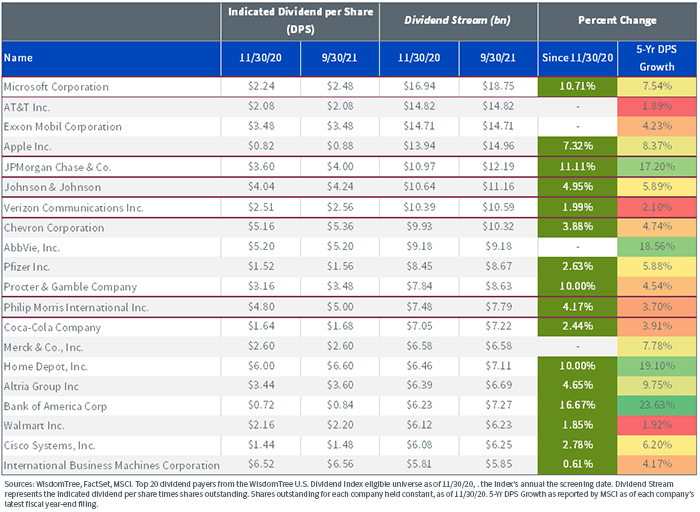
Microsoft and JPMorgan—both top five U.S. dividend payers—each increased 11%.
Microsoft also announced a whopping $60 billion stock buyback plan. That’s double the $30 billion plan that JPMorgan announced last December.
Verizon and Philip Morris increased their dividends 2% and 4%, respectively.
Of the group of the 20 largest dividend payers, there have been 16 dividend increases and four unchanged, combining for an average increase of 4.8% this year.
Top 20 U.S. Dividend Payers
Dividend Initiations/Resumptions
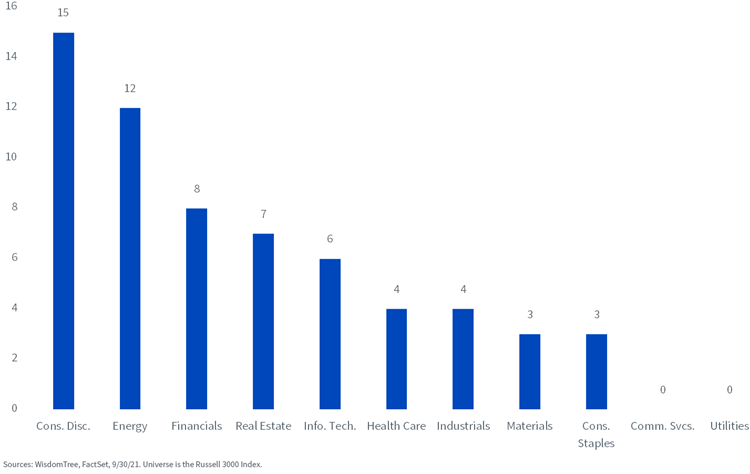
One of the main stories about dividends this year is the number of companies initiating or resuming payouts.
Since the end of the first quarter, 62 initiations/resumptions have been made by Russell 3000 Index constituents. Among these companies, many are in sectors that were most impacted by 2020 shutdowns—Consumer Discretionary, Energy, Financials and Real Estate.
At WisdomTree’s annual domestic Index rebalance in December, all active dividend payers are eligible for our starting universe. We anticipate more names from these sectors being added to our dividend Indexes.
Dividend Initiations/Resumptions since 1Q21
Real Estate Sector
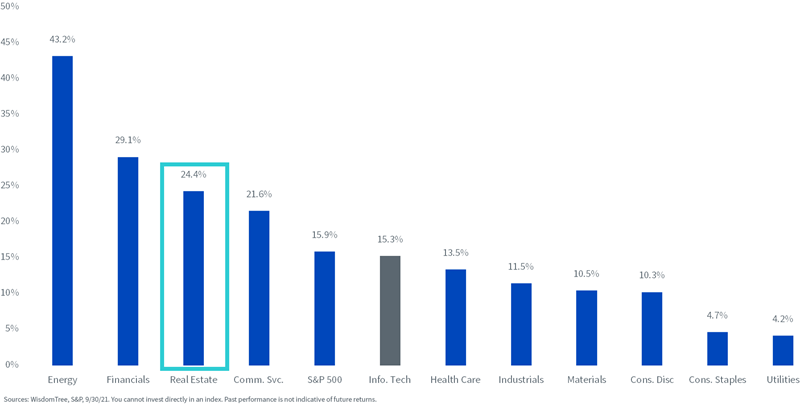
With interest rates historically low and property markets recovering from the COVID-19 pandemic, the Real Estate sector has been one of the top performers year-to-date.
S&P 500 Sector Performance
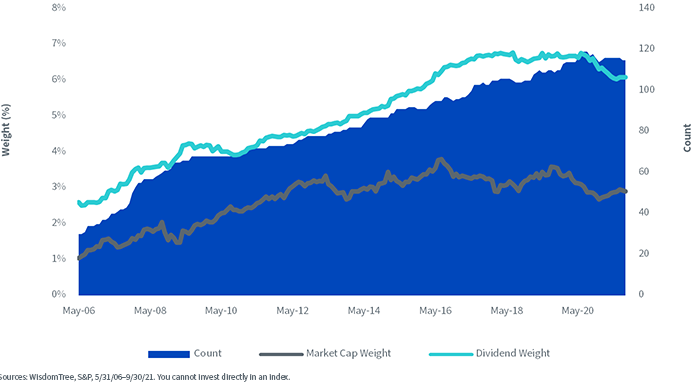
The number of publicly traded Real Estate companies has grown dramatically over the past several years—up from 40 in May 2006, when WisdomTree launched its first dividend Indexes—to nearly 120 today.
The sector’s market cap weight in the S&P 1500 is just under 3%. Given its high payouts, the sector’s dividend weight is twice that at around 6%.
S&P 1500 Real Estate Sector
REITs—which make up much of the Real Estate sector—are a unique class of equities. They are required to pay out at least 90% of their taxable income as dividends.
As a result of the payout requirement, the sector has the fourth-highest dividend yield. On the other hand, it is also one of only two sectors that have a negative net buyback yield—meaning companies issue more in shares than they buy back. That’s why some index providers choose to exclude the sector from dividend indexes.
Removing Real Estate means removing exposure to a sector with a premium dividend yield and one that has not only performed well in 2021 but is growing in weight (i.e., importance) in market cap-weighted benchmark indexes.
S&P 500 Index–Total Shareholder Yield by Sector
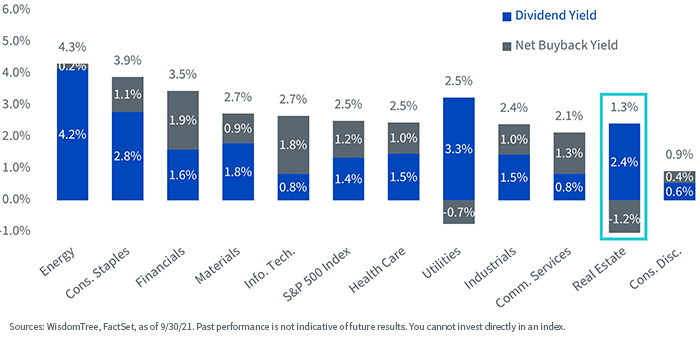
For WisdomTree’s U.S. dividend Indexes, we have chosen to include Real Estate companies with caps—either at 5% or 10%, depending on the Index.
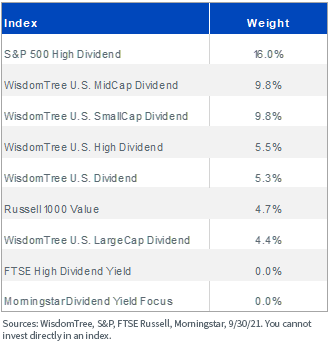
As we show below, some dividend Indexes—like the FTSE High Dividend Yield Index and the Morningstar Dividend Yield Focus Index—have no exposure.
On the other end of the spectrum, the S&P 500 High Dividend Index has a 16% weight to the sector—an over-weight of over 13% relative to the S&P 500.
We believe our approach of including Real Estate within guardrails strikes a good balance of broadness, maximizing yield and mitigating tracking risk relative to comparable value indexes.
In a low-rate environment, the premium income of the sector and its price appreciation potential makes it an attractive component of our dividend Indexes, in our view.
Percent Index Weight: Real Estate
Categories
Related articles

Dividend Growth Is Not One Strategy

Beyond Market Cap: A Nearly 19-Year Case for Dividend-Driven Emerging Markets
Quality as a Foundation in an Uncertain World
Value Isn’t What It Used to Be
Don’t Mistake Speculation for Strength: The Mirage of Small-Cap “Junk” Outperformance
From Momentum to Discipline: Navigating Volatility in Emerging Markets
A Rebalance Review for U.S. Large-Cap Dividends
The Discipline of Dividends: Capturing Value in U.S. Large Caps
A Review of Our 2025 Global Dividend Rebalance
About the contributor

Matt Wagner, CFA
Director, Research
Matt Wagner joined WisdomTree in May 2017 as an Analyst on the Research team. He currently serves as a Director, where he supports the creation, maintenance, and reconstitution of WisdomTree’s indexes and actively managed ETFs. Matt began his career at Morgan Stanley, working as an analyst in Treasury Capital Markets from 2015 to 2017, focusing on unsecured funding planning, execution, and risk management. He graduated magna cum laude from Boston College in 2015 with a B.A. in International Studies, concentrating in Economics. In 2020, he earned a Certificate in Advanced Valuation from NYU Stern. He is also a Chartered Financial Analyst (CFA) charterholder.