
HEDJ
Europe Hedged Equity Fund

Published July 13, 2026

Global Head of Research
There are moments when a particular corner of the equity market finds itself sitting at the intersection of several favorable currents simultaneously. For investors thinking about European equities, we believe 2026 may represent one of those moments.
It’s possible that the companies we find most interesting are not really domestic stories at all.
The WisdomTree Europe Hedged Equity Fund (HEDJ) holds companies that are required to generate more than half of their revenues outside of Europe. That export orientation is a structural screen that connects the portfolio to global demand pools:
South Korea: When the AI Memory Supercycle Walks into a Luxury Boutique
Potentially, the most counterintuitive tailwind for HEDJ's luxury holdings may be unfolding in the Gyeonggi Province region south of Seoul, and it begins with high-bandwidth memory chips.
The artificial intelligence infrastructure build-out has created an insatiable demand for the memory chips that are included in AI accelerators. Samsung Electronics and SK Hynix, which together dominate global dynamic random access memory (DRAM) and high-bandwidth memory production, have been the primary beneficiaries. In the first quarter of 2026 alone, Samsung posted operating profit of 57.2 trillion won and SK Hynix 37.6 trillion won, a combined 94.8 trillion won, or roughly $68.7 billion, in a single quarter.5 The profits have been extraordinary, and South Korean workers are beginning to see them in their bank accounts.
In September 2025, SK Hynix's labor union ratified an agreement allocating 10% of the company's annual operating profit to employee bonuses, payable in cash or stock at each worker's election.6 Samsung followed in May 2026, with union members voting 73.7% in favor of a deal committing 10.5% of its semiconductor division's operating profit to a special bonus pool, paid in company shares, with lock-up periods of up to two years on the majority of the payout.7 The math that results is striking.8
These are not figures reserved for executives. They flow to the engineers, technicians, and manufacturing workers who run the fabs.
The spending effects are already visible in transaction data. Card spending in Gyeonggi Province, which is home to major Samsung and SK Hynix fabrication sites, has outpaced other regions of South Korea.9 At a Shinsegae department store branch in southern Gyeonggi, overall store sales rose 19% year-over-year. Luxury goods led the surge:10
South Korea was already one of the world's most sophisticated per-capita luxury markets. Bonus payments of this magnitude into that consumer base represent a genuine incremental demand pulse.
For HEDJ, the connection runs through holdings including LVMH, Hermès, Kering (home to Gucci, Bottega Veneta, and Saint Laurent), Moncler, Brunello Cucinelli, Puig Brands, and EssilorLuxottica.11 South Korean luxury consumers have long favored European heritage houses specifically, making the portfolio's composition particularly relevant. It is also worth noting what the Bank of Korea itself has flagged:
Economists have warned that the bonus formulas being established at Samsung and SK Hynix are now spreading to other large Korean conglomerates, with Hyundai Motor's union demanding 30% of net profit as performance bonuses.12
The luxury demand impulse may extend well beyond chip workers alone.
The U.S. Consumer: Spending More Than Sentiment Surveys Suggest
Sentiment indices for the U.S. consumer have been soft for much of 2026, and headlines have dutifully reflected that softness. The hard spending data, however, tells a more encouraging story for export-oriented European companies with U.S. revenue.
According to the U.S. Census Bureau, retail sales rose 0.9% month-over-month in May 2026, above the 0.5% consensus forecast, which was the third consecutive monthly gain. Year-over-year, retail trade sales were up 7.5% from May 2025, and the three-month rolling total from March through May was up 5.3% versus the same period a year prior.13
The divergence between what consumers say and what they actually spend is a recurring feature of this cycle, and for HEDJ holdings with meaningful U.S. sales exposure, the spending data matters more than the confidence readings.
The fund's U.S.-relevant holdings span a wider range than the luxury names might suggest. Anheuser-Busch InBev and Heineken are embedded in U.S. on-premise consumption. Danone's North American business includes household yogurt and plant-based brands. L'Oréal, Beiersdorf, and Puig Brands sell into U.S. personal care aisles and premium beauty retail. Adidas competes for U.S. athletic wear share. EssilorLuxottica operates through LensCrafters and licenses Ray-Ban, both U.S. consumer touchpoints. The aggregate exposure to American spending across HEDJ is substantial and likely underappreciated by investors anchored on European domestic conditions.14
AI Infrastructure: The Components No One Else Can Make
HEDJ's largest position, ASML Holding,15 is something of a case study in the concept of a structural moat. ASML is the only company in the world capable of manufacturing extreme ultraviolet (EUV) lithography machines, which is the equipment required to produce the most advanced semiconductors. Every leading-edge chip used in AI data centers, from Nvidia's H100 and Blackwell series to custom silicon at the major hyperscalers, is manufactured using ASML equipment.16 There is no credible substitute on the horizon.
But ASML is not the only HEDJ holding that sits at an irreplaceable point in the AI hardware chain.
The AI infrastructure theme within HEDJ is thus not a single-stock story. It is a set of European companies that occupy genuinely non-substitutable positions in the global semiconductor supply chain, at a moment when that supply chain is being stretched by the largest sustained capital investment cycle in technology history. While everyone is looking at South Korea and Taiwan when they think about semiconductors, we’d note that they cannot forget about Europe.
The IPO Wealth Effect: Newly Liquid Capital Seeks European Quality
On June 12, 2026, SpaceX debuted on the Nasdaq under the ticker SPCX, raising $75 billion in what became the largest initial public offering in history. The listing valued SpaceX at approximately $1.77 trillion and created one of the most broadly distributed wealth events in modern corporate history. According to analysis by investment platform Hill.com, more than 4,400 current and former SpaceX employees are expected to become millionaires through their equity holdings, with roughly 400 holding stakes worth $100 million or more.18
What distinguishes this from prior large IPOs is the breadth of the beneficiaries. Unlike software IPOs that tend to concentrate wealth at the founder and venture capital layer, SpaceX's workforce, including welders, machinists, and cafeteria workers who received stock as part of their compensation, participated in the windfall. Private wealth advisors from major institutions are already traveling to California, Texas, and Florida to court newly liquid SpaceX clients. Lock-up periods will release selling tranches over the coming 6 to 18 months, meaning the consumption impulse is extended in time rather than concentrated in a single quarter.
For HEDJ, the relevant holdings are those indexed to high-net-worth and aspirational spending:19
SpaceX is also unlikely to be the only catalyst, and several late-stage private companies remain pre-IPO, with each successful large listing creating social and market permission for more, suggesting the wealth effect could compound over multiple years.
A Different Way to Think About European Equity Exposure
The conventional framing of European equities centers on European growth, and looks at such things as the pace of European Central Bank (ECB) policy normalization, the state of German manufacturing, or the trajectory of southern European fiscal balances. These are real considerations, but they describe a set of companies that HEDJ is specifically tilting away from. The fund's export orientation requirement means its holdings are connected not as prominently to Frankfurt or Brussels but rather to fabs in Gyeonggi, data centers in Virginia, shopping streets in Seoul, and the bank accounts of newly public engineers in Hawthorne, California.
Each of the four narratives described above represents a distinct pathway through which global demand may translate into revenue for different groups of HEDJ's holdings. Some, like ASML's role in AI infrastructure, are already well understood by sophisticated investors. Others, like the connection between memory chip bonuses in South Korea and luxury jewelry sales at a department store outside Seoul, are less intuitively obvious. It is often in those less obvious connections that value gets created for investors patient enough to look for them.
Figure 1: Table of Holdings Discussed in this Piece
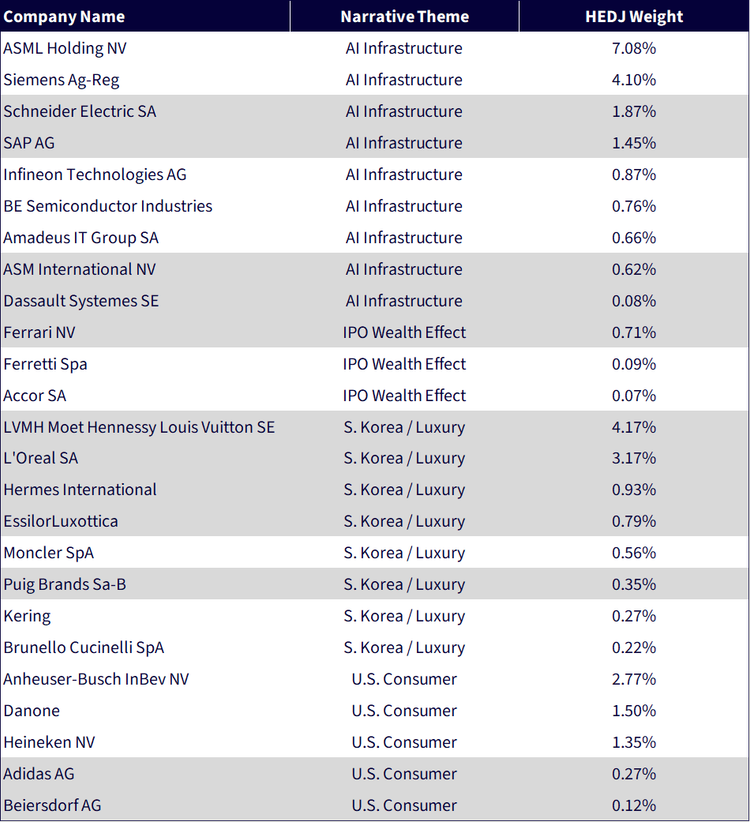
Source: WisdomTree, specifically the HEDJ fund page with data sourced as of June 26, 2026. For current holdings of HEDJ, please click . Holdings are subject to risk and change.
1 Sources: University of Michigan. (2026). Surveys of Consumers [Data set]. Survey Research Center, University of Michigan; U.S. Census Bureau. (2026, June). Advance monthly retail trade report, May 2026. U.S. Department of Commerce.
2 Source: ASML Holding N.V. (2026). 2025 annual report.
3 Source: Frank, R. (2026, June 11). SpaceX millionaires are set to spend big on luxury homes, watches and private jet travel. CNBC.
4 Source: Frank, R. (2026, June 20). Massive bonuses for South Korea's chip workers puts central bank on inflation alert. CNBC.
5 Sources: Samsung Electronics. (2026, April 30). Samsung Electronics announces first quarter 2026 results. Samsung Global Newsroom; SK Hynix. (2026, April 22). SK hynix announces 1Q26 financial results. SK Hynix Newsroom.
6 Source: Bloomberg News. (2025, September 4). SK Hynix set to pay $2.7 billion bonuses to quell labor tensions. Bloomberg.
7 Source: Korea Herald. (2026, May 27). Samsung's strike-averting wage deal passes union vote. The Korea Herald.
8 Source for bullets: Jin, H., & Yang, H. (2026, May 21). Samsung chip workers to get $340,000 average bonus in AI boom. Reuters.
9 Source: Bank of Korea. (2026, June 17). Price stability report [보도자료].
10 Source for store sales and bullets: Frank, R. (2026, June 20). Massive bonuses for South Korea's chip workers puts central bank on inflation alert. CNBC.
11 Source: WisdomTree, with specific exposures to these companies within HEDJ noted in Figure 1.
12 Sources: Kwon, H. (2026, May 26). Samsung-SK Hynix bonuses to hit 30 trillion won [Bloomberg Economics report cited in Seoul Economic Daily]. Seoul Economic Daily; Korea Herald. (2026, June 24). Hyundai Motor union's 30% bonus push gains momentum. The Korea Herald.
13 Source: U.S. Census Bureau. (2026, June 17). Advance monthly sales for retail and food services, May 2026 [Press release].
14 Source: WisdomTree, with specific exposures to these companies within HEDJ noted in Figure 1.
15 Sourced from the HEDJ fund page. Subject to change.
16 Source: ASML Holding N.V. (2026). 2025 annual report.
17 Source: Infineon Technologies AG. (2025, November 12). FY 2025 concluded in line with expectations [Press release].
18 Sources: Kolodny, L., & Kolodny, L. (2026, June 11). SpaceX raising $75 billion in record-setting IPO as Nasdaq debut awaits. CNBC; Benson, A. (2026, June 12). SpaceX IPO wealth analysis [Data]. Hill.com, as reported in The New York Times.
19 Source: WisdomTree, with specific exposures to these companies within HEDJ noted in Figure 1.
There are risks associated with investing, including possible loss of principal. Foreign investing involves special risks, such as risk of loss from currency fluctuation or political or economic uncertainty. This Fund focuses its investments in Europe, thereby increasing the impact of events and developments associated with the region which can adversely affect performance. Derivative investments can be volatile and these investments may be less liquid than other securities, and more sensitive to the effect of varied economic conditions. As this Fund can have a high concentration in some issuers, the Fund can be adversely impacted by changes affecting those issuers. Due to the investment strategy of this Fund it may make higher capital gain distributions than other ETFs. Dividends are not guaranteed, and a company currently paying dividends may cease paying dividends at any time. The Fund invests in the securities included in, or representative of, its Index regardless of their investment merit, and the Fund does not attempt to outperform its Index. Please read the Fund’s prospectus for specific details regarding the Fund’s risk profile.
Europe Hedged Equity Fund

Global Head of Research
Christopher Gannatti began at WisdomTree as a Research Analyst in December 2010, working directly with Jeremy Schwartz, CFA®, Director of Research. In January of 2014, he was promoted to Associate Director of Research where he was responsible to lead different groups of analysts and strategists within the broader Research team at WisdomTree. In February of 2018, Christopher was promoted to Head of Research, Europe, where he was based out of WisdomTree’s London office and was responsible for the full WisdomTree research effort within the European market, as well as supporting the UCITs platform globally. In November 2021, Christopher was promoted to Global Head of Research, now responsible for numerous communications on investment strategy globally, particularly in the thematic equity space. Christopher came to WisdomTree from Lord Abbett, where he worked for four and a half years as a Regional Consultant. He received his MBA in Quantitative Finance, Accounting, and Economics from NYU’s Stern School of Business in 2010, and he received his bachelor’s degree from Colgate University in Economics in 2006. Christopher is a holder of the Chartered Financial Analyst Designation.


