
DXJ
Japan Hedged Equity Fund

Published July 20, 2026

Global Chief Investment Officer
For U.S. investors, Japan has always been two decisions: Japanese equities and yen exposure. The WisdomTree Japan Hedged Equity Fund’s (DXJ) 20-year history shows why separating currency exposure matters.

Source: WisdomTree, Morningstar. Return data from 6/16/2006 to 6/16/2026. DXJ returns based on NAV total returns. Benchmark index returns based on net total returns. Past performance is not indicative of future results. Investment return and principal value of an investment will fluctuate so that an investor’s shares, when redeemed, may be worth more or less than their original cost. Current performance may be lower or higher than the performance data quoted. For the most recent month-end and standardized performance, click here.
The simple story of DXJ is that it helped investors own Japan without making the yen the centerpiece of the allocation. That sounds obvious today. It was not obvious in 2010.
DXJ launched in 2006 as the WisdomTree Japan Total Dividend Fund, consistent with WisdomTree's original dividend-weighted approach. The defining decision came four years later, when WisdomTree added a currency-hedged feature and renamed the strategy the WisdomTree Japan Hedged Equity Fund.
Our central insight, after a period in which the yen strengthened persistently, was that currency moves are not permanent and that there could come a time when the trend reversed. Over the last 15 years, the yen has weakened considerably, and the Japanese equity market has been among the top-performing global markets—so long as you hedged the currency.
Core Thesis:
The question was never simply "Japan or no Japan." It was "Japan with the yen, or Japan without the yen?" DXJ made that choice explicit. And often a weakening currency is a better time to own the local equities.
The last 20 years were a difficult period for developed international equities. Over the common period from June 16, 2006, through June 16, 2026, the S&P 500 Index compounded at 11.5% annually, while the MSCI EAFE Index compounded at just 5.8%, roughly half that rate. Unhedged Japan, represented by MSCI Japan, was even weaker at 5.2%, trailing the S&P 500 by 6.3% annually.
Many U.S. allocators have lost patience with international markets with such a long stretch of under-performance. But it is a mistake to conclude that all international structures were equivalent.
DXJ compounded at 9.41% over the same common period. It did not beat the S&P 500 over the full 20 years, and we should say that plainly. But it dramatically changed the Japan and international allocation experience: +423 basis points per year versus unhedged Japan and +357 basis points per year versus MSCI EAFE.
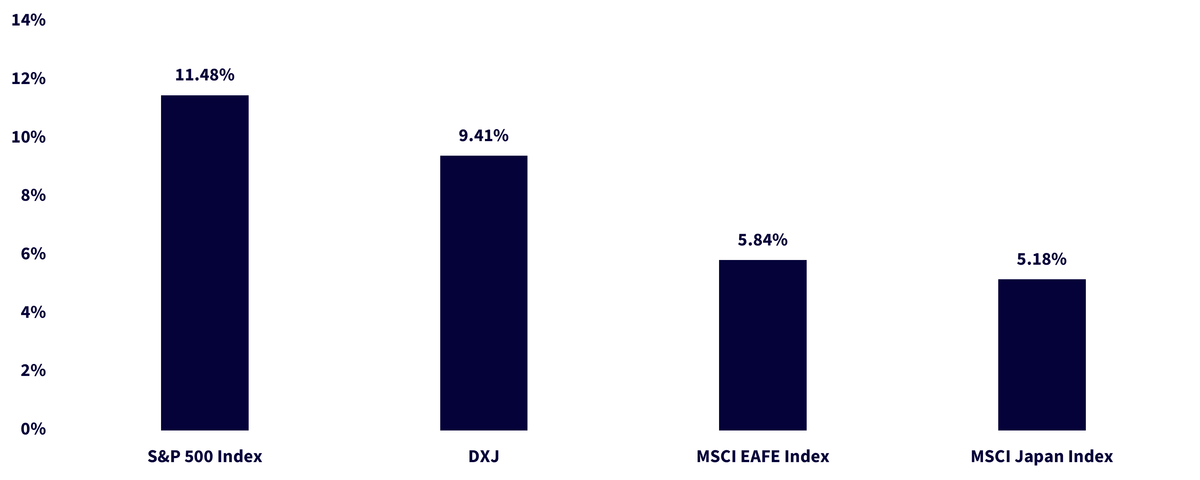
Source: WisdomTree, S&P, MSCI. Return data from 6/16/2006 to 6/16/2026. DXJ returns based on NAV total returns. Benchmark index returns based on net total returns for MSCI EAFE and MSCI Japan. Gross total returns for S&P 500.
DXJ began on June 16, 2006, as a Japan dividend strategy. The original idea was very WisdomTree: use dividends as an anchor to fundamentals and create broad exposure to Japanese dividend-paying companies. That mattered because Japan had spent years associated with low growth, deflation, and disappointment. Dividend discipline was a way to insist on real corporate economics rather than index weight alone.
But the first version of DXJ still carried the currency exposure that most U.S. investors accepted by default. A U.S. investor buying Japanese equities was also buying the yen.
Our view was that the yen was not a reliable source of long-run equity compensation. It was a source of volatility, and in many periods it was the risk that dominated the investor experience. We observed that currencies could regularly move 10% a year. We wanted investors to make a cleaner decision: own Japanese companies, not a speculative currency overlay.
On April 1, 2010, WisdomTree added the currency hedge. The fund was renamed the WisdomTree Japan Hedged Equity Fund, and the objective shifted toward Japanese equity exposure while mitigating fluctuations between the yen and the U.S. dollar.
Most allocators buying Japan were not consciously choosing the yen as their primary risk. They were trying to own Japanese corporate earnings, valuations and dividends.
DXJ separated those two decisions. And WisdomTree was the first firm to pioneer currency hedging in the ETF format. It turned "Japan plus yen" into "Japan equities with yen exposure mitigated” while also capturing the interest rate differential between the U.S. and Japan.
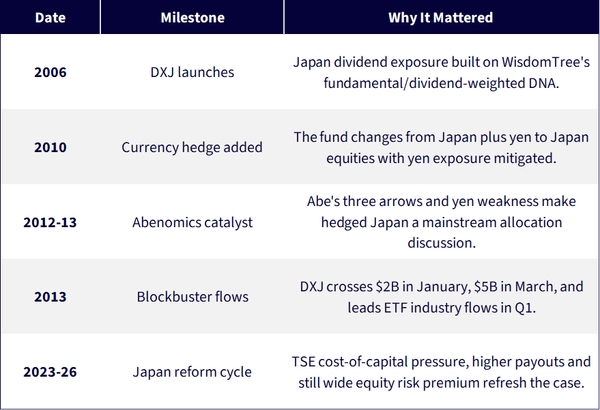
The market discovered DXJ in 2012 and 2013, when Shinzo Abe championed his Abenomics platform that became a defining global macro story. Abe’s three arrows were aggressive monetary policy, flexible fiscal policy and structural reform—but with an explicit mandate that the yen was too strong.
For global investors, the first arrow mattered immediately. Aggressive monetary policy changed the yen narrative. Yen weakness became one of the clearest expressions of Japan's reflation trade. DXJ was not created for Abenomics, but it was built for such an environment.
The flows followed. DXJ surpassed $2 billion in assets in January 2013, more than doubling its assets in under a month. By March 2013, it surpassed $5 billion. WisdomTree later reported that its currency-hedged Japanese equity strategy led the entire ETF industry with $3.9 billion of net inflows in the first quarter of 2013.
That was the blockbuster moment. But the more important lesson came later.
Many investors got the macro call right and the holding period wrong. They recognized the Abe catalyst. They recognized the yen problem. They recognized the appeal of hedged Japan. But too many treated DXJ as a tactical trade rather than a strategic solution.
That is one of the great mistakes investors have made in Japan: betting on the yen instead of owning the equity risk premium. When the yen weakens, unhedged investors can give back a meaningful portion of Japanese equity returns. When the yen strengthens, the hedge can lag. But that is exactly the point. Currency exposure is a separate bet. It should be intentional, not accidental.
The compounding record is the evidence. A structure many investors treated as a tactical trade became, over 20 years, one of the most important demonstrations of why currency exposure deserves explicit management.
The last 10 years have been an interesting period. Abenomics was the catalyst, not the whole story. The more recent performance numbers are striking both relative to unhedged Japan, broad international, and the S&P 500.
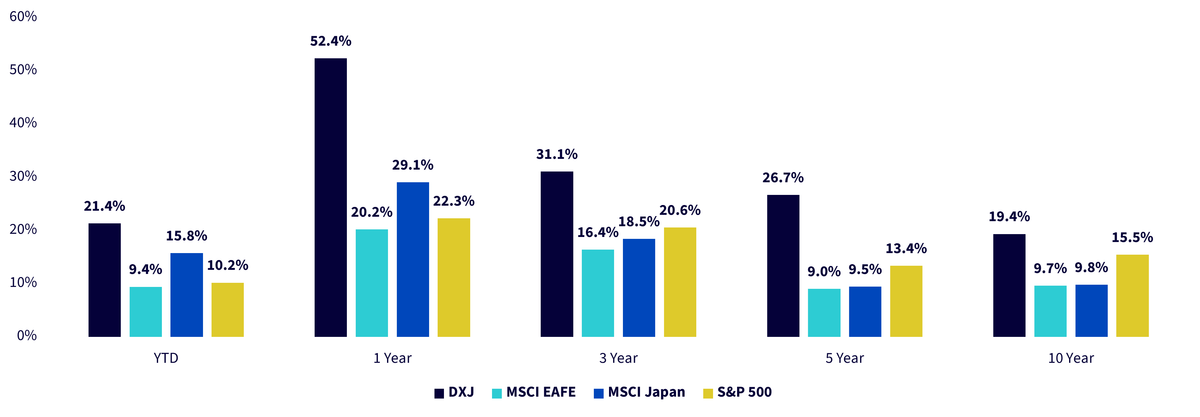
Source: WisdomTree, S&P, MSCI as of 6/30/2026. DXJ returns based on NAV total returns. Benchmark index returns based on net total returns for MSCI EAFE and MSCI Japan. Gross total returns for S&P 500. Returns greater than 1 year are annualized.
Many macro watchers today are pointing to the sharply rising Japanese bond yields as a risk to global liquidity and equity prices, thinking it could lead to unwinding carry trades as the cost for borrowed yen rises.
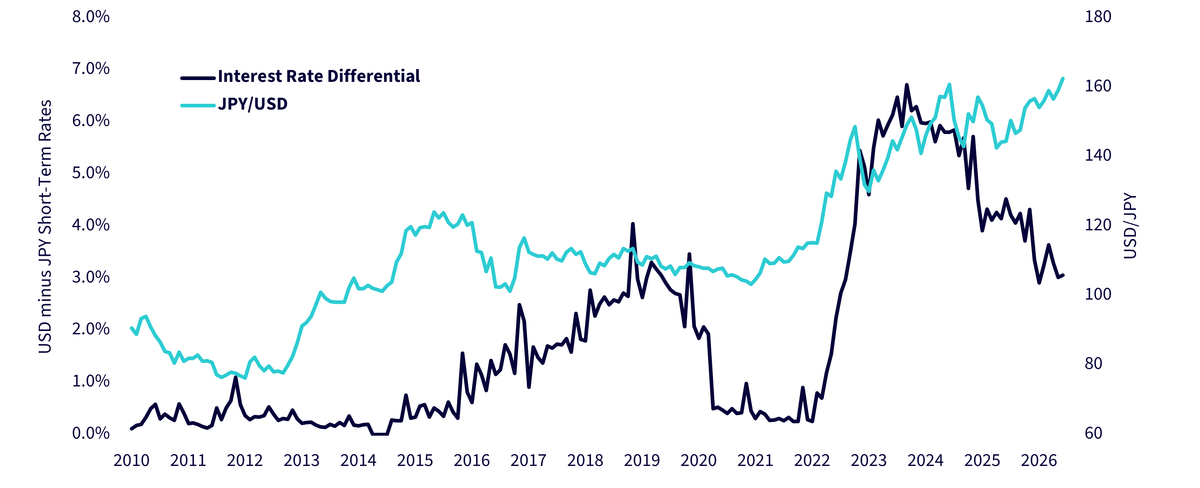
Short-term rates in Japan are still just 1%, while the Fed has a short-term rate of 3.6%. Yes, the spread at the long end has come down, but many of these carry trades are structured in shorter-term borrowings. Notably, it is also the spread that currency-hedged ETFs earn on top of the local market return. Stated differently, the yen has to appreciate by roughly 2.5%-3% to “catch up” with the hedged carry.
The forward-looking case for Japan today: corporate reforms and more shareholder distributions, a still-attractive equity risk premium, and still attractive economics of hedging the yen.
Yes, equity premiums are off their highs, but they are still attractive in absolute terms and particularly when compared to what is available in the U.S. markets.
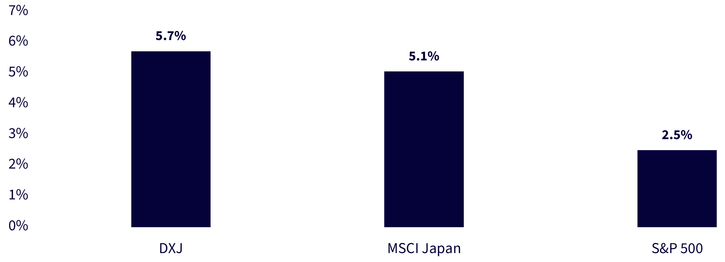
The estimated equity risk premiums were 5.7% for DXJ, 5.1% for MSCI Japan and 2.5% for the S&P 500 as of June 30, 2026. That puts DXJ at roughly double the S&P 500 equity risk premium. Japan may not be screaming cheap relative to its own history, but it still offers meaningfully more equity compensation than the U.S. market.
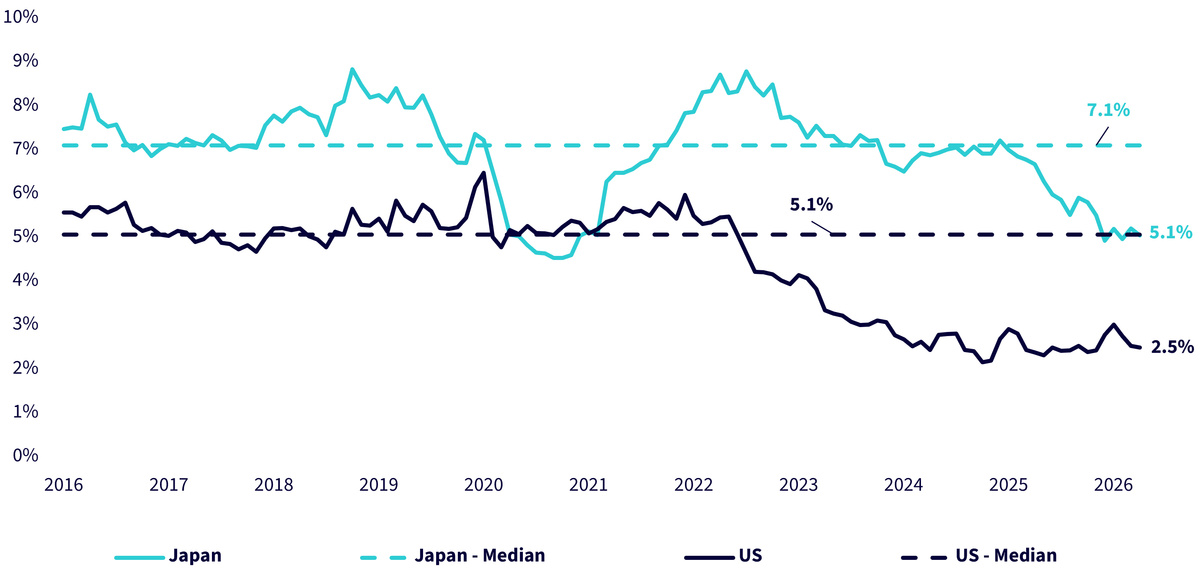
Source: WisdomTree, MSCI, S&P. Japan = MSCI Japan. U.S. = S&P 500. Historical Equity Risk Premiums from 3/31/16–6/30/26. You cannot invest directly in an index. Past performance is not indicative of future returns.
The Japan story is also increasingly micro. In March 2023, the Tokyo Stock Exchange (TSE) requested that Prime and Standard Market companies take action to implement management conscious of cost of capital and stock price. The TSE has continued to update the initiative, including investor-focused guidance and disclosure lists.
That matters because Japan's long-term problem was not just monetary policy. It was balance-sheet inefficiency, low returns on equity, excess cash, cross-shareholdings and insufficient accountability to shareholders. The TSE reform push has helped make capital efficiency, buybacks, dividends and ROE discipline mainstream boardroom issues.
DXJ provides exposure to companies growing their dividends, naturally leaning into companies being most responsive to these shareholder reforms and pressures.
The strongest objection today is straightforward: the BOJ is normalizing policy, and the yen carry trade can unwind violently. That risk should not be dismissed.
The right question is not whether the yen will ever rally. Of course it will. The right question is whether yen exposure is risk U.S. investors want as the centerpiece of their Japan equity allocation. DXJ's answer remains: own the equity premium; neutralize the currency unless the investor explicitly wants the yen bet.
Since the start of 2021, the yen has depreciated from nearly 100 to over 160 per U.S. dollar. That move has coincided with a widening gap in short-term policy rates—at its widest, the U.S.-Japan differential implied by forward pricing approached 7%. Today's roughly 3% differential still offers a “head start” for hedged investors.
Source: WisdomTree, FactSet, 1/31/2010-6/30/2026. Past performance is not indicative of future returns.
The bearish argument deserves a mention. DXJ benefited from a long regime of yen weakness and low Japanese rates. If the BOJ tightens faster, the yen rallies sharply, U.S.-Japan rate differentials compress toward zero, Japanese exporters face earnings pressure and U.S. equities continue to dominate, DXJ could underperform unhedged Japan or the S&P 500.
The 20-year lesson of DXJ: investors should know which risks they are being paid to take.
Japanese equity risk is one decision. Yen exposure is another.
Over the last 20 years, separating those decisions made an enormous difference. In a period when EAFE lagged the S&P 500 badly and unhedged Japan lagged even more, DXJ compounded at a rate that transformed the Japan allocation experience.
DXJ's history is the story of a product structure that turned Japan from a currency trade into an equity allocation.
There are risks associated with investing, including possible loss of principal. Foreign investing involves special risks, such as risk of loss from currency fluctuation or political or economic uncertainty. The Fund focuses its investments in Japan, thereby increasing the impact of events and developments in Japan that can adversely affect performance. Derivative investments can be volatile and these investments may be less liquid than other securities, and more sensitive to the effect of varied economic conditions. As this Fund can have a high concentration in some issuers, the Fund can be adversely impacted by changes affecting those issuers. Due to the investment strategy of this Fund, it may make higher capital gain distributions than other ETFs. The Fund invests in the securities included in, or representative of, its Index regardless of their investment merit and the Fund does not attempt to outperform its Index. Please read the Fund’s prospectus for specific details regarding the Fund’s risk profile.
Japan Hedged Equity Fund

Global Chief Investment Officer
Jeremy Schwartz has served as Global Chief Investment Officer since November 2021 and leads WisdomTree’s investment strategy team in the construction of WisdomTree’s equity Indexes, quantitative active strategies and multi-asset Model Portfolios. Jeremy joined WisdomTree in May 2005 as a Senior Analyst, adding Deputy Director of Research to his responsibilities in February 2007. He served as Director of Research from October 2008 to October 2018 and as Global Head of Research from November 2018 to November 2021. Before joining WisdomTree, he was a head research assistant for Professor Jeremy Siegel and, in 2022, became his co-author on the sixth edition of the book Stocks for the Long Run. Jeremy is also co-author of the Financial Analysts Journal paper “What Happened to the Original Stocks in the S&P 500?” He received his B.S. in economics from The Wharton School of the University of Pennsylvania and hosts the Behind the Markets podcast. Jeremy is a member of the CFA Society of Philadelphia.


