
DGRW
U.S. Quality Dividend Growth Fund

Published November 13, 2026

Lucas Armada
Associate, Quantitative Research

Director, Quantitative Research

Head of Indexes, U.S.
The year 2026 is one for the books: record-breaking IPOs, markets pushing toward all-time highs despite ongoing geopolitical tensions all around the world and firms beating estimates against the backdrop of a race toward AI supremacy.
Things are starting to unfold, though, and the story may be more complex if one looks more closely at the composition of the benchmark indices. Take the S&P 500, for example. Year to date, it has returned 11.75%.1 More than half of that return is attributable to the top-10 companies within that index.
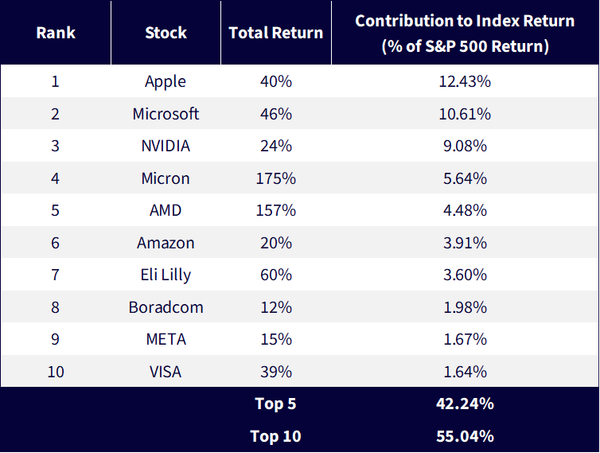
Source: Bloomberg, data from March 30, 2026, to October 30, 2026 (latest available data).
The story for the other 490 companies is different: 31%1 of the 500 companies are down this year, and roughly 74% are down more than 10% from their all-time highs.
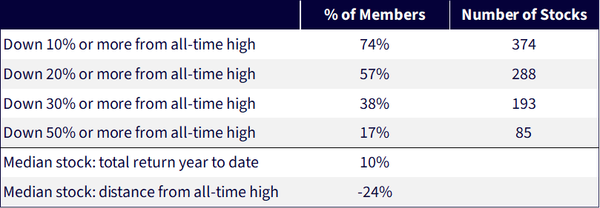
Source: Bloomberg, data as of October 30, 2026 (latest available data).
Table showing S&P 500 constituents’ declines from all-time highs and median year-to-date performance, highlighting uneven participation in market gains. Data as of 30/10/2026.
Earnings have kept on growing for the past four years and are starting to appear more and more saturated. For example, Google has recently reported sales and income per share below what analysts estimated, wiping out 13% of its stock price in a single day (October 28, 2026); Amazon fell more than 7% after reporting operating income below estimates; and Intel fell nearly 30% after missing revenue targets.
Overall S&P earnings growth seems to have reached saturation, with earnings growth expected to slow to half of current levels (see Figure 3).
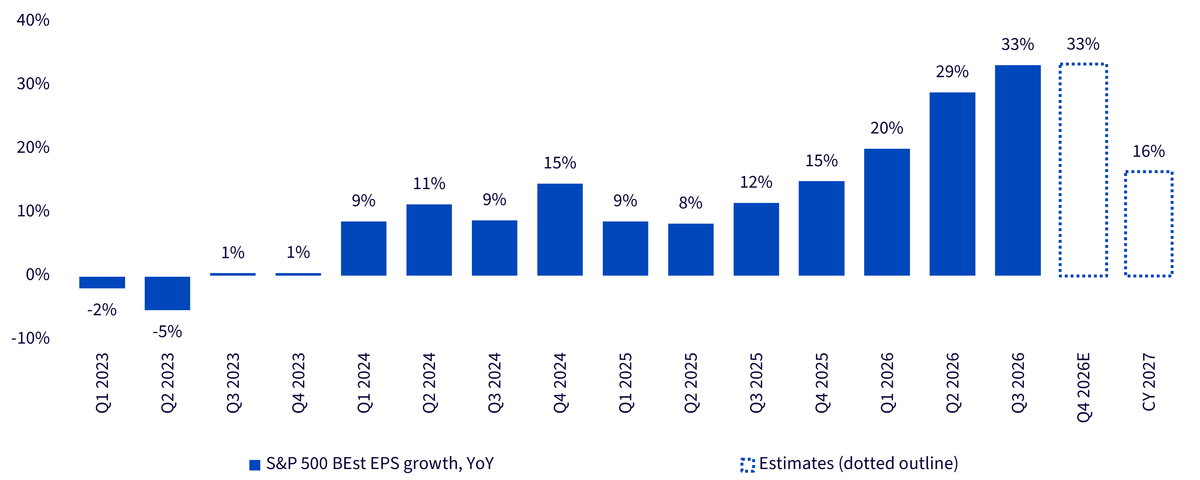
Source: Bloomberg, quarterly year-over-year earnings growth—estimates for the fourth quarter of 2026 and calendar year 2027. Estimates in dotted outline.
On the other hand, bond markets are giving investors the opportunity to lock in the highest yields seen in the past few years, which raises the question: is there a way for investors to navigate rough market conditions while still being exposed to equities?
We argue that defensive equities, in the form of quality and high-dividend stocks, provide one solution to the question raised.
Dividend-paying stocks have a built-in buffer that could help companies withstand choppy markets better than non-dividend-paying stocks. Historically, dividends have provided a safety buffer when the broader market was down, helping hedge negative returns to some extent.
High-dividend indices have consistently outperformed the broader market in calendar years when it was down, like 2008 or 2022. In the most recent example, U.S. high-dividend-paying companies outperformed the market by nearly 14 percentage points when the S&P 500 was down 18%.
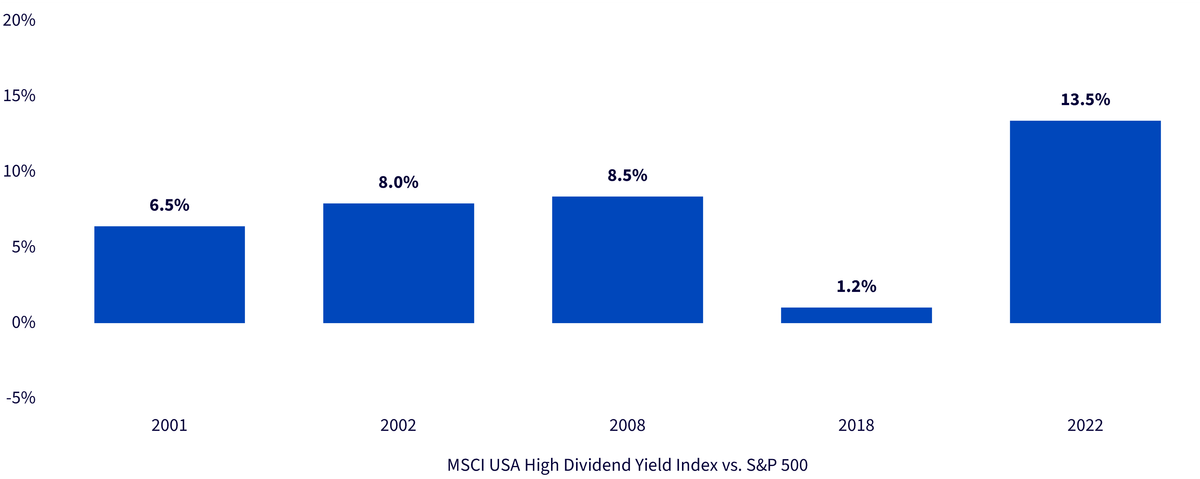
Source: Bloomberg, data from December 31, 1999, to October 31, 2026 (latest available data).
The reason for this is twofold:
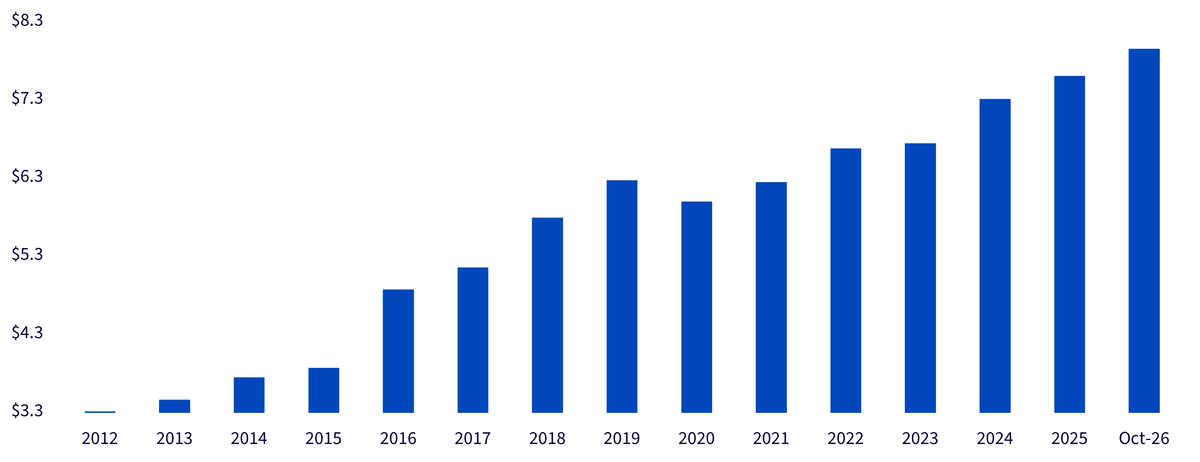
Source: Bloomberg, data from December 31, 2011, to October 31, 2026 (past 15 years).
Assuming $100 as the base value, the dividend received each year would have increased from roughly $3.4 in 2013 to nearly $8 in 2026.
Despite market drawdowns that impacted the price of the underlying stocks, the dividend payments have been resilient and have risen steadily over time.
The WisdomTree U.S. High Dividend Index offers a way to be exposed to liquid and high-dividend-paying companies by selecting the top 30% of stocks that pay the highest dividends.
The index excludes companies with a low quality and momentum score using a proprietary Composite Risk Score (CRS) mechanism. The rationale behind it is simple: strategies targeted toward value and dividend stocks could select ones where the trend and fundamentals might not be supported. WisdomTree strategies aim to avoid value traps by adding a risk management layer in the form of CRS.
The companies are weighted by the actual cash dividend paid, which provides an innovative and robust way of being exposed to such stocks.
When the market takes a turn for the worse, certain factors tend to underperform. Growth, value, size or momentum tend to be hit harder than other factors. Others, like the high-dividend factor covered in the last section, or quality, tend to be more resilient in such market conditions. Quality along with dividend provides investors an additional layer of protection in the form of profitability.
The WisdomTree U.S. Quality Dividend Growth Index provides exposure to profitable dividend-paying companies, targeting ones that can grow their dividends over time. As can be seen in Figure 6 below, in years when the market fell, the WisdomTree U.S. Quality Dividend Growth Index provided resilient and consistent outperformance.
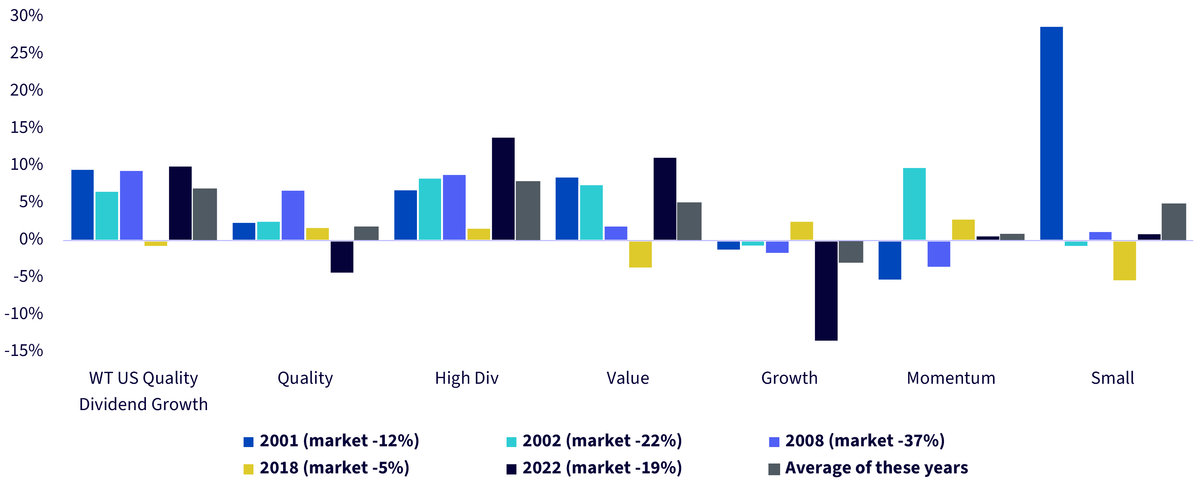
Source: Bloomberg, data from December 31, 2000, to October 31, 2026 (latest available data). “Factors” correspond to MSCI USA indices.
Stocks are also excluded on the basis of their CRS, described in the previous section. The remaining stocks are selected using three metrics:
This methodology allows investors to gain exposure to high-quality companies, and the weighting methodology allows investors to be more exposed to companies that will pay a higher dividend.
With geopolitical tensions and AI trades unfolding all around the globe, investors may find in defensive equities a convenient way of being exposed to more resilient companies while still maintaining exposure to the equity market.
Investors have several choices for gaining exposure to such stocks. High-dividend-paying companies or high-quality companies can help in navigating rough market conditions by providing investors with an extra layer of security when markets tumble. Avoiding value traps is a crucial aspect of building such strategies—WisdomTree uses a proprietary Composite Risk Score (CRS) to avoid low-quality and low-price-momentum companies.
1 Bloomberg, as of October 30, 2026.
There are risks associated with investing, including possible loss of principal. Please read the Fund’s prospectus for specific details regarding the Fund’s risk profile.
DHS: Dividends are not guaranteed, and a company currently paying dividends may cease paying dividends at any time. Funds focusing their investments on certain sectors and/or regions increase their vulnerability to any single economic or regulatory development. The Fund invests in the securities included in, or representative of, its Index regardless of their investment merit and the Fund does not attempt to outperform its Index. The composition of the Index is governed by an Index Committee and the Index may not perform as intended.
DGRW: Growth stocks, as a group, may be out of favor with the market and underperform value stocks or the overall equity market. Growth stocks are generally more sensitive to market movements than other types of stocks. Dividends are not guaranteed, and a company currently paying dividends may cease paying dividends at any time. The Fund is non-diversified; as a result, changes in the market value of a single security could cause greater fluctuations in the value of Fund shares than would occur in a diversified fund. The Fund invests in the securities included in, or representative of, its Index regardless of their investment merit and the Fund does not attempt to outperform its Index. The composition of the Index is governed by an Index Committee and the Index may not perform as intended.

Associate, Quantitative Research
Lucas Armada joined WisdomTree in 2026 as an Associate in the Quantitative Research team, where he supports the development of quantitative strategies across equities and fixed income.
Lucas began his career in Geneva in 2021 as a Quantitative Analyst in manager selection teams, first at Pittet Associates, a Swiss pension fund consultant, and later at Rothschild & Co's private bank, where he was responsible for building quantitative tools and automating reports used for fund selection.
Lucas holds a Bachelor's degree in physics and a Master's degree in financial engineering from École polytechnique fédérale de Lausanne (EPFL).

Director, Quantitative Research
Ayush Babel is the Director of Quantitative Research in WisdomTree's multi-asset quantitative research and index teams. In this role, he focuses on developing innovative quantitative strategies across various asset classes while supporting WisdomTree's diverse range of products. His expertise spans factor exploration, portfolio construction and optimization, quantitative investment research, and product development.
With over a decade of experience in the financial services industry, Ayush has held investment research roles at J.P. Morgan and Franklin Templeton. At these institutions, he was responsible for developing and managing equity and fixed income smart beta products, as well as cross-asset risk premia solutions for global institutional and retail clients. His experience covers a broad spectrum of asset classes and investment styles.
Ayush holds a bachelor's in Engineering Physics and a master’s degree in Nanoscience from the Indian Institute of Technology, Bombay.

Head of Indexes, U.S.
Alejandro Saltiel joined WisdomTree in May 2017 as part of the Quantitative Research team. Alejandro oversees the firm’s Equity indexes and actively managed ETFs. He is also involved in the design and analysis of new and existing strategies. Alejandro leads the quantitative analysis efforts across equities and alternatives and contributes to the firm’s website tools and model portfolio infrastructure. Prior to joining WisdomTree, Alejandro worked at HSBC Asset Management’s Mexico City office as Portfolio Manager for multi-asset mutual funds. Alejandro received his Master’s in Financial Engineering degree from Columbia University in 2017 and a Bachelor’s in Engineering degree from the Instituto Tecnológico Autónomo de México (ITAM) in 2010. He is a holder of the Chartered Financial Analyst designation.


