
DXJ
Japan Hedged Equity Fund

Published November 13, 2026

Global Head of Research
Japan’s equity market has spent the past decade dismantling assumptions that took a generation to form. Deflationary expectations had become the default lens, and with them, the presumption that Japanese equities had little to offer.
Japan was, for most, a tactical consideration at best, an interesting country allocation, but rarely a conviction position.
The contrast with that earlier era is now difficult to ignore. Policy is pulling in the same direction as corporate behavior, and Japan’s recovery is being led by exactly the industries—technology, defense and global export champions—that give it structural rather than merely cyclical credibility.
In such a dynamic market, it has been amazing to look at the track record of the WisdomTree Japan Hedged Equity Fund (DXJ).
In Figure 1b, we see the numbers that DXJ has put up relative to the Morningstar Japan Stock Category:
Oftentimes, creating an investment strategy that achieves top quartile, quintile or decile is viewed as strong. Here we are talking about literal #1 and #2 performance.
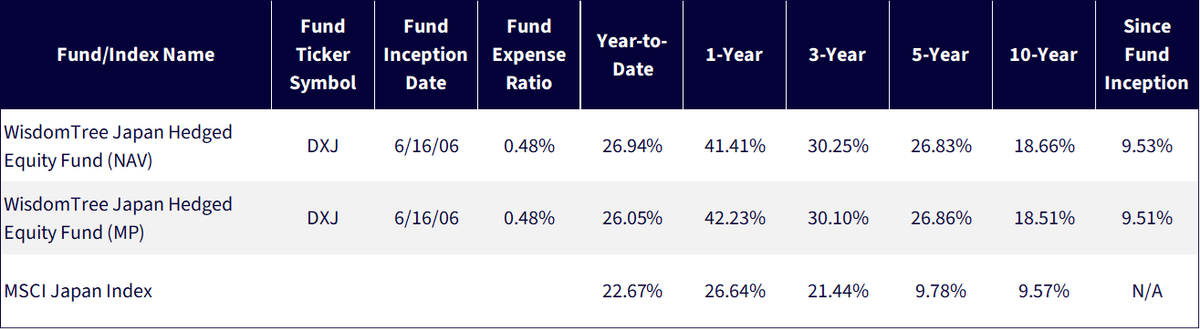
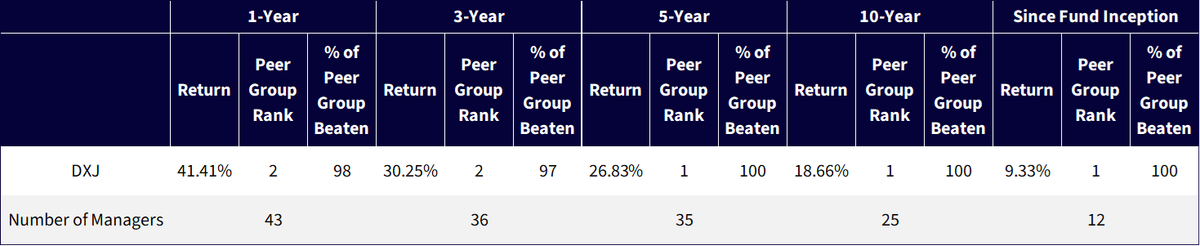
Sources: For Figure 1a: Morningstar, FactSet and WisdomTree, specifically, data is from the PATH Fund Comparison Tool, accessed as of October 23, 2026, but showing returns for the period ended September 30, 2026. NAV denotes total return performance at net asset value. MP denotes market price performance. Figure 1b: Morningstar Direct, with all results shown for the Morningstar Japan Stock Category. Past performance is not indicative of future results. Investment return and principal value of an investment will fluctuate so that an investor’s shares, when redeemed, may be worth more or less than their original cost. Current performance may be lower or higher than the performance data quoted. For the most recent month-end and standardized performance, click here.
DXJ is designed to track the total return performance of, before fees and expenses, the WisdomTree Japan Hedged Equity Index. For any index, it’s important to think through two main considerations:
In 2026, currency exposure is increasingly a choice rather than a given for U.S. investors allocating internationally. DXJ has been neutralizing yen/dollar exchange rate exposure since 2010. Notably, a depreciating yen tends to enhance the competitiveness and earnings of Japan’s globally oriented companies, leading currency performance to be a substantive part of the investment thesis rather than simply a risk control.
A common misconception is worth addressing directly. Neutralizing currency exposure means exactly that: removing the exchange rate’s impact on total return. The strategy neither loses when the yen appreciates nor gains when it depreciates. The investor’s return is driven primarily by the underlying equities. There is an additional dimension worth noting.
Since U.S. interest rates have generally run above Japanese rates, DXJ investors have historically been paid to hedge through the carry embedded in currency forward contracts.
Japan’s equity story has rarely been this coherently constructed. What makes the current moment distinctive is not any single catalyst but the alignment of several reinforcing forces:
The Bank of Japan’s gradual normalization adds a layer of discipline rather than disruption. A central bank that moves carefully, tethering each step to wage and demand evidence, is signaling confidence in the underlying economy rather than urgency to restrain it. That is a constructive backdrop, not a headwind.
For investors, the opportunity is to access all of this at a valuation that still reflects skepticism the fundamentals no longer warrant. Japanese equities continue to trade at a meaningful discount to the broader market, with a dividend yield that more than compensates for that gap. When earnings momentum, policy conviction and institutional capital flows converge at a discount to fair value, the case for allocation tends to make itself.
Japan, in this case, is not asking investors to be patient. The evidence has already been arriving.
1 Source: Sano, H. (2026, August 18). Japan’s earnings surprise analysts to fuel bets for broad rally. Bloomberg.
2 Source: The Japan Times. (2026, June 24). Japan unveils $2.3 trillion investment plan for next 14 years.
3 Source: Reuters. (2026, July 13). Japan has no plans to overhaul pension funds’ asset allocation, sources say. Yahoo Finance.
There are risks associated with investing, including possible loss of principal. Foreign investing involves special risks, such as risk of loss from currency fluctuation or political or economic uncertainty. The Fund focuses its investments in Japan, thereby increasing the impact of events and developments in Japan that can adversely affect performance. Derivative investments can be volatile and these investments may be less liquid than other securities, and more sensitive to the effect of varied economic conditions. As this Fund can have a high concentration in some issuers, the Fund can be adversely impacted by changes affecting those issuers. Due to the investment strategy of this Fund, it may make higher capital gain distributions than other ETFs. The Fund invests in the securities included in, or representative of, its Index regardless of their investment merit and the Fund does not attempt to outperform its Index. Please read the Fund’s prospectus for specific details regarding the Fund’s risk profile.
Morningstar, Inc., 2026. All rights reserved. The information contained herein: (1) is proprietary to Morningstar and/or its content providers; (2) may not be copied or distributed; and (3) is not warranted to be accurate, complete or timely. Neither Morningstar nor its content providers are responsible for any damages or losses arising from any use of this information. Past performance, rankings and ratings are no guarantee of future results. The % of Peer Group Beaten is the funds’ total-return percentile rank compared to all funds within the same Morningstar Category and is subject to change each month. Regarding ranking of funds, 1 = Best.
Japan Hedged Equity Fund

Global Head of Research
Christopher Gannatti began at WisdomTree as a Research Analyst in December 2010, working directly with Jeremy Schwartz, CFA®, Director of Research. In January of 2014, he was promoted to Associate Director of Research where he was responsible to lead different groups of analysts and strategists within the broader Research team at WisdomTree. In February of 2018, Christopher was promoted to Head of Research, Europe, where he was based out of WisdomTree’s London office and was responsible for the full WisdomTree research effort within the European market, as well as supporting the UCITs platform globally. In November 2021, Christopher was promoted to Global Head of Research, now responsible for numerous communications on investment strategy globally, particularly in the thematic equity space. Christopher came to WisdomTree from Lord Abbett, where he worked for four and a half years as a Regional Consultant. He received his MBA in Quantitative Finance, Accounting, and Economics from NYU’s Stern School of Business in 2010, and he received his bachelor’s degree from Colgate University in Economics in 2006. Christopher is a holder of the Chartered Financial Analyst Designation.


