
OPPJ
Japan Opportunities Fund

Published November 11, 2026

Global Head of Research
Ranking first in a category is the kind of result that speaks for itself. Over the one-year period ended September 30, 2026, the WisdomTree Japan Opportunities Fund (OPPJ) ranked #1 in the Morningstar Japan Stock category. The specific data is presented in Figure 1b.
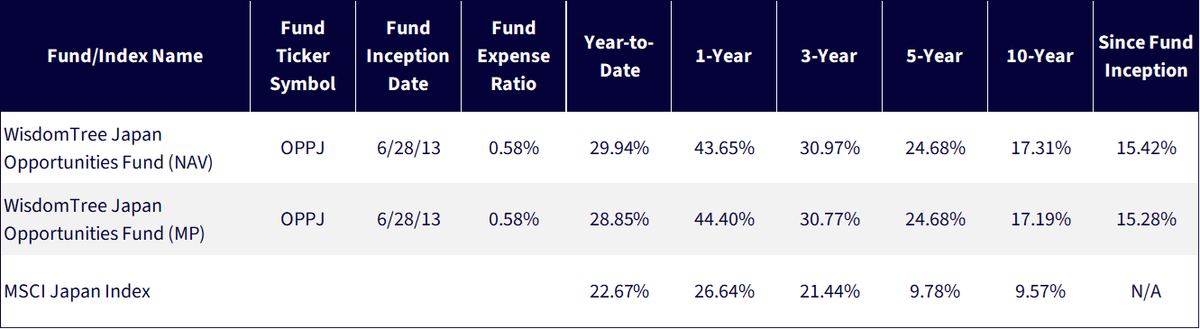

Sources: For Figure 1a: Morningstar, FactSet and WisdomTree, with data from the PATH Fund Comparison Tool, accessed as of October 23, 2026, but showing returns for the period ended September 30, 2026. Prior to July 1, 2025, the Fund was known as the WisdomTree Japan Hedged SmallCap Equity Fund (DXJS). On that date, the Fund’s investment policy changed. NAV denotes total return performance at net asset value. MP denotes market price performance. Figure 1b: Morningstar Direct, with all results shown for the Morningstar Japan Stock category. Past performance is not indicative of future results. Investment return and principal value of an investment will fluctuate so that an investor’s shares, when redeemed, may be worth more or less than their original cost. Current performance may be lower or higher than the performance data quoted. For the most recent month-end and standardized performance, click here.
That result did not happen by accident. It reflects a deliberate strategic repositioning made more than one year ago, and an investment thesis on Japan that has, so far, proven correct.
Prior to July 1, 2025, OPPJ operated under a different investment policy as the WisdomTree Japan Hedged SmallCap Equity Fund (DXJS). On that date, the Fund transitioned to track the WisdomTree Japan Opportunities Index, which is a meaningfully different approach designed to capture the full complexity of Japan’s evolving equity opportunity rather than a single factor or market-cap segment.
The new strategy is built around four distinct sleeves.
The first targets the five trading conglomerates, the sogo shosha, in which Berkshire Hathaway holds strategic stakes:1
These firms are themselves broadly diversified across the Japanese industrial economy, and they have delivered shareholder yields that compare favorably to both the MSCI Japan Index and the S&P 500 Index.2 Buffett’s entry into these names in 2019 reinvigorated foreign investor attention to Japan, and the positions have compounded well since.3
The second sleeve focuses on high shareholder yield, meaning companies returning capital through dividends and net buybacks at above-average rates. Two-plus decades of data show that the highest shareholder yield quintile within Japan has outperformed the lowest by a wide margin, with lower volatility.4 As Japanese companies increasingly deploy buybacks alongside dividends, the signal becomes more powerful:
Over 90% of MSCI Japan constituents now carry a positive net buyback yield, up from nearly zero in the mid-1990s.5
The third sleeve targets corporate governance improvers, companies with low valuations, such as low price-to-book ratios, that are also demonstrating earnings and dividend growth. This is a systematic way to capture companies mid-reform, before their transformation is fully priced in.
The fourth, and most distinctive, sleeve is the Geopolitical-Alpha (GeoAlpha) component. This provides exposure to companies positioned to benefit from geopolitical events, fiscal and monetary policy shifts, technological innovation and shifting consumer preferences. It is where the AI infrastructure, defense spending and domestic capital expenditure themes enter the portfolio in a rules-based way.
The strategy also applies a dynamic currency hedging overlay, managing yen exposure monthly across a 0% to 100% hedged range.
The Japan investment story in 2025–2026 has not been a single-factor trade. It has been a convergence:
No single sleeve or factor captures all of that, but OPPJ was designed around that complexity.
The #1 ranking in the Morningstar Japan Stock category over one year reflects both the strength of the underlying Japan thesis and the quality of the strategic design.
1 As of July 13, 2026, OPPJ held 7.45% in Sumitomo Corp., 7.18% in Marubeni Corp., 7.06% in Mitsubishi Corp., 6.40% in Mitsui & Co. Ltd. and 5.30% in Itochu Corp. Holdings subject to change.
2 Sources: WisdomTree, FactSet and S&P, with data through September 30, 2026. Past performance is not indicative of future returns.
3 Source: Buffett, W. E. (2024). 2023 annual report: Letter to shareholders. Berkshire Hathaway Inc.
4 Sources: WisdomTree, FactSet and MSCI, with period measured from 12/31/2002 to 5/31/2025. Past performance is not indicative of future returns.
5 Sources: WisdomTree, FactSet and MSCI, with data measured from 4/28/1995 to 9/30/2026. Past performance is not indicative of future returns.
Japan Opportunities Fund

Global Head of Research
Christopher Gannatti began at WisdomTree as a Research Analyst in December 2010, working directly with Jeremy Schwartz, CFA®, Director of Research. In January of 2014, he was promoted to Associate Director of Research where he was responsible to lead different groups of analysts and strategists within the broader Research team at WisdomTree. In February of 2018, Christopher was promoted to Head of Research, Europe, where he was based out of WisdomTree’s London office and was responsible for the full WisdomTree research effort within the European market, as well as supporting the UCITs platform globally. In November 2021, Christopher was promoted to Global Head of Research, now responsible for numerous communications on investment strategy globally, particularly in the thematic equity space. Christopher came to WisdomTree from Lord Abbett, where he worked for four and a half years as a Regional Consultant. He received his MBA in Quantitative Finance, Accounting, and Economics from NYU’s Stern School of Business in 2010, and he received his bachelor’s degree from Colgate University in Economics in 2006. Christopher is a holder of the Chartered Financial Analyst Designation.


