DGRW
U.S. Quality Dividend Growth Fund

Published November 20, 2026

Equity Strategist
October offered a reminder of how quickly market leadership can change and why strategies providing downside protection are always valuable, even if they’re not the flashiest allocation in a portfolio. As investors scrutinized the relationship between artificial intelligence (AI) capital expenditures, cash flow generation and profit monetization, many of the market’s most rewarded growth stocks in 2026 suffered steep declines, plunging several into bear market territory and others well past correction. The fell 0.87% in October, while several U.S. Growth indexes declined more than 6%.
The WisdomTree U.S. Quality Dividend Growth Fund (DGRW), meanwhile, returned a positive 1.40% at net asset value (NAV), outperforming the S&P 500 by nearly 2.3%. Its combination of quality, growth and dividend discipline proved valuable as leadership rotated toward cyclical, value-oriented and defensive areas of the market.
For investors who have wondered whether keeping pace with U.S. equities requires embracing every corner of the AI infrastructure trade, October offered a useful counterpoint.
For much of 2026, avoiding certain AI infrastructure buildout beneficiaries came at a cost. A small cohort of semiconductor and tech memory and storage companies rallied to produce triple-digit total returns several times over, and their absence from DGRW weighed on performance relative to the S&P 500.
October abruptly changed that equation. Intel (INTC), Micron Technology (MU), Sandisk (SNDK) and Advanced Micro Devices (AMD), all among DGRW’s 10 largest detractors from relative performance through September, each declined at least 16% during October. Some even suffered losses beyond 30% and 40%.
Together, these companies represented approximately 5% of the S&P 500 at September’s end and fell to under 4% by October’s end. DGRW owned none of them. The same positioning that had created an opportunity cost during their advance became a meaningful advantage during their retreat.
This is an important distinction when evaluating a disciplined investment process. Relative performance depends partly on what a strategy avoids in addition to what it gets right, and the consequences of those decisions can change sharply when investors reassess expectations. October rewarded a portfolio that participated less in some of AI’s most volatile exposures.
The rotation extended beyond a handful of technology stocks. At the end of September, only Energy and Information Technology outperformed the S&P 500 year-to-date. By October’s close, that list had expanded to five sectors: Energy, Health Care, Information Technology, Consumer Staples and Materials, in that order.
DGRW remains overweight in four of those five sectors relative to the S&P 500, with Information Technology as its only underweight. That positioning gave the Fund exposure to both defensive businesses and cyclical opportunities as investors looked beyond the companies dominating the AI narrative.
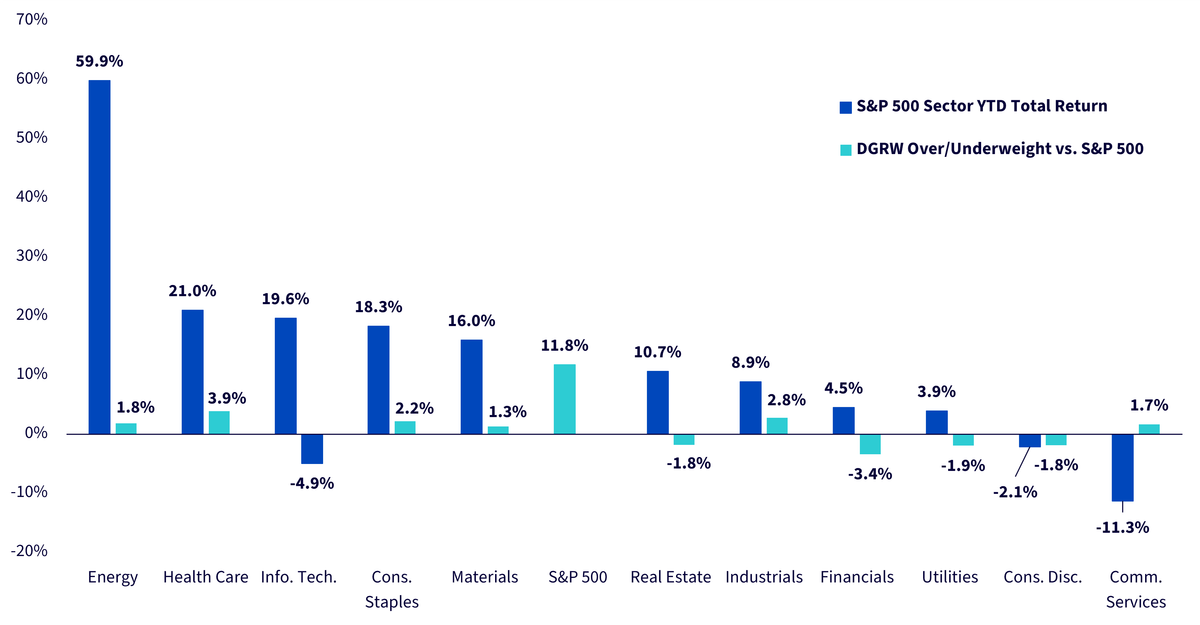
Source: WisdomTree, FactSet, Standard & Poor’s, as of 10/31/2026. You cannot invest directly in an index. Subject to change.
Their simultaneous leadership illustrates why a portfolio’s ability to participate across sectors matters when a concentrated rally begins to unwind. Certainly, an underweight in Technology can be challenging when it exhibits concentrated leadership with narrow breadth across other sectors. But when leadership broadens as it did in October, the rest of the portfolio has more room to contribute.
DGRW’s approach begins with dividend-paying companies and applies quality and growth screens to identify businesses with the capacity to grow their dividends. Measures of profitability, including and , help anchor the investment case to fundamentals.
That focus is especially relevant when investors become less willing to reward spending without sufficient evidence of profit monetization and cash flow generation. A growing dividend, however, is a tangible receipt for an investor.
Recent dividend increases among DGRW holdings illustrate the breadth of that opportunity. The list includes several household and ancillary names across sectors, including ExxonMobil, Marathon Petroleum, AbbVie, D.R. Horton, Visa, Vistra, EQT Corp., Phillips 66, Lincoln Electric, A.O. Smith, Texas Instruments, T-Mobile, McDonald’s and Fifth Third Bancorp.
These businesses span Energy, Health Care, Financials, Consumer Discretionary, Information Technology and more. Their dividend decisions reinforce why dividend growth investing can provide exposure to a wide range of earnings drivers, including opportunities well beyond the AI infrastructure buildout.
October’s resilience also substantially narrowed DGRW’s year-to-date performance gap. Through month-end, the Fund had returned 11.16% at NAV versus 11.77% for the S&P 500, leaving it just 61 basis points behind the benchmark despite its lower Technology allocation and limited direct exposure to the AI buildout.
DGRW was also approximately 81 basis points ahead of the average year-to-date total return of its Morningstar U.S. Large Blend category. That comparison provides another perspective on the strategy’s effectiveness during a year of changing market leadership.
We believe these results reinforce DGRW’s appeal as an all-weather equity allocation. Its outperformance hit rate over the S&P 500 during the index’s most severe selloffs complements its ability to capture meaningful upside. Notably, when the index fell one standard deviation or more (-1.13%) during a daily session, DGRW outperformed 84% of the time (220 out of 261 observations).
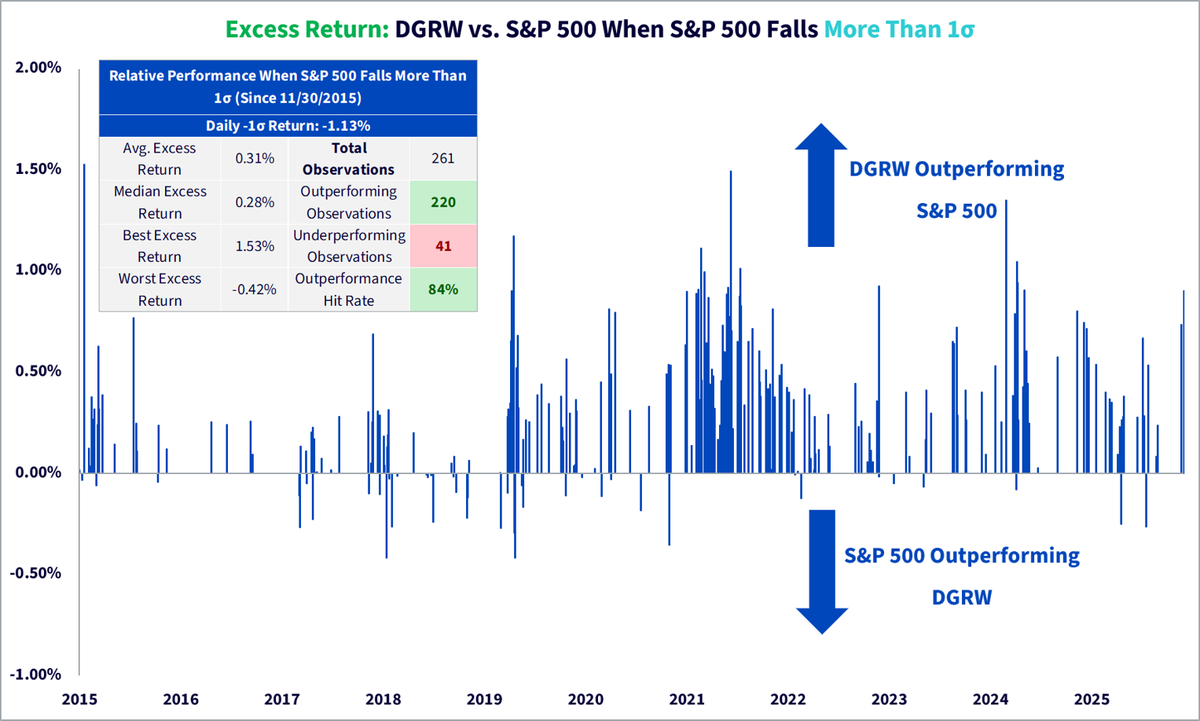
Source: WisdomTree, S&P, as of 10/31/2026. You cannot invest directly in an index. Evaluation period corresponds to the beginning of our S&P 500 daily return series in November 2015. Past performance is not indicative of future results. Investment return and principal value of an investment will fluctuate so that an investor’s shares, when redeemed, may be worth more or less than their original cost. Current performance may be lower or higher than the performance data quoted. For the most recent month-end and standardized performance, click here.
October demonstrated another source of resilience: participation when cyclical and defensive businesses reclaim leadership from a narrow group of technology stocks.
For current holdings of DGRW, please click here. Holdings are subject to risk and change.
There are risks associated with investing, including possible loss of principal. Growth stocks, as a group, may be out of favor with the market and underperform value stocks or the overall equity market. Growth stocks are generally more sensitive to market movements than other types of stocks. Dividends are not guaranteed, and a company currently paying dividends may cease paying dividends at any time. The Fund is non-diversified, as a result, changes in the market value of a single security could cause greater fluctuations in the value of Fund shares than would occur in a diversified fund. The Fund invests in the securities included in, or representative of, its Index regardless of their investment merit and the Fund does not attempt to outperform its Index. The composition of the Index is governed by an Index Committee and the Index may not perform as intended. Please read the Fund’s prospectus for specific details regarding the Fund’s risk profile.
U.S. Quality Dividend Growth Fund

Equity Strategist
Brian Manby is an Equity Strategist at WisdomTree and part of the Investment Strategy team.
He is responsible for developing and communicating equity market insights, investment themes, and portfolio strategies that support the firm’s ETF and investment solutions platform. He evaluates sectors, valuations, fundamentals and equity styles to identify investment opportunities and provide actionable perspectives to clients and advisors. He also helps investors understand how WisdomTree’s equity strategies can be used to achieve long-term investment objectives in evolving market environments.
Brian joined WisdomTree in October 2018 as an Investment Strategy Analyst after a few years as a Consultant for FactSet Research Systems, Inc. He earned a B.A. in Economics and Political Science from the University of Connecticut in 2016 and has been a Chartered Financial Analyst since 2022.

