
OPPE
European Opportunities Fund

Published November 19, 2026

Global Head of Research
On October 21, 2026, Vladimir Putin agreed “in principle” to resume three-way talks with Washington and Kyiv after November 10, according to his foreign affairs adviser, Yuri Ushakov, with the stated focus being a security system for Russia and Ukraine once the conflict ends. The Associated Press reported no sign of an imminent high-level breakthrough. Earlier trilateral rounds in Abu Dhabi and Geneva produced little beyond prisoner exchanges, and Ukrainian President Volodymyr Zelenskyy described a freeze of the fighting as the minimum he needs from Russia.1
So the base case today may still be a long war with intermittent diplomacy.
The question we think is worth asking here is narrower.
What if 2027 brings a ceasefire or a freeze sooner than markets assume?
Nobody can forecast that, but the ingredients of a faster outcome are visible, including renewed talks, a U.S. administration pressing Kyiv to make a deal and a Kremlin that says it wants to discuss post-war security.1 An outcome that arrives unexpectedly tends to reprice a portfolio all at once.
We have a recent measurement. On January 22, after Zelenskyy said Ukrainian and Russian teams would meet U.S. officials in a three-way format for the first time, Reuters reported that stocks expected to benefit from the war ending rallied while defense stocks fell.2
Two caveats come with that data. It is a single day, and Reuters noted that defense stocks were already under pressure after the U.S. backed away from tariff threats against Europe and ruled out taking Greenland by force, so the move is not a clean read on peace alone.2 Still, the shape matters more than the size. Peace is not simply good or bad for European equities. It is good for some European businesses and bad for others, and a portfolio’s sensitivity depends on which ones it owns.
The fifth Rapid Damage and Needs Assessment, produced jointly by the World Bank Group, the Government of Ukraine, the European Commission and the United Nations, puts the cost of recovery and reconstruction at almost $588 billion over 2026 to 2035, equivalent to almost three times Ukraine’s 2025 gross domestic product (GDP). Transport is the largest line at $96.3 billion, followed by energy at $90.6 billion and housing at $89.8 billion. The figures stop at December 31, 2025, and the fighting has continued since.3
Two cautions belong beside that number.
The WisdomTree European Opportunities Fund (OPPE) is an exchange-traded fund that tracks the WisdomTree European Opportunities Index, a rules-based selection of roughly 90 European mid- and large-cap companies.4 We will not walk through all of its mechanics here. Two features matter for the question we are posing: what if something that looks like peace comes sooner than markets may presently be expecting.
The first is that two-thirds of the index is built around a question that has nothing to do with the war in Ukraine.
Which companies return the most cash to their owners?
The measure is total shareholder yield, the dividends a company pays plus the net value of shares it buys back, as a percentage of its market value. As of September 30, 2026, the index carried a 6.0% shareholder yield against 3.8% for the , a broad benchmark of large and mid-sized European companies.5 That part of the portfolio takes no view on whether the fighting stops.
The second is the remaining third, the GeoAlpha sleeve (a sleeve is a separately selected group of stocks within the index). It holds companies chosen for opportunities created by geopolitical developments, technology trends and macroeconomic conditions. Geopolitical events, which the methodology defines to include supply-chain changes, defense spending and alliances, and trade and tariff policy, are allotted 25% to 50% of that sleeve, which works out to roughly 8% to 17% of the whole index. The committee that runs the index may also rebalance between its usual quarterly dates after events such as kinetic conflicts, cyberattacks or tariffs. In other words, one slice of the portfolio is designed to be re-pointed when geopolitics changes. That is the structural connection to a faster peace, at least where it could show up within the underlying exposure.
As of October 23, 2026, the fund’s holdings put it on both sides of the trade, meaning some stocks that could do well if the conflict continues and some stocks that could do well if the peace were to come sooner than expected.6
The largest group, energy at about 7.6% across five names, could cut either way, depending on how specific situational details unfold.
What emerges is a portfolio that is neither a defense trade nor a reconstruction trade, at least as of October 23, 2026, but holds some of each inside a larger machine for harvesting shareholder returns.
A thesis about 2027 is only a story until it meets a scoreboard, and the scoreboard does not wait for the war to end. It is a fair question to ask how OPPE has actually performed while all of this has been unfolding and the war between Russia and Ukraine has persisted.7
Over those roughly 17 months, OPPE’s cumulative total return ended near 32%, against about 18% for the MSCI Europe Index, a gap of roughly 14 percentage points.
This record was earned while the war between Russia and Ukraine was still being fought. It shows how the strategy has behaved in the base case, not in the scenario this piece has explored. If the diplomatic developments discussed above turns into something more, the useful question is not whether OPPE called it, but whether a portfolio built this way can be positioned to meet that moment.
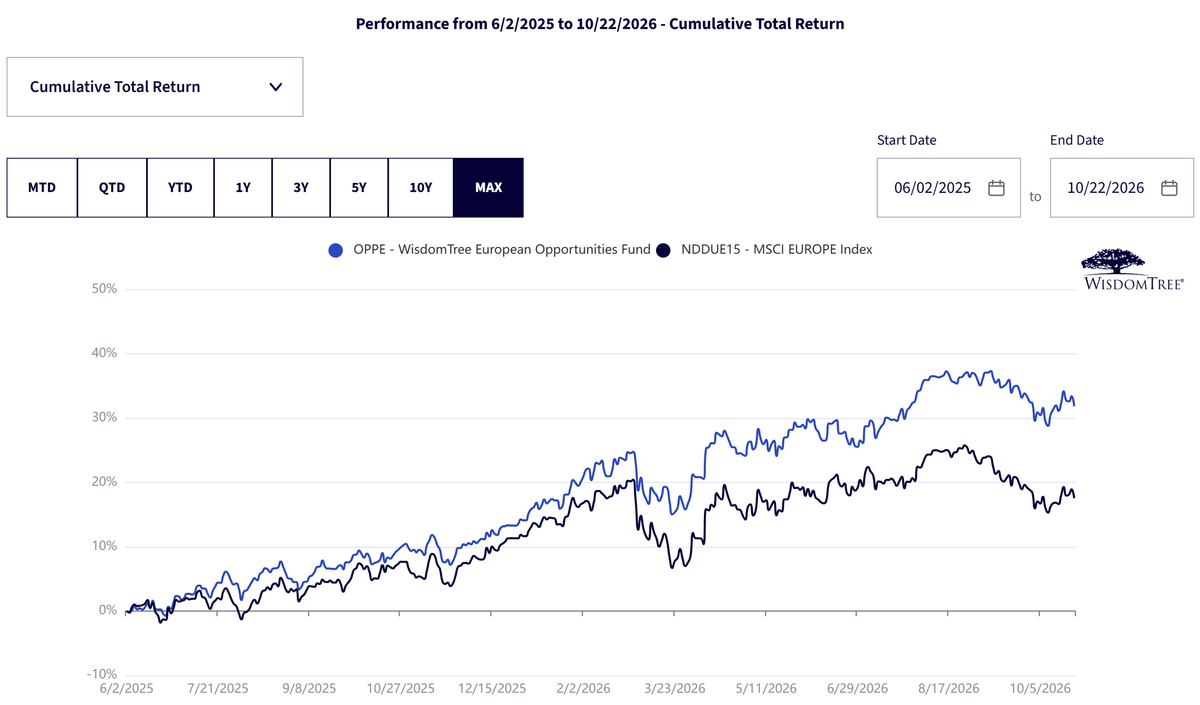

Sources: For Figure 1a: Morningstar, FactSet and WisdomTree, specifically, data from the PATH Fund Comparison Tool, accessed as of October 24, 2026, but showing returns for the period ended October 22, 2026. Prior to June 2, 2025, the Fund was known as the WisdomTree Europe Hedged SmallCap Equity Fund. On that date the Fund’s investment policy changed. NAV denotes total return performance at net asset value. MP denotes market price performance. Figure 1b is as of September 30, 2026. Past performance is not indicative of future results. Investment return and principal value of an investment will fluctuate so that an investor’s shares, when redeemed, may be worth more or less than their original cost. Current performance may be lower or higher than the performance data quoted. For the most recent month-end and standardized performance, click here.
1 Source: Associated Press. (2026, October 21). Putin agrees to resume trilateral Russia-Ukraine-U.S. talks next month. PBS News.
2 Source for bullets and reaction: John, A. (2026, January 22). Ukraine-exposed stocks rally, defence dips on Ukraine peace hopes. Reuters.
3 Source: World Bank Group, Government of Ukraine, European Commission, & United Nations. (2026, February). Ukraine: Fifth rapid damage and needs assessment (RDNA5), February 2022–December 2025: Main report. World Bank.
4 Source: OPPE fund page, with data as of October 23, 2026. Holdings subject to change.
5 Sources: WisdomTree, FactSet, MSCI, with data as of September 30, 2026.
6 For each mentioned company, if it is a constituent of OPPE as of October 23, 2026, that weight is in parentheses following the company name’s first mention. Source is the OPPE fund page. Holdings are subject to change.
7 Figure 1a indicates a start date of June 2, 2025. Prior to June 2, 2025, the Fund was known as the WisdomTree Europe Hedged SmallCap Equity Fund. On that date the Fund’s investment policy changed to the strategy we have been discussing in this piece.
For current holdings of OPPE, please click here. Holdings are subject to risk and change.
There are risks associated with investing, including possible loss of principal. Foreign investing involves special risks, such as risk of loss from currency fluctuation or political or economic uncertainty. This Fund focuses its investments in Europe, thereby the impact of events and developments associated with the region can adversely affect performance. The Fund invests in derivatives in seeking to obtain a dynamic currency hedge exposure. Derivative investments can be volatile, and these investments may be less liquid than other securities, and more sensitive to the effects of varied economic conditions. Derivatives used by the Fund may not perform as intended. The Fund invests in the securities included in, or representative of, its Index regardless of their investment merit and the Fund does not attempt to outperform its Index. The composition of the Index is governed by an Index Committee and the Index may not perform as intended. Due to the investment strategy of this Fund, it may make higher capital gain distributions than other ETFs. Please read the Fund’s prospectus for specific details regarding the Fund’s risk profile.
European Opportunities Fund

Global Head of Research
Christopher Gannatti began at WisdomTree as a Research Analyst in December 2010, working directly with Jeremy Schwartz, CFA®, Director of Research. In January of 2014, he was promoted to Associate Director of Research where he was responsible to lead different groups of analysts and strategists within the broader Research team at WisdomTree. In February of 2018, Christopher was promoted to Head of Research, Europe, where he was based out of WisdomTree’s London office and was responsible for the full WisdomTree research effort within the European market, as well as supporting the UCITs platform globally. In November 2021, Christopher was promoted to Global Head of Research, now responsible for numerous communications on investment strategy globally, particularly in the thematic equity space. Christopher came to WisdomTree from Lord Abbett, where he worked for four and a half years as a Regional Consultant. He received his MBA in Quantitative Finance, Accounting, and Economics from NYU’s Stern School of Business in 2010, and he received his bachelor’s degree from Colgate University in Economics in 2006. Christopher is a holder of the Chartered Financial Analyst Designation.


