
USFR
Floating Rate Treasury Fund

Published November 18, 2026

Head of Investment and Fixed Income Strategy
This blog is the latest installment in our series on the recent movements in the U.S. Treasury (UST) 10-year yield. We’ve been diligently reporting on the forces that have directly impacted the 10-year over the last few months, and based upon the most recent trading activity, it looks like it’s going to be the gift that keeps on giving. In fact, the reversal of the safe-haven trade we discussed only a week or so ago has placed the UST 10-year yield on a potential path for a round-tripper.
To be clear, by the term round-tripper, I’m referring to the fact that the 10-year yield reached a multi-decade high-water mark in early October and then plunged due to safe-haven demand from the AI/Tech-related sell-off (with some short covering thrown in for good measure). However, the more orderly equity market trading activity over the last week or so has seen the safe-haven bid retreat, and as a result the Treasury market reversed course yet again with yields surging.
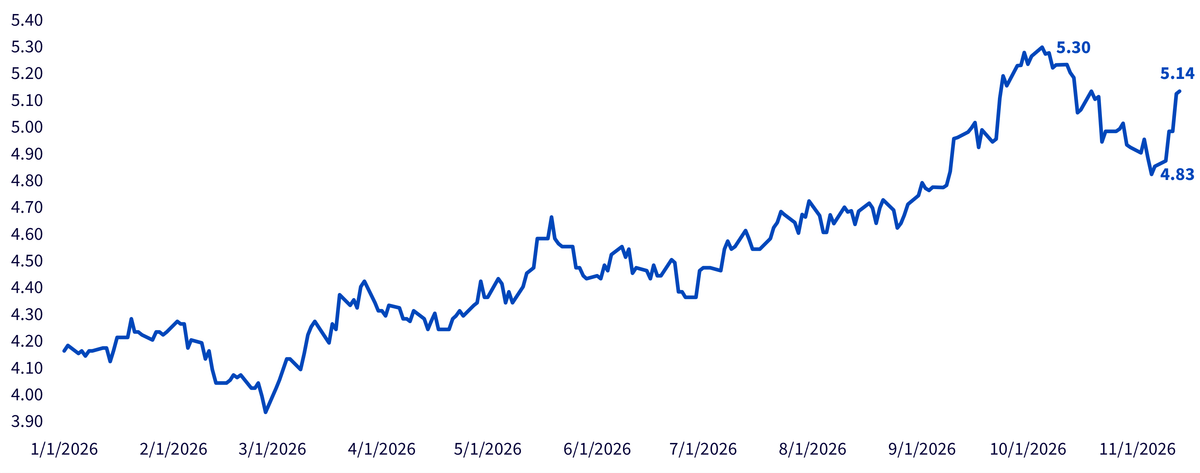
Source: Bloomberg, as of 11/13/2026.
The above graph offers the reader some distinct perspective. The aforementioned October peak was placed at 5.30%, although it hit as high as 5.36% on an intraday trading basis. Then, the headline-grabbing AI/Tech sell-off in the stock market brought the 10-year yield down by an eye-opening 55 basis points at one point before settling in at 4.83%. Fast-forward to the present and the removal of the safe-haven bid saw the UST 10-year yield retrace almost two-thirds of the flight-to-quality decrease to 5.14%, or only 16 basis points below the October closing high.
So what happened? Well, with the removal of the safe-haven trade, the forces that pushed long-term rates higher in the first place (solid economy, sticky inflation, the Fed and supply, supply, supply) returned, led by a much better-than-expected jobs report, but arguably more importantly, a hotter print. Needless to say, that upped the ante for a December rate hike. As we have noted on many occasions, these forces remain ever-present and are not going away any time soon.
There was another integral factor at work. While there was no increase in Treasury coupon auction sizes, the nation’s debt managers did offer a hefty $125 billion in 3-, 10- and 30-year securities as part of their quarterly refunding. This factor was noteworthy because, even though yield levels for all three of these maturities rose into the bidding process, demand was tepid, at best. In other words, sponsorship at these elevated yield levels failed to produce any uptick in demand from investors.
While the UST 10-year yield has not quite done a ‘round-tripper’ yet, our motto remains “why try to time the top in yield?” Against this backdrop, we continue to highlight the WisdomTree Zero-Duration suite for investors to consider as the cornerstone for their fixed income portfolios:
There are risks associated with investing, including possible loss of principal. Please read the Fund’s prospectus for specific details regarding the Fund’s risk profile.
USFR: Securities with floating rates can be less sensitive to interest rate changes than securities with fixed interest rates, but may decline in value. Fixed income securities will normally decline in value as interest rates rise. The value of an investment in the Fund may change quickly and without warning in response to issuer or counterparty defaults and changes in the credit ratings of the Fund’s portfolio investments. Due to the investment strategy of this Fund, it may make higher capital gain distributions than other ETFs. The Fund invests in the securities included in, or representative of, its Index regardless of their investment merit, and the Fund does not attempt to outperform its Index.
AGZD: Fixed income investments are subject to interest rate risk; their value will normally decline as interest rates rise. The Fund seeks to mitigate interest rate risk by taking short positions in U.S. Treasuries (or futures providing exposure to U.S. Treasuries), but there is no guarantee this will be achieved. Derivative investments can be volatile and these investments may be less liquid than other securities, and more sensitive to the effects of varied economic conditions. Fixed income investments are also subject to credit risk, the risk that the issuer of a bond will fail to pay interest and principal in a timely manner, or that negative perceptions of the issuer’s ability to make such payments will cause the price of that bond to decline. The Fund may engage in “short sale” transactions of U.S. Treasuries where losses may be exaggerated, potentially losing more money than the actual cost of the investment and the third party to the short sale may fail to honor its contract terms, causing a loss to the Fund. While the Fund attempts to limit credit and counterparty exposure, the value of an investment in the Fund may change quickly and without warning in response to issuer or counterparty defaults and changes in the credit ratings of the Fund’s portfolio investments. Investing in mortgage- and asset-backed securities involves interest rate, credit, valuation, extension and liquidity risks and the risk that payments on the underlying assets are delayed, prepaid, subordinated or defaulted on. Due to the investment strategy of the Fund, it may make higher capital gain distributions than other ETFs. The Fund invests in the securities included in, or representative of, its Index regardless of their investment merit and the Fund does not attempt to outperform its Index.
HYZD: High-yield or “junk” bonds have lower credit ratings and involve a greater risk to principal. Fixed income investments are subject to interest rate risk; their value will normally decline as interest rates rise. The Fund seeks to mitigate interest rate risk by taking short positions in U.S. Treasuries (or futures providing exposure to U.S. Treasuries), but there is no guarantee this will be achieved. Derivative investments can be volatile and these investments may be less liquid than other securities, and more sensitive to the effects of varied economic conditions.
Fixed income investments are also subject to credit risk, the risk that the issuer of a bond will fail to pay interest and principal in a timely manner, or that negative perceptions of the issuer’s ability to make such payments will cause the price of that bond to decline. The Fund may engage in “short sale” transactions where losses may be exaggerated, potentially losing more money than the actual cost of the investment and the third party to the short sale may fail to honor its contract terms, causing a loss to the Fund. While the Fund attempts to limit credit and counterparty exposure, the value of an investment in the Fund may change quickly and without warning in response to issuer or counterparty defaults and changes in the credit ratings of the Fund’s portfolio investments. Due to the investment strategy of the Fund, it may make higher capital gain distributions than other ETFs. The Fund invests in the securities included in, or representative of, its Index regardless of their investment merit and the Fund does not attempt to outperform its Index.

Head of Investment and Fixed Income Strategy
Kevin serves as the Head of Investment and Fixed Income Strategy. In this role, he writes macro and fixed income-related content and works closely with the sales, research and marketing teams. In addition, Kevin conducts client-facing webinars and meetings, providing expertise on WisdomTree’s existing and future bond ETFs. Prior to joining WisdomTree, Kevin spent 30 years at Morgan Stanley, where he was Managing Director and Chief Fixed Income Strategist for Wealth Management. He was responsible for tactical and strategic recommendations and created asset allocation models for fixed income securities. He was a contributor to the Morgan Stanley Wealth Management Global Investment Committee, primary author of Morgan Stanley Wealth Management’s monthly and weekly fixed income publications, and collaborated with the firm’s Research and Consulting Group Divisions to build ETF and fund manager asset allocation models. Kevin has an MBA from Pace University’s Lubin Graduate School of Business, and a B.S. in Finance from Fairfield University.

