
WTAI
Artificial Intelligence and Innovation Fund

Published March 6, 2025

Global Head of Research

Associate Director, Quantitative Research

Associate Director, Quantitative Research & Multi Asset Solutions
DeepSeek has been making headlines since the eve of the Year of the Snake (January 27, 2025), with financial markets reacting sharply and in mixed ways. Discussions about data privacy, intellectual property and geopolitical tensions quickly followed. Here, we step back from those broader debates and focus on DeepSeek's technical advances and how they might affect the software sector.
DeepSeek's AI model builds on the transformer architecture but includes multiple design and engineering optimizations. Rather than creating entirely novel architecture, DeepSeek combines innovations and addresses practical constraints—such as limited computing power—balancing theoretical advances with robust engineering execution. Two breakthroughs stand out in DeepSeek-V3 and DeepSeek-R1-Zero1:
The Impact on Software Companies
Since the release of ChatGPT, software investors have wrestled with a big question: how much value will AI add to SaaS companies? The developments of AI raised concerns over the sustainability of software growth—particularly whether AI could eventually replace traditional software. In addition, integrating AI models into SaaS offerings has introduced new usage costs, sparking doubts about potential margin pressures. However, recent developments point to a potentially more encouraging landscape.
A key driver of this shift is DeepSeek. Its open source models deliver performance comparable to leading large language models but at a lower cost. This affordability reduces barriers to entry, enabling SaaS firms to integrate AI features with fewer concerns about ballooning expenses. In addition, leading cloud platforms including Microsoft Azure, AWS and Google Cloud have already added DeepSeek-R1 to their services, and this addresses privacy and regulatory concerns by deploying outside of China. Several U.S. companies have already embraced DeepSeek. Perplexity, known for its AI-driven Q&A services, integrated the DeepSeek-R1 model in their search engine. Cerebras and Groq also joined the trend. Meanwhile, Zoominfo has expressed interest to buy access to DeepSeek-R1 through U.S. cloud platforms.3
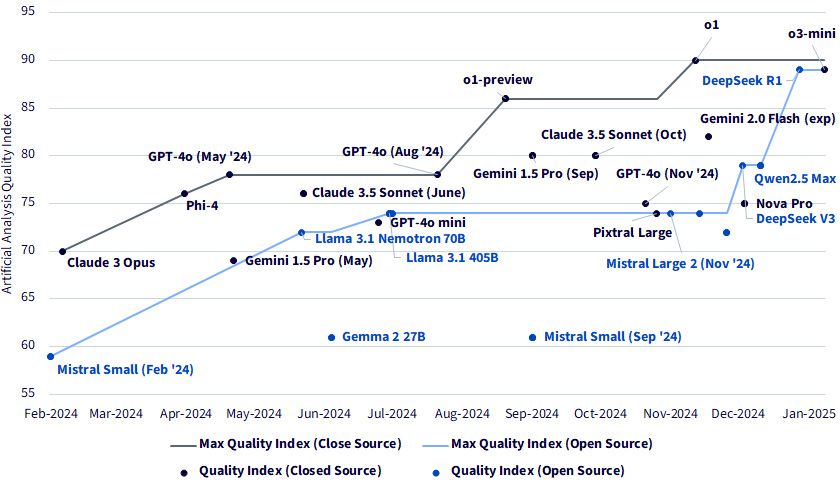
Source: Artificial Analysis. Artificial Analysis Quality Index refers to average result across our evaluations covering different dimensions of model intelligence. Currently includes MMLU, GPQA, Math and HumanEval. OpenAI o1 model figures are preliminary and are based on figures stated by OpenAI. Data as of 1/31/25.
More broadly, by offering competitive pricing, DeepSeek may trigger a "catfish effect," prompting other model providers to release more cost-effective models. For instance, OpenAI launched GPT-o3 mini at roughly $4.4 per million tokens—about 63% cheaper than GPT-o1 mini. This competition benefits software companies, allowing them to adopt AI without eroding profit margins much. In addition, DeepSeek has published its optimization methods, which boosts open-source communities and may further narrow the gap between open-source and closed-source models. Over time, such openness should sustain competition and keep AI costs manageable.
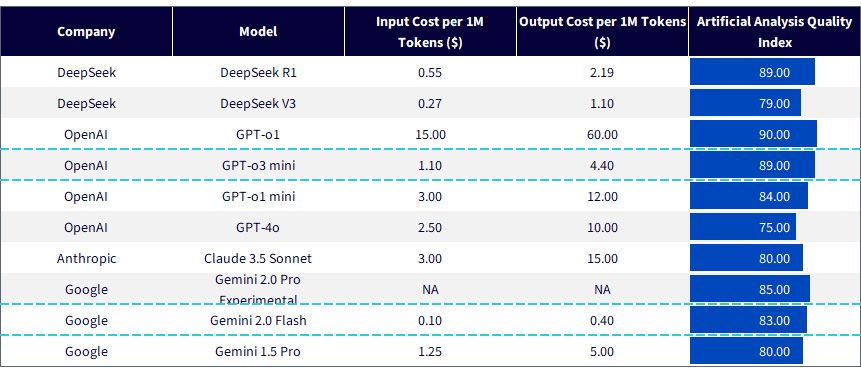
Sources: Bloomberg, DeepSeek, OpenAI, Anthropic, Google, Artificial Analysis. Models in red box were released after DeepSeek-R1 release. The API prices are provided by model owners and may differ from prices offered by third-party providers. Artificial Analysis Quality Index refers to average result across our evaluations covering different dimensions of model intelligence. Currently includes MMLU, GPQA, Math and HumanEval. OpenAI o1 model figures are preliminary and are based on figures stated by OpenAI. Data as of 2/5/25.
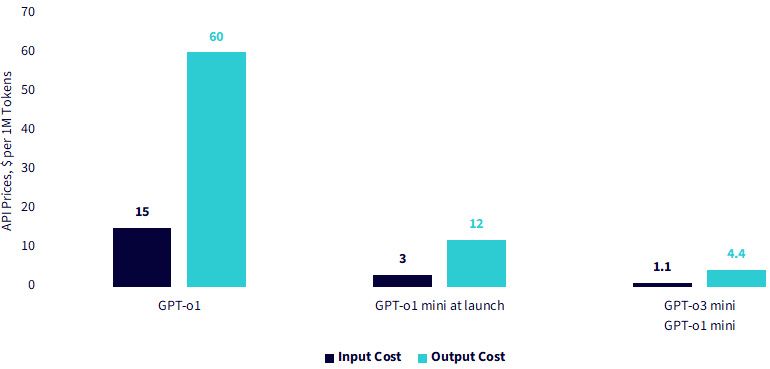
Source: OpenAI. The API prices are provided by model owners and may differ from prices offered by third-party providers. OpenAI o1 mini model figures were lowered after GPT-o3 mini's release. Data as of 2/6/25.
Can Cloud Software Ride the DeepSeek Wave?
Turning to market reactions, we take BVP Nasdaq Emerging Cloud Index (EMCLOUD Index) as a proxy of cloud software segment. The index focuses on pure-play cloud computing companies and can indicate investor sentiment on the sector. Following DeepSeek's release on January 27–28, nearly all index constituents saw a positive response, with a median return of 4.9% during that short period (excluding PayPal). No major earnings announcements coincided with these dates, suggesting DeepSeek's announcement was a driving force. The Federal Reserve's FOMC meeting on January 28–29 then curbed some enthusiasm, pulling the median five-day return back to 2.7%.
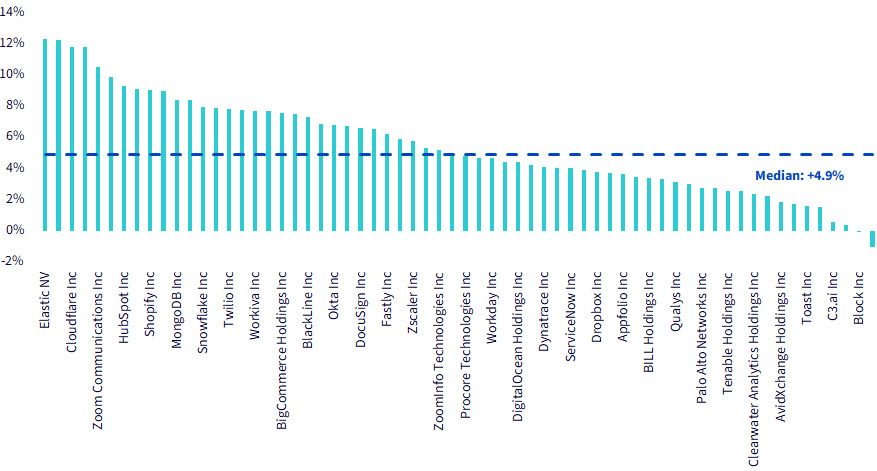
Sources: WisdomTree, Bloomberg. Returns are presented for the companies within the BVP Nasdaq Emerging Cloud Index for the period of 1/27/25–1/28/25. You cannot invest directly in an index. Past performance is not indicative of future results.
The EMCLOUD Index also outperformed broad equity benchmarks following the launch of DeepSeek-R1. As of February 7, EMCLOUD delivered a YTD return of 7.3%, significantly exceeding the S&P 500's 2.5% and the Nasdaq-100's 2.3%. Following the release of DeepSeek-R1, Nvidia experienced significant volatility, driving its YTD return to -3.3% as of February 7, while the BVP Nasdaq Emerging Cloud Index showed consistent outperformance.
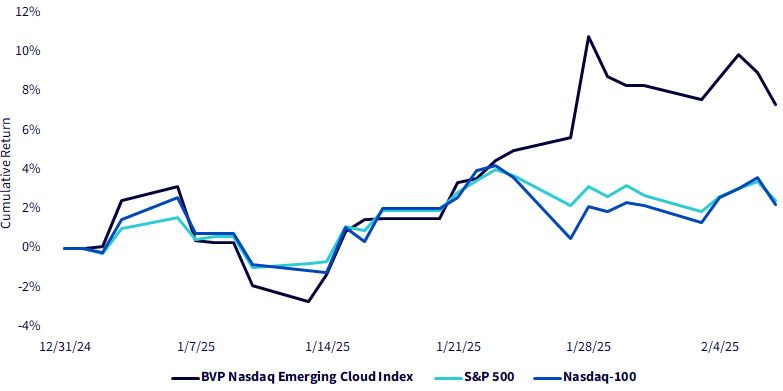
Sources: WisdomTree, Bloomberg. Period 12/31/24–2/7/25. You cannot invest directly in an index. Past performance is not indicative of future results.
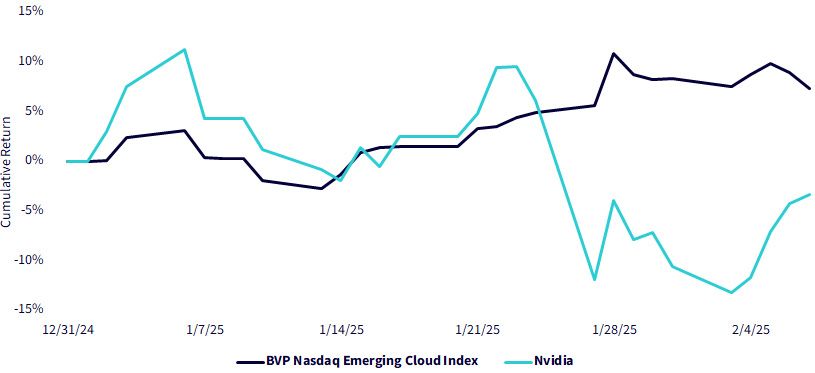
Sources: WisdomTree, Bloomberg. Period 12/31/24–2/7/25. You cannot invest directly in an index. Past performance is not indicative of future results.
Over the past two years, cloud software companies have not been viewed as direct AI beneficiaries, unlike AI infrastructure players and model developers. Their role in the AI revolution was seen as downstream, requiring them to first integrate AI into their products before capturing value. Additionally, concerns arose over AI-related costs impacting margins, especially in the context of lower pricing power amid macroeconomic headwinds and constrained software budgets.
An era of more affordable AI models, heralded by DeepSeek's release, marks a potential turning point, offering cloud software companies opportunities for product differentiation, cost efficiencies and new revenue streams. Recent trends suggest a strategic shift in the cloud software space, with companies increasingly focusing on agentic AI (autonomous systems that perform tasks with minimal human intervention) and vertical AI (highly specialized AI models in a specific industry or domain, e.g., healthcare, legal, finance). The emergence of AI-native cloud companies further underscores this evolution, positioning cloud providers to benefit more directly from AI advancements.
DeepSeek's release, sparking a new wave of innovations in the AI space, is set to accelerate AI adoption. As AI adoption accelerates, companies are poised to increase their spend on software with rising demand to leverage AI technology across the board. In the shorter term, a more hawkish monetary policy in the U.S. presents a headwind for cloud software providers, but earnings releases throughout February and early March might offer a line of sight into companies' plans to capitalize on this AI-driven transformation of the space.
As AI breakthroughs like DeepSeek continue to reshape the cloud software landscape, investors looking to capitalize on these advancements may consider targeted exposure through thematic ETFs. The WisdomTree Cloud Computing Fund (WCLD) provides access to high-growth cloud software companies at the forefront of AI integration, while the WisdomTree Artificial Intelligence and Innovation Fund (WTAI) offers diversified exposure to AI-driven innovations, including software, hardware and infrastructure powering the next wave of technological disruption.
1 Source: DeepSeek Technical Report, publicly available at: https://arxiv.org/html/2412.19437v1
2 In the following version, DeepSeek-R1, SFT was applied in model training, but its focus was on improving the readability and coherence of the model’s responses. The model’s reasoning and decision-making capabilities were primarily refined through reinforcement learning (RL).
3 The Information: https://www.theinformation.com/articles/deepseek-attracts-surge-of-business-users
There are risks associated with investing, including possible loss of principal. Please read the Fund’s prospectus for specific details regarding the Fund’s risk profile.
WCLD: The Fund invests in cloud computing companies, which are heavily dependent on the Internet and utilizing a distributed network of servers over the Internet. Cloud computing companies may have limited product lines, markets, financial resources or personnel and are subject to the risks of changes in business cycles, world economic growth, technological progress, and government regulation. These companies typically face intense competition and potentially rapid product obsolescence. Additionally, many cloud computing companies store sensitive consumer information and could be the target of cybersecurity attacks and other types of theft, which could have a negative impact on these companies and the Fund. Securities of cloud computing companies tend to be more volatile than securities of companies that rely less heavily on technology and, specifically, on the Internet. Cloud computing companies can typically engage in significant amounts of spending on research and development, and rapid changes to the field could have a material adverse effect on a company’s operating results. The composition of the Index is heavily dependent on quantitative and qualitative information and data from one or more third parties and the Index may not perform as intended.
WTAI: The Fund invests in companies primarily involved in the investment theme of Artificial Intelligence (AI) and Innovation. Companies engaged in AI typically face intense competition and potentially rapid product obsolescence. These companies are also heavily dependent on intellectual property rights and may be adversely affected by loss or impairment of those rights. Additionally, AI companies typically invest significant amounts of spending on research and development, and there is no guarantee that the products or services produced by these companies will be successful. Companies that are capitalizing on Innovation and developing technologies to displace older technologies or create new markets may not be successful. The Fund invests in the securities included in, or representative of, its Index regardless of their investment merit and the Fund does not attempt to outperform its Index or take defensive positions in declining markets. The composition of the Index is governed by an Index Committee and the Index may not perform as intended.

Global Head of Research
Christopher Gannatti began at WisdomTree as a Research Analyst in December 2010, working directly with Jeremy Schwartz, CFA®, Director of Research. In January of 2014, he was promoted to Associate Director of Research where he was responsible to lead different groups of analysts and strategists within the broader Research team at WisdomTree. In February of 2018, Christopher was promoted to Head of Research, Europe, where he was based out of WisdomTree’s London office and was responsible for the full WisdomTree research effort within the European market, as well as supporting the UCITs platform globally. In November 2021, Christopher was promoted to Global Head of Research, now responsible for numerous communications on investment strategy globally, particularly in the thematic equity space. Christopher came to WisdomTree from Lord Abbett, where he worked for four and a half years as a Regional Consultant. He received his MBA in Quantitative Finance, Accounting, and Economics from NYU’s Stern School of Business in 2010, and he received his bachelor’s degree from Colgate University in Economics in 2006. Christopher is a holder of the Chartered Financial Analyst Designation.

Associate Director, Quantitative Research
Elvira has been a member of the WisdomTree Research team since September 2018. With over nine years of experience in the ETF and asset management industry and an academic background in quantitative finance, Elvira combines technical expertise with thematic strategy insights to contribute to thought leadership research and the development of new innovative strategies at WisdomTree. As a lead specialist in thematic strategies, she supports the periodic review and rebalancing of thematic portfolios, delivers quantitative insights, bespoke analysis for clients, strategic thought pieces as well as commentary on market trends and thematic strategies. She also develops comprehensive product collateral designed to support client needs.

Associate Director, Quantitative Research & Multi Asset Solutions
Baoqi Zhu joined WisdomTree in 2023 as a Senior Associate on the Research team. Baoqi focuses on quantitative research on thematic equity indices and portfolio solutions. Prior to WisdomTree, Baoqi spent over two years at Ernst & Young (EY) in their Quantitative Advisory Services, where he was involved in the research and development of quantitative risk models. Earlier in his career, Baoqi served as a quantitative analyst within a multi-asset structuring team at Maven Global for more than three years. His responsibilities included designing and optimising bespoke hedging strategies based on derivatives. Baoqi holds a MSc in Financial Engineering & Risk Management from Imperial College London and a BSc in Actuarial Science from Nankai University, China. He is also a certified Financial Risk Manager (FRM).
