
GCC
Enhanced Commodity Strategy Fund

Published March 4, 2025

Global Head of Research
We have been writing about concepts of broad commodity exposure and efficient core for some time, but we wanted to step back and consider how these ideas might come together in a broader portfolio context.
Within this piece, we will set up an array of hypothetical exposures that utilize different WisdomTree ETFs as building blocks. We also created a hypothetical benchmark, 60/40 U.S. equity to U.S. fixed income exposure. With these blends, we are not seeking to recommend anything specific but rather to illustrate what types of characteristics different hypothetical blends might have.
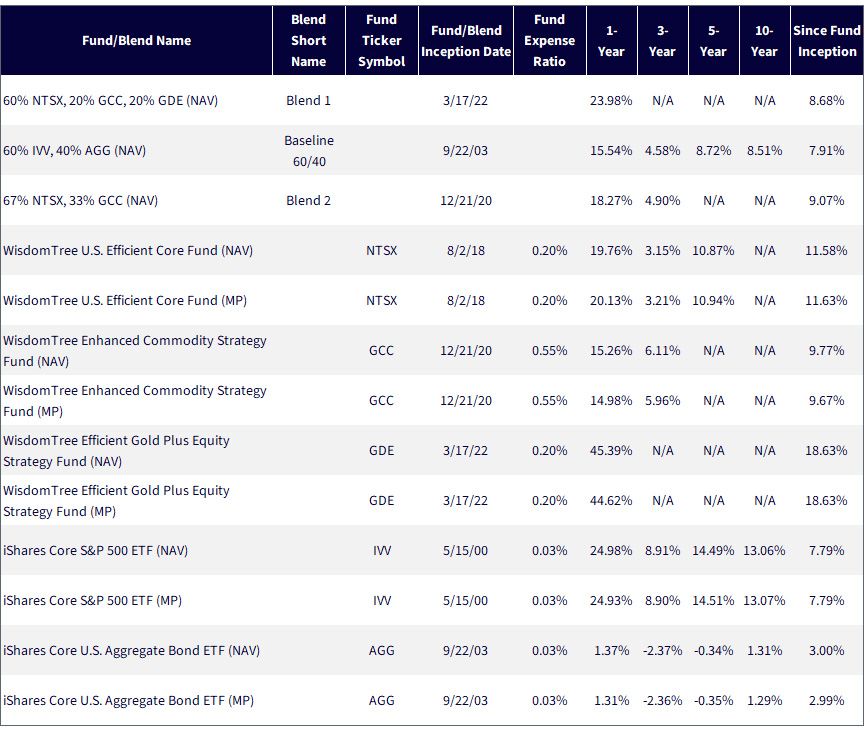
Source: WisdomTree, specifically data from the Fund Comparison Tool in the PATH suite of tools, accessed 2/27/25, with returns as of 12/31/24. NAV denotes total return performance at net asset value. MP denotes market price performance. Past performance is not indicative of future results. Investment return and principal value of an investment will fluctuate so that an investor's shares, when redeemed, may be worth more or less than their original cost. Current performance may be lower or higher than the performance data quoted. For the most recent month-end and standardized performances, click the relevant ticker: NTSX, GCC, GDE, IVV, AGG.
In figure 2, we showcase two distinct hypothetical allocations or blends that focus on thinking about different levels of broad commodity exposure and sometimes utilize WisdomTree's Efficient Core methodology through either NTSX, GDE or both.
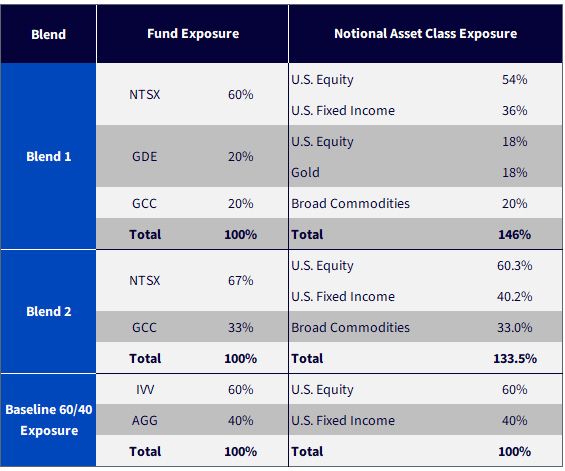
Source: WisdomTree. Blends are created for hypothetical illustration purposes only and should not be construed as recommendations. Strategies that incorporate leverage could lead to higher overall portfolio volatility.
Investors take a lot of time to craft appropriate asset allocations, and 60% equity, 40% fixed income is often a starting point. At the same time, the options on the overall investment menu have dramatically expanded. Many might feel like they are sitting on a seesaw—on one side, considering an appropriate asset allocation for their goals and risk tolerance, and on the other side, wanting to represent some of the "new, cool tools" in their portfolio.
Efficient Core allocations represent one way to create space in a portfolio for some of those "interesting options," if that is indeed desired. In this piece, we showcase using it to add exposures to commodities and gold without dramatically reducing either the equity or fixed income component. To be fair, this approach does use leverage, and leverage may increase the overall volatility of returns, so it is important to always have this in mind when looking at Efficient Core.
The concept of hypothetical blends, in our opinion, makes a lot of sense, but it's important to consider how these ideas have translated back to performance. In figure 3, we look across the available live history of the underlying ETFs and indicate how these different blends have performed over a few periods.
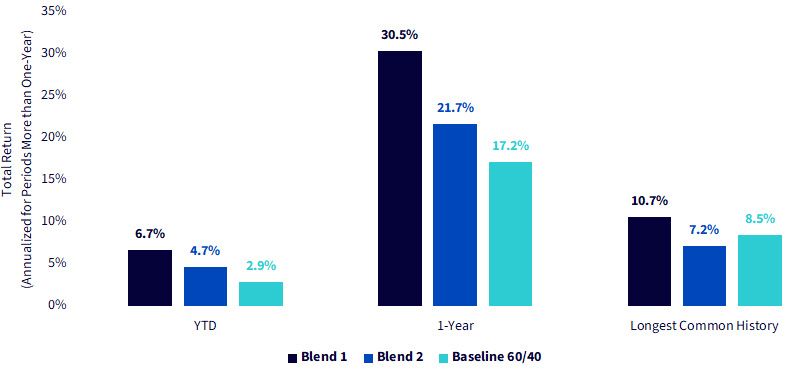
Source: WisdomTree, specifically data from the Fund Comparison Tool in the PATH suite of tools, accessed 2/17/25, with returns as of 12/31/24. Longest Common History denotes the period starting at GDE's inception and going through 2/14/25. NAV denotes total return performance at net asset value. MP denotes market price performance. Past performance is not indicative of future results. Investment return and principal value of an investment will fluctuate so that an investor's shares, when redeemed, may be worth more or less than their original cost. Current performance may be lower or higher than the performance data quoted. For the most recent month-end and standardized performances and to download the respective Fund prospectuses, click the relevant ticker: NTSX, GCC, GDE, IVV, AGG.
The inherent challenge to thinking about blends and portfolios is that the options are truly limitless. Each investor might have different goals, risk tolerances and other preferences. In this piece, we were seeking to look at a few hypothetical allocations that could help investors picture how using Efficient Core might open up space in an asset allocation to bring in other exposures. While these illustrations brought in gold and broad commodities, we'd note that these are far from the only options.
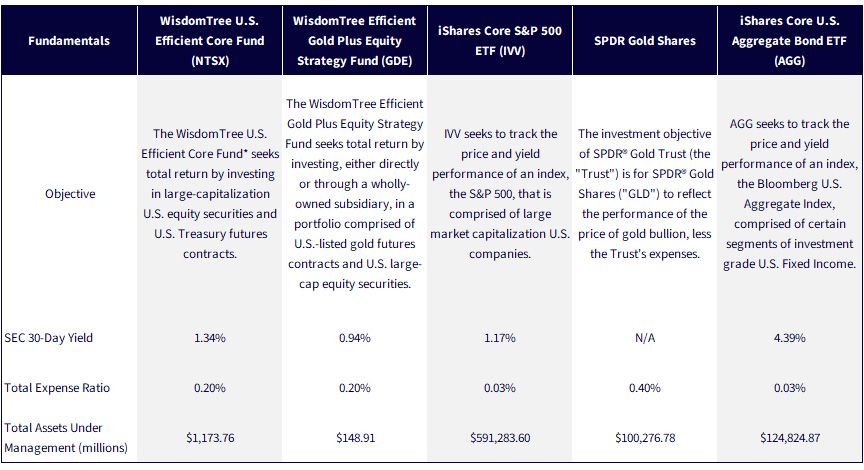
Sources: WisdomTree and the Fund pages of the non-WisdomTree ETFs.
There are risks associated with investing, including the possible loss of principal. Please read the Fund’s prospectus for specific details regarding the Fund’s risk profile.
NTSX: While the Fund is actively managed, the Fund’s investment process is expected to be heavily dependent on quantitative models, and the models may not perform as intended. Equity securities, such as common stocks, are subject to market, economic and business risks that may cause their prices to fluctuate. The Fund invests in derivatives to gain exposure to U.S. Treasuries. The return on a derivative instrument may not correlate with the return of its underlying reference asset. The Fund’s use of derivatives will give rise to leverage, and derivatives can be volatile and may be less liquid than other securities. As a result, the value of an investment in the Fund may change quickly and without warning, and you may lose money. Interest rate risk is the risk that fixed income securities, and financial instruments related to fixed income securities, will decline in value because of an increase in interest rates and changes to other factors, such as the perception of an issuer’s creditworthiness.
GCC: An investment in this Fund is speculative, involves a substantial degree of risk and should not constitute an investor’s entire portfolio. One of the risks associated with the Fund is the complexity of the different factors that contribute to the Fund’s performance. These factors include the use of commodity futures contracts. In addition, bitcoin and bitcoin futures are a relatively new asset class. They are subject to unique and substantial risks and, historically, have been subject to significant price volatility. While the bitcoin futures market has grown substantially since bitcoin futures commenced trading, there can be no assurance that this growth will continue. In addition, derivatives can be volatile and may be less liquid than other securities and more sensitive to the effects of varied economic conditions. The value of the shares of the Fund relate directly to the value of the futures contracts and other assets held by the Fund, and any fluctuation in the value of these assets could adversely affect an investment in the Fund’s shares. Because of the frequency with which the Fund expects to roll futures contracts, the price of futures contracts further from expiration may be higher (a condition known as “contango”) or lower (a condition known as “backwardation”), and the impact of such contango or backwardation may be greater than the impact would be if the Fund experienced less portfolio turnover.
GDE: The Fund is actively managed and invests in U.S.-listed gold futures and U.S. equity securities. The Fund’s use of U.S.-listed gold futures contracts will give rise to leverage, magnifying gains and losses and causing the Fund to be more volatile than if it had not been leveraged. Moreover, the price movements in gold and gold futures contracts may fluctuate quickly and dramatically, and have a historically low correlation with the returns of the stock and bond markets. U.S. equity securities, such as common stocks, are subject to market, economic and business risks that may cause their prices to fluctuate. The Fund’s investment strategy will also require it to redeem shares for cash or to otherwise include cash as part of its redemption proceeds, which may cause the Fund to recognize capital gains.
IVV: Carefully consider the Fund’s investment objectives, risk factors, charges and expenses before investing. This and other information can be found in the Fund’s prospectus and, if available, summary prospectus, which may be obtained by calling 1-800-iShares (1-800-474-2737) or by visiting www.iShares.com or www.blackrock.com. Read the prospectus carefully before investing.
Investing involves risk, including the possible loss of principal.
Diversification may not protect against market risk or the loss of principal. Shares of ETFs are bought and sold at market price (not NAV) and are not individually redeemed from the Fund. Any applicable brokerage commissions will reduce returns.
Index returns are for illustrative purposes only. Index performance returns do not reflect any management fees, transaction costs or expenses. Indexes are unmanaged, and one cannot invest directly in an index. Past performance does not guarantee future results.
“Acquired Fund Fees and Expenses” (AFFE) reflect the Fund’s pro rata share of the indirect fees and expenses incurred by investing in one or more acquired funds, such as mutual funds, business development companies or other pooled investment vehicles. AFFE are reflected in the prices of the acquired funds and, thus, included in the total returns of the Fund.
The iShares Funds are distributed by BlackRock Investments, LLC (together with its affiliates, “BlackRock”).
The iShares Funds are not sponsored, endorsed, issued, sold or promoted by S&P Dow Jones Indices LLC, nor does this company make any representation regarding the advisability of investing in the Funds. BlackRock is not affiliated with S&P Dow Jones Indices LLC.
BlackRock provides compensation in connection with obtaining or using third-party ratings and rankings.
© 2025 BlackRock, Inc., or its affiliates. All rights reserved. ISHARES, IBONDS and BLACKROCK are trademarks of BlackRock, Inc., or its affiliates. All other trademarks are those of their respective owners.
FOR MORE INFORMATION, VISIT WWW.ISHARES.COM OR CALL 1-800-ISHARES (1-800-474-2737).
AGG: Carefully consider the Fund’s investment objectives, risk factors, charges and expenses before investing. This and other information can be found in the Fund’s prospectus and, if available, summary prospectus, which may be obtained by calling 1-800-iShares (1-800-474-2737) or by visiting www.iShares.com or www.blackrock.com. Read the prospectus carefully before investing.
Investing involves risk, including the possible loss of principal.
Fixed income risks include interest-rate and credit risk. Typically, when interest rates rise, there is a corresponding decline in bond values. Credit risk refers to the possibility that the bond issuer will not be able to make principal and interest payments.
Diversification may not protect against market risk or the loss of principal. Shares of ETFs are bought and sold at market price (not NAV) and are not individually redeemed from the Fund. Any applicable brokerage commissions will reduce returns.
Index returns are for illustrative purposes only. Index performance returns do not reflect any management fees, transaction costs or expenses. Indexes are unmanaged, and one cannot invest directly in an index. Past performance does not guarantee future results.
“Acquired Fund Fees and Expenses” (AFFE) reflect the Fund’s pro rata share of the indirect fees and expenses incurred by investing in one or more acquired funds, such as mutual funds, business development companies or other pooled investment vehicles. AFFE are reflected in the prices of the acquired funds and, thus, included in the total returns of the Fund.
The iShares Funds are distributed by BlackRock Investments, LLC (together with its affiliates, “BlackRock”).
The iShares Funds are not sponsored, endorsed, issued, sold or promoted by Bloomberg, nor does this company make any representation regarding the advisability of investing in the Funds. BlackRock is not affiliated with Bloomberg.
BlackRock provides compensation in connection with obtaining or using third-party ratings and rankings.
© 2025 BlackRock, Inc., or its affiliates. All rights reserved. ISHARES, IBONDS and BLACKROCK are trademarks of BlackRock, Inc., or its affiliates. All other trademarks are those of their respective owners.
FOR MORE INFORMATION, VISIT WWW.ISHARES.COM OR CALL 1-800-ISHARES (1-800-474-2737).

Global Head of Research
Christopher Gannatti began at WisdomTree as a Research Analyst in December 2010, working directly with Jeremy Schwartz, CFA®, Director of Research. In January of 2014, he was promoted to Associate Director of Research where he was responsible to lead different groups of analysts and strategists within the broader Research team at WisdomTree. In February of 2018, Christopher was promoted to Head of Research, Europe, where he was based out of WisdomTree’s London office and was responsible for the full WisdomTree research effort within the European market, as well as supporting the UCITs platform globally. In November 2021, Christopher was promoted to Global Head of Research, now responsible for numerous communications on investment strategy globally, particularly in the thematic equity space. Christopher came to WisdomTree from Lord Abbett, where he worked for four and a half years as a Regional Consultant. He received his MBA in Quantitative Finance, Accounting, and Economics from NYU’s Stern School of Business in 2010, and he received his bachelor’s degree from Colgate University in Economics in 2006. Christopher is a holder of the Chartered Financial Analyst Designation.

