


Super Bowl for Markets: Jobs, Earnings & Portfolio Diversifiers
Published February 13, 2025

Jeremy Schwartz, CFA
Global Chief Investment Officer

Christopher Gannatti, CFA
Global Head of Research

Samuel Rines
Macro Strategist, Model Portfolios

Jeff Weniger, CFA
Head of Equity Strategy
Key Takeaways
- The U.S. economy remains resilient, with strong labor markets and income growth, but elevated interest rates and global trade shifts introduce uncertainty, making productivity gains and capital investment critical factors for sustained momentum.
- Market leadership is broadening beyond large-cap tech, with financials, industrials and mid-cap stocks emerging as compelling opportunities, driven by deregulation, potential tax policy shifts and renewed M&A activity.
- Capital-efficient strategies, such as those discussed by Sonu Varghese, allow investors to enhance diversification without reducing equity exposure, exemplified by the WisdomTree Efficient Gold Plus Equity Strategy Fund (GDE) and Efficient Core offerings.
On February 7, 2025, Jeremy Schwartz, Chris Gannatti, Sam Rines and Jeff Weniger were joined on the Behind the Markets podcast by Sonu Varghese, Vice President and Global Macro Strategist at the Carson Group. He brought a sharp, practical perspective to the current economic landscape, with insights spanning the resilience of the U.S. economy, equity sector opportunities and the increasingly important and very useful role of capital efficiency in modern portfolio management.
The U.S. Economy: Nuanced Strength
The economy, much like a well-built structure, stands strong—but not without its stress points. Sonu remains confident in the fundamental pillars of labor market strength and aggregate income growth. With U.S. consumption forming the bulk of GDP, steady income growth in the 4%–4.5% range fuels continued momentum.
Yet, the economic story isn’t without complications. Elevated interest rates, possible cyclical sector weaknesses and a shifting global trade environment introduce uncertainty. Still, Sonu argues that productivity gains and capital investment will likely offset these risks, keeping the economic engine running. It was notable to be able to talk about a picture characterized by productivity growth that appears above the longer-run trend, especially as we spend a lot of time considering what all of the new AI capabilities are being used for.
Where Are the Opportunities?
Markets are rarely a one-lane highway. Sonu highlighted financials, industrials and communication services as well-positioned sectors in the evolving landscape. A notable shift is the broadening of market leadership beyond the usual large-cap tech dominance that we have seen since the advent of ChatGPT in November 2022, with mid-cap and small-cap stocks emerging as attractive opportunities. One specific illustration of this that was discussed was the recent shift in performance of the S&P 500 Equal-Weight Index versus the standard S&P 500 Index, which is market capitalization-weighted. Sonu noted that the recent outperformance of the equal-weight index over the market capitalization-weighted index is a good signal for mid-cap stocks in the U.S.
Sam Rines also focused on the growing bullishness in U.S. mid-cap stocks. He pointed to deregulation, potential tax policy shifts and the return of an M&A cycle as key drivers. When organic growth slows, companies go shopping for acquisitions, and mid-caps stand to benefit. Under the Biden administration, M&A activity was fairly quiet.
The Productivity Boom: AI as the Catalyst
Few topics generate as much market interest as artificial intelligence. Sonu and Christopher Gannatti emphasized AI’s transformative role in boosting efficiency across industries. Companies continue to pour capital into AI, with projected spending exceeding $300 billion this year.1
Around the time of recording, we saw the image shown in figure 1 posted by The Transcript on X. It allows us to visualize the spending trajectory of four of the largest companies (Amazon, Alphabet, Microsoft and Meta).
Figure 1: Spend Baby, Spend
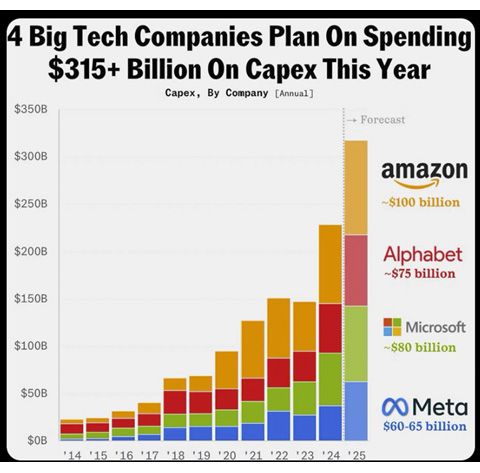
Source: The Transcript, as posted on X on 2/7/25. Past performance is not indicative of future returns.
Rates, Inflation and the Market’s Tug-of-War
Interest rates sit at the intersection of growth and risk. Markets currently expect higher rates, driven by economic resilience, while the Federal Reserve signals a different trajectory, anticipating easing due to slowing inflation.
Sonu argued that productivity-driven growth could create a middle ground, where rates may stabilize around 3.75% on the U.S. 10-Year Treasury Note yield, in his view. The balance between labor efficiency gains and inflationary pressures will be a key storyline in the coming months, helping to see if this prediction proves accurate.
Capital Efficiency: Smart Diversification for Modern Portfolios
Investing is about maximizing returns while minimizing unnecessary risk. Traditional diversification often forces investors to give up equity exposure to make room for bonds or alternatives. Sonu offers a different approach: capital efficiency. The concept was discussed on the podcast, but on January 21, 2025, Sonu also published an article on this topic: Outlook 2025: Diversifying Diversifiers and Using Capital Efficiency to Do It. Those looking to dive more deeply into Sonu’s research on this topic can find the piece on the Carson Group website.
During the podcast discussion, Sonu focused on the concept of seeking to create a 10% sleeve that he could use to further diversify a hypothetical portfolio. By allocating to efficient core, he was able to paint a picture that allowed him to then add 5% to a gold exposure and 5% to a managed futures exposure without shifting the overall target exposures to equities and fixed income. Of course, this is just one possible example, and each investor can leverage a capital-efficient strategy to free up space to add in allocations that make more sense for their investment goals.
The bottom line for capital-efficient strategies: By leveraging these strategies that create greater than $1.00 of notional exposure for every $1.00 invested, investors can maintain broad exposure while enhancing diversification.
At WisdomTree, we have the WisdomTree Efficient Gold Plus Equity Strategy Fund (GDE). This Fund is 90% exposed to underlying large-capitalization U.S. equities and 90% exposed to gold futures. If investors are looking to add exposure to gold (like Sonu was discussing) and not impact the level of an overall U.S. equity allocation, this strategy could be of particular interest.
Looking Ahead: Positioning for a Changing Market
The Carson Group remains focused on global diversification, macroeconomic adaptability and capital-efficient investment strategies. Sonu and his team continuously assess geopolitical shifts, inflation risks and currency dynamics to refine their outlook.
At the end of the podcast, the group went around the horn. Jeff Weniger drew out the “Make Europe Great Again” acronym, “MEGA,” and we expect this will be a continued discussion. He noted a select list of European Financials, indicating a significant focus on share buybacks over the past year. As the weeks go by, we expect that we’ll be returning to this topic.
You can listen to our full conversation here or below.
WisdomTree’s Efficient Core Investment Strategies
With the conversation touching on the concept of Efficient Core strategies, and Sonu recently writing the aforementioned research piece on the topic, we wanted to note the menu of options at WisdomTree presently available for those interested in gathering further detail on specific strategies. The WisdomTree U.S. Efficient Core Fund was launched on August 2, 2018, and, as of this writing, has more than $1 billion in assets under management.2 We have expanded the range of offerings over time, as is clear from the list below, where we focus only on our more strategic capital-efficient options.
- WisdomTree U.S. Efficient Core Fund (NTSX): The WisdomTree U.S. Efficient Core Fund3 seeks total return by investing in large market capitalization U.S. equity securities and U.S. Treasury futures contracts.
- WisdomTree International Efficient Core Fund (NTSI): The WisdomTree International Efficient Core Fund seeks total return by investing in international equity securities and U.S. Treasury futures contracts.
Investors intrigued by the capital-efficient structure within investment strategies should continue visiting WisdomTree’s website, as we expect to continue putting out notable research and viewpoints on these strategies as we progress through the year.
1 Source: Woodring et al., “Cloud Capex Tracker: GOOGL Surprise Capex Guide Pushes ’25 Capex Growth to 29% Y/Y,” Morgan Stanley Research, 2/5/25.
2 Source: NTSX Fund page, with data as of 2/7/25.
3 NTSX was formerly named the WisdomTree 90/60 U.S. Balanced Fund.
Important Risks Related to this Article
There are risks associated with investing, including the possible loss of principal. Please read the Fund’s prospectus for specific details regarding the Fund’s risk profile.
NTSX: While the Fund is actively managed, the Fund’s investment process is expected to be heavily dependent on quantitative models, and the models may not perform as intended. Equity securities, such as common stocks, are subject to market, economic and business risks that may cause their prices to fluctuate. The Fund invests in derivatives to gain exposure to U.S. Treasuries. The return on a derivative instrument may not correlate with the return of its underlying reference asset. The Fund’s use of derivatives will give rise to leverage, and derivatives can be volatile and may be less liquid than other securities. As a result, the value of an investment in the Fund may change quickly and without warning, and you may lose money. Interest rate risk is the risk that fixed income securities, and financial instruments related to fixed income securities, will decline in value because of an increase in interest rates and changes to other factors, such as the perception of an issuer’s creditworthiness.
NTSI: Investments in non-U.S. securities involve political, regulatory and economic risks that may not be present in U.S. securities. For example, foreign securities may be subject to risk of loss due to foreign currency fluctuations, political or economic instability, or geographic events that adversely impact issuers of foreign securities. While the Fund is actively managed, the Fund’s investment process is expected to be heavily dependent on quantitative models, and the models may not perform as intended. Equity securities, such as common stocks, are subject to market, economic and business risks that may cause their prices to fluctuate. The Fund invests in derivatives to gain exposure to U.S. Treasuries. The return on a derivative instrument may not correlate with the return of its underlying reference asset. The Fund’s use of derivatives will give rise to leverage, and derivatives can be volatile and may be less liquid than other securities. As a result, the value of an investment in the Fund may change quickly and without warning, and you may lose money. Interest rate risk is the risk that fixed income securities, and financial instruments related to fixed income securities, will decline in value because of an increase in interest rates and changes to other factors, such as the perception of an issuer’s creditworthiness. Diversification does not eliminate the risk of experiencing investment losses.
NTSE: Investments in non-U.S. securities involve political, regulatory and economic risks that may not be present in U.S. securities. For example, foreign securities may be subject to risk of loss due to foreign currency fluctuations, political or economic instability, or geographic events that adversely impact issuers of foreign securities. Investments in securities and instruments traded in developing or emerging markets, or that provide exposure to such securities or markets, can involve additional risks relating to political, economic or regulatory conditions not associated with investments in U.S. securities and instruments or investments in more developed international markets. While the Fund is actively managed, the Fund’s investment process is expected to be heavily dependent on quantitative models, and the models may not perform as intended. Equity securities, such as common stocks, are subject to market, economic and business risks that may cause their prices to fluctuate. The Fund invests in derivatives to gain exposure to U.S. Treasuries. The return on a derivative instrument may not correlate with the return of its underlying reference asset. The Fund’s use of derivatives will give rise to leverage, and derivatives can be volatile and may be less liquid than other securities. As a result, the value of an investment in the Fund may change quickly and without warning, and you may lose money. Interest rate risk is the risk that fixed income securities, and financial instruments related to fixed income securities, will decline in value because of an increase in interest rates and changes to other factors, such as the perception of an issuer’s creditworthiness. Diversification does not eliminate the risk of experiencing investment losses.
GDE: The Fund is actively managed and invests in U.S.-listed gold futures and U.S. equity securities. The Fund’s use of U.S.-listed gold futures contracts will give rise to leverage, magnifying gains and losses and causing the Fund to be more volatile than if it had not been leveraged. Moreover, the price movements in gold and gold futures contracts may fluctuate quickly and dramatically and have a historically low correlation with the returns of the stock and bond markets. U.S. equity securities, such as common stocks, are subject to market, economic and business risks that may cause their prices to fluctuate. The Fund’s investment strategy will also require it to redeem shares for cash or to otherwise include cash as part of its redemption proceeds, which may cause the Fund to recognize capital gains.
Categories
About the contributors

Jeremy Schwartz, CFA
Global Chief Investment Officer
Jeremy Schwartz has served as Global Chief Investment Officer since November 2021 and leads WisdomTree’s investment strategy team in the construction of WisdomTree’s equity Indexes, quantitative active strategies and multi-asset Model Portfolios. Jeremy joined WisdomTree in May 2005 as a Senior Analyst, adding Deputy Director of Research to his responsibilities in February 2007. He served as Director of Research from October 2008 to October 2018 and as Global Head of Research from November 2018 to November 2021. Before joining WisdomTree, he was a head research assistant for Professor Jeremy Siegel and, in 2022, became his co-author on the sixth edition of the book Stocks for the Long Run. Jeremy is also co-author of the Financial Analysts Journal paper “What Happened to the Original Stocks in the S&P 500?” He received his B.S. in economics from The Wharton School of the University of Pennsylvania and hosts the Behind the Markets podcast. Jeremy is a member of the CFA Society of Philadelphia.

Christopher Gannatti, CFA
Global Head of Research
Christopher Gannatti began at WisdomTree as a Research Analyst in December 2010, working directly with Jeremy Schwartz, CFA®, Director of Research. In January of 2014, he was promoted to Associate Director of Research where he was responsible to lead different groups of analysts and strategists within the broader Research team at WisdomTree. In February of 2018, Christopher was promoted to Head of Research, Europe, where he was based out of WisdomTree’s London office and was responsible for the full WisdomTree research effort within the European market, as well as supporting the UCITs platform globally. In November 2021, Christopher was promoted to Global Head of Research, now responsible for numerous communications on investment strategy globally, particularly in the thematic equity space. Christopher came to WisdomTree from Lord Abbett, where he worked for four and a half years as a Regional Consultant. He received his MBA in Quantitative Finance, Accounting, and Economics from NYU’s Stern School of Business in 2010, and he received his bachelor’s degree from Colgate University in Economics in 2006. Christopher is a holder of the Chartered Financial Analyst Designation.

Samuel Rines
Macro Strategist, Model Portfolios
Samuel Rines is a Macro Strategist at WisdomTree, where he extends the firm's custom model portfolio management capabilities. Before joining WisdomTree in 2024, he was the Managing Director at CORBU, LLC, leading the PolyMacro advisory product. With over a decade of experience in economics and finance, Samuel has held significant roles such as Chief Economist at Avalon Investment & Advisory and Economist and Portfolio Manager at Chilton Capital Management LLC. He is also the author of "After Normal: Making Sense of the Global Economy," and holds a Master’s degree in Economics from the UNH Peter T. Paul College of Business and Economics, as well as having studied Economics at the University of Oxford.

Jeff Weniger, CFA
Head of Equity Strategy
Jeff Weniger, CFA, has been with WisdomTree since 2017 and serves as the Head of Equities. He shapes the firm’s market outlook through a combination of macroeconomic and fundamental analysis. With more than two decades in investment strategy, Jeff is known for his work on market cycles and valuations. Before joining WisdomTree, Jeff was with BMO Private Bank and BMO Global Asset Management for 11 years. At BMO, he sat on the firm’s Asset Allocation Committee and co-managed ETF model portfolios across the U.S. and Canada. In 2013, at age 32, he became the youngest member of BMO’s Global Investment Forum. When he left BMO to come to WisdomTree, his final role was Director, Senior Strategist in the Office of the CIO in 2017.
Jeff is a frequent television guest on networks such as CNBC, Bloomberg, and Schwab, with regular print appearances in The Wall Street Journal, Barron’s and Reuters. He also appears weekly on the Behind the Markets podcast and is a regular on SiriusXM’s The Business Briefing. On X, Jeff has developed one of the larger followings in financial media. He earned a B.S. in Finance from the University of Florida and an MBA from the University of Notre Dame. He has held the CFA charter since 2006.