
WTV
U.S. Value Fund

Published December 6, 2024

Director, Research
The Magnificent 7 has taken over the world.
At least that feels like the overwhelming narrative for investors over much of the last 24 months.
And the feeling is supported by the numbers.
At no point in the last 30 years has the S&P 500 Index been so concentrated in just a handful of names.
The top 10 holdings account for almost 37% of index weight, double the weight of the top 10 holdings a decade ago, as seen in figure 1.
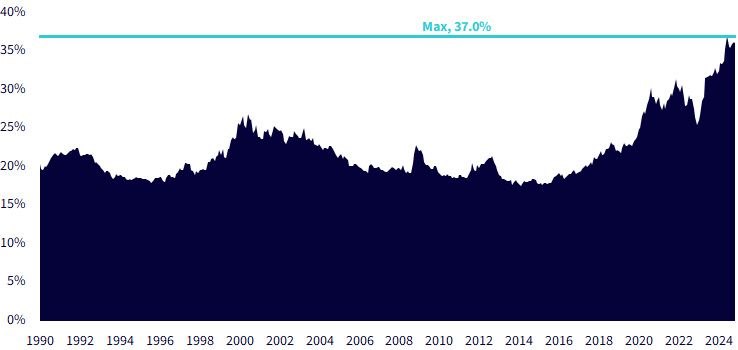
Sources: WisdomTree, S&P, 1/31/1990–11/30/2024. You cannot invest directly in an index.
The growing dominance of a few richly valued companies has elevated S&P 500 valuations—lowering future return forecasts—and reduced the diversification benefits of index-based investing.
As demonstrated in figure 2, the nearly 23x forward price-to-earnings (P/E) on the index is well above the historical median valuation of 17x.
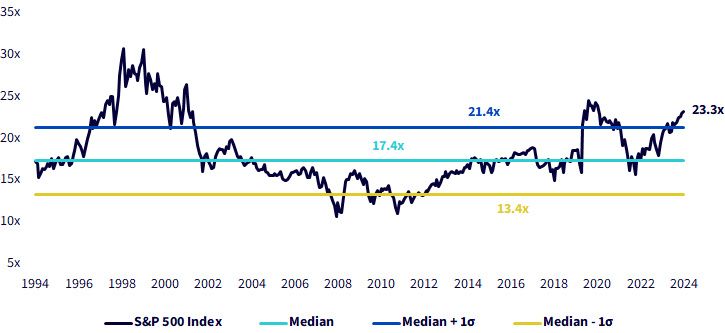
Sources: WisdomTree, FactSet, S&P, 12/30/1994–12/2/2024. You cannot invest directly in an index. + 1σ = 1 Standard Deviation above the median. -1σ = 1 Standard Deviation below the median.
Investors may feel hard-pressed to find portfolio diversifiers that haven’t drastically lagged amid this growth-led rally.
And many clients (rightly) assume that if they are looking at a strategy that has outperformed this year, then it must be loaded up on these Mag 7 names, or at least have a high correlation to growth indexes.
WisdomTree has two solutions that we believe can help solve for this so-called “diversification dilemma”: the WisdomTree U.S. Value Fund (WTV) and the WisdomTree U.S. Multifactor Fund (USMF).
WTV invests in mid-cap and large-cap U.S. equities that have high total shareholder yields (dividend yield + buyback yield).
To sidestep potential value traps, the Fund selects companies with high shareholder yields that also have high quality (profitability) characteristics. An additional step is to focus on “high conviction” buybacks by excluding companies buying back shares only to offset share dilution.
Securities are initially weighted based on shareholder yield with considerations to constrain turnover and over- and under-weight allocations to sectors.
Because securities are selected based on shareholder yield, we tend to include those that also have low valuation ratios on other traditional valuation metrics like P/E and price-to-book.
WTV has been that rare fund that has outperformed so far in 2024 without ANY exposure to the Mag 7. Though many of the Mag 7 have high cash dividends and buybacks, they tend to not have high enough yields for consistent inclusion in the Fund.
This 2024 outperformance has built on a track record of consistent success. WTV is a five star-rated fund that ranks in the top 5 percentile in its Morningstar Category across the one-, three-, five- and 10-year periods, as seen in figure 3 below.
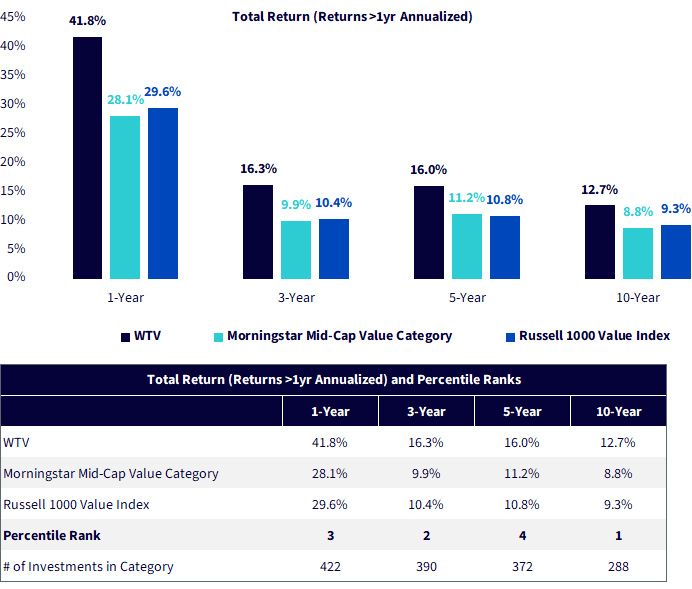
Sources: WisdomTree, Russell, Morningstar, as of 11/30/24. The WisdomTree U.S. Value Fund (WTV) was launched on 2/23/07. Fund returns measured at NAV. Index returns are total return. Returns greater than one-year are annualized. Mid-Cap Value Category. Morningstar, Inc. All rights reserved. The information contained herein: (1) is proprietary to Morningstar and/or its content providers; (2) may not be copied or distributed; and (3) is not warranted to be accurate, complete or timely. Neither Morningstar nor its content providers are responsible for any damages or losses arising from any use of this information. Past performance, rankings and ratings are no guarantee of future results. The Morningstar Rating™ for funds, or “star rating,” is calculated for managed products with at least a three-year history. Exchange-traded funds and open-ended mutual funds are considered a single population for comparative purposes. It is calculated based on a Morningstar Risk-Adjusted Return measure that accounts for variation in a managed product's monthly excess performance, placing more emphasis on downward variations and rewarding consistent performance. The top 10% of products in each product category receive five stars, the next 22.5% receive four stars, the next 35% receive three stars, the next 22.5% receive two stars, and the bottom 10% receive one star. The Overall Morningstar Rating for a managed product is derived from a weighted average of the performance figures associated with its three- and five-year Morningstar Rating metrics. The weights are: 100% three-year rating for 36-59 months of total returns, 60% five-year rating/40% three-year rating for 60-119 months of total returns. Regarding ranking of funds, 1 = Best. Morningstar rankings are based on a fund’s average annual total return relative to all funds in the same Morningstar category. Fund performance used within the rankings, reflects certain fee waivers, without which, returns and Morningstar rankings would have been lower. The highest (or most favorable) percentile rank is 1 and the lowest (or least favorable) percentile rank is 100. Past performance is not indicative of future results. Investment return and principal value of an investment will fluctuate so that an investor’s shares, when redeemed, may be worth more or less than their original cost. Current performance may be lower or higher than the performance data quoted. For the most recent month-end and standardized performances and to download the respective Fund prospectuses, click here.
USMF invests in mid-cap and large-cap U.S. equities in a fashion that closely resembles equal-weighting. USMF selects 200 securities that have a high combined multifactor score on several widely accepted factors: value, quality, momentum and low correlation.
This multifactor score is used as part of the weighting mechanism, which is complemented by a low-volatility score that gives greater weight to less volatile stocks.
USMF's modified equal-weighting approach results in a tilt to mid-cap securities similar to the S&P 500 Equal Weight approach. As a result, the Fund is included in Morningstar’s Mid-Cap Blend Category where it is rated four stars relative to its category peers, as outlined in figure 4.
USMF also has ZERO exposure to the Magnificent 7, as of this writing.
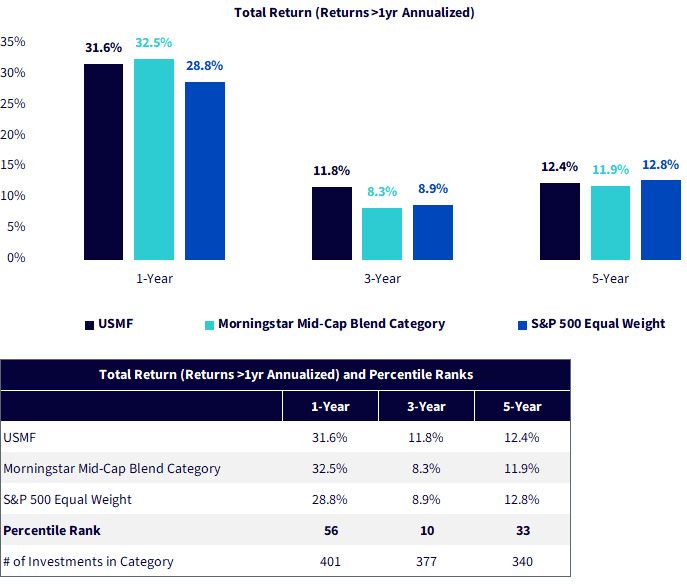
Sources: WisdomTree, Russell, Morningstar, as of 11/30/24. The WisdomTree U.S. Multifactor Fund (USMF) was launched on 6/29/17. Fund returns measured at NAV. Index returns are total return. Returns greater than 1-year are annualized. Mid-Cap Blend Category. Morningstar, Inc. All rights reserved. The information contained herein: (1) is proprietary to Morningstar and/or its content providers; (2) may not be copied or distributed; and (3) is not warranted to be accurate, complete or timely. Neither Morningstar nor its content providers are responsible for any damages or losses arising from any use of this information. Past performance, rankings and ratings are no guarantee of future results. The Morningstar Rating™ for funds, or “star rating,” is calculated for managed products with at least a three-year history. Exchange-traded funds and open-ended mutual funds are considered a single population for comparative purposes. It is calculated based on a Morningstar Risk-Adjusted Return measure that accounts for variation in a managed product's monthly excess performance, placing more emphasis on downward variations and rewarding consistent performance. The top 10% of products in each product category receive five stars, the next 22.5% receive four stars, the next 35% receive three stars, the next 22.5% receive two stars, and the bottom 10% receive one star. The Overall Morningstar Rating for a managed product is derived from a weighted average of the performance figures associated with its three- and five-year Morningstar Rating metrics. The weights are: 100% three-year rating for 36-59 months of total returns, 60% five-year rating/40% three-year rating for 60-119 months of total returns. Regarding ranking of funds, 1 = Best. Morningstar rankings are based on a fund’s average annual total return relative to all funds in the same Morningstar category. Fund performance used within the rankings, reflects certain fee waivers, without which, returns and Morningstar rankings would have been lower. The highest (or most favorable) percentile rank is 1 and the lowest (or least favorable) percentile rank is 100. Past performance is not indicative of future results. Investment return and principal value of an investment will fluctuate so that an investor’s shares, when redeemed, may be worth more or less than their original cost. Current performance may be lower or higher than the performance data quoted. For the most recent month-end and standardized performances and to download the respective Fund prospectuses, click here.
We consistently hear from clients that valuations looked stretched for the S&P 500. As demonstrated in figure 5, both WTV and USMF offer significant discounts on forward P/Es at 14.7x and 17.0x, respectively, compared to the S&P 500’s 23.1x.
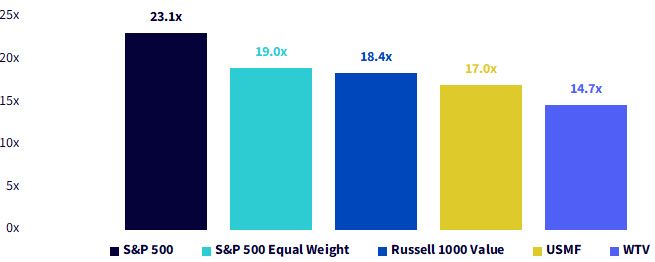
Sources: WisdomTree, FactSet, S&P, Russell, as of 11/30/24. You cannot invest directly in an index.
Shareholder yield, the primary selection criteria for WTV, provides another way to think of valuations. Assuming valuations remain constant (no multiple expansion or contraction), WTV has a 340-basis points head start on expected returns relative to the S&P 500, due to its 6.1% versus the 2.7% yield for the S&P 500, as seen in figure 6 below.
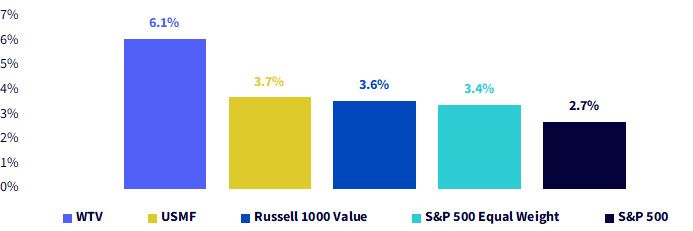
Sources: WisdomTree, FactSet, S&P, Russell, as of 11/30/24. You cannot invest directly in an index.
We also often hear that maybe other segments of the market are “cheap for a reason,” meaning there is a clear tradeoff between profitability and valuation. And based on return on equity (ROE), the S&P 500 is in fact the most profitable of the below funds and indexes, as demonstrated in figure 7.
But USMF and WTV provide a distinct profitability improvement relative to the Russell indexes that have no quality criteria to their selection, solving for the tradeoff between valuation and profitability investors typically must make.
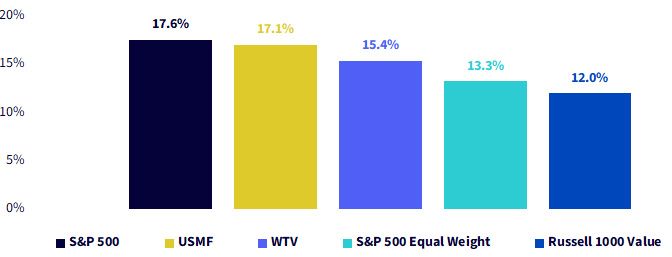
Sources: WisdomTree, FactSet, S&P, Russell, as of 11/30/24. You cannot invest directly in an index.
The broadening of equity market participation was a key theme that WisdomTree was calling for heading into 2024. Though the Mag 7 continued to lead this year, we have highlighted two solutions with competitive returns over the last several years, with WTV having outperformed the S&P 500 so far this year without any Mag 7 exposure.
Heading into 2025, we view these two solutions as good ways to balance out portfolios without doubling down on mega-cap U.S. tech exposures.
There are risks associated with investing, including the possible loss of principal. Please read the Fund’s prospectus for specific details regarding the Fund’s risk profile.
WTV: Funds focusing their investments on certain sectors increase their vulnerability to any single economic or regulatory development. This may result in greater share price volatility. While the Fund is actively managed, the Fund’s investment process is expected to be heavily dependent on quantitative models and the models may not perform as intended.
USMF: There are risks associated with investing, including the possible loss of principal. Investing in a Fund exposed to particular sectors increases the vulnerability to any single economic, political or regulatory development. This may result in greater share price volatility. Due to the investment strategy of the Fund, it may make higher capital gain distributions than other ETFs.

Director, Research
Matt Wagner joined WisdomTree in May 2017 as an Analyst on the Research team. He currently serves as a Director, where he supports the creation, maintenance, and reconstitution of WisdomTree’s indexes and actively managed ETFs. Matt began his career at Morgan Stanley, working as an analyst in Treasury Capital Markets from 2015 to 2017, focusing on unsecured funding planning, execution, and risk management. He graduated magna cum laude from Boston College in 2015 with a B.A. in International Studies, concentrating in Economics. In 2020, he earned a Certificate in Advanced Valuation from NYU Stern. He is also a Chartered Financial Analyst (CFA) charterholder.


