


Sorry, Your Ticket Has Not Been Validated
Published October 16, 2024

Kevin Flanagan
Head of Investment and Fixed Income Strategy
Key Takeaways
- The recent U.S. Treasury rally has reversed sharply, as stronger-than-expected labor data and a potential inflation setback have altered market expectations for Fed rate cuts.
- Fed Funds Futures have dialed back expectations from eight rate cuts to five or six by Q4 2025, leading to a rebound in UST yields, with the 2- and 10-Year Treasury yields rising back to and, in the case of the latter, above 4%.
- With upcoming economic data likely skewed by hurricane disruptions, the current figures may represent the last clear snapshot of underlying trends before the bond market faces additional uncertainty.
A recurring theme I’ve been emphasizing during the two “big” rallies in the U.S. Treasury (UST) market within the last year has been that, at some point, the visible decline in yields will need to be validated. Investors saw this phenomenon play out earlier this year when UST yields reversed course and retraced a good portion of the Q4 decline. Here we are now, almost a year later, and investors have been witnessing another episode of a UST rally that hasn’t received the necessary validation.
Actually, it has been quite remarkable to see the complete “180” the money and bond markets have experienced just within the last few weeks. Think about where economic and Fed rate cut expectations were right after the September Federal Open Market Committee (FOMC) meeting and where they are currently. Right around that mid-September timeframe, the narrative was that the labor market was “cooling” more than expected while disinflation was firmly intact, with the Fed’s 50-basis-point (bp) rate cut only the beginning.
To provide some perspective, implied probabilities for Fed Funds Futures were pricing in a total of eight rate cuts (assuming 25-bp intervals) worth a cumulative total of an eye-opening 200 bps by Q4 2025. For those keeping track, that would have brought the Fed Funds target range down to around 2.90%. Needless to say, UST yields followed suit, with the 2-Year yield plunging -144 bps from its late May high watermark down to just barely above 3.50% as recently as September 24. The 10-Year got into the action as well, with the yield here falling around -100 bps to roughly 3.60% on September 17.
U.S. Treasury Yields
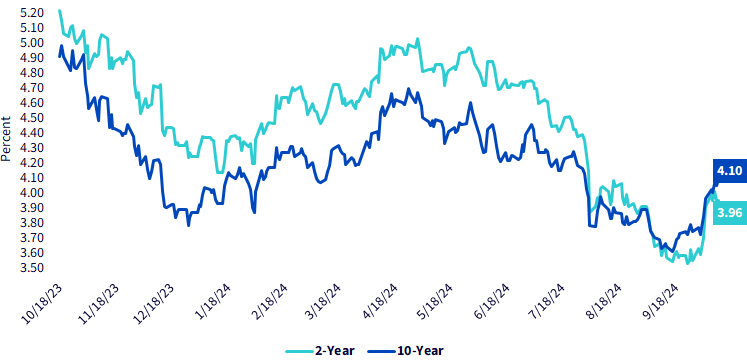
Source: Bloomberg, as of 10/11/24.
That was then, but what about now? Well, the recently released jobs report revealed that while labor market activity may be cooling, it was not nearly as “cool” as what the markets were thinking a few weeks earlier. In addition, the September CPI data revealed that the improving inflation picture may have hit a possible roadblock. This landscape is materially different from when Powell & Co. met less than a month ago.
Against this backdrop, Fed rate cut expectations have been dialed back to where only about five or six decreases are expected by Q4 of next year. In fact, a modest probability has now been given for no rate cut at the upcoming November FOMC meeting, where pre-jobs report, odds between a 25-bp or 50-bp cut were going back and forth.
Needless to say, UST yields have retraced anywhere from just under 30% of the aforementioned decline for the 2-Year note to a more substantial move of almost 50% for the 10-Year maturity. For those keeping track, these are upward moves of roughly +45 bps and +50 bps, respectively, bringing absolute levels back to the 4% threshold, if not higher, in the case of the 10-Year note.
Conclusion
Due to the unfortunate events from Hurricanes Helene and Milton, the rest of October will be the last few weeks of relatively “clean” sets of data for a while. In fact, last week’s jobless claims did reveal the first signs of these adverse effects already. As a result, the data released up until now may take on heightened importance for the bond market and the Fed because it could be the last time, for a few months, that we’ll get a true sense of underlying economic/labor market and inflation trends.
Categories


About the contributor

Kevin Flanagan
Head of Investment and Fixed Income Strategy
Kevin serves as the Head of Investment and Fixed Income Strategy. In this role, he writes macro and fixed income-related content and works closely with the sales, research and marketing teams. In addition, Kevin conducts client-facing webinars and meetings, providing expertise on WisdomTree’s existing and future bond ETFs. Prior to joining WisdomTree, Kevin spent 30 years at Morgan Stanley, where he was Managing Director and Chief Fixed Income Strategist for Wealth Management. He was responsible for tactical and strategic recommendations and created asset allocation models for fixed income securities. He was a contributor to the Morgan Stanley Wealth Management Global Investment Committee, primary author of Morgan Stanley Wealth Management’s monthly and weekly fixed income publications, and collaborated with the firm’s Research and Consulting Group Divisions to build ETF and fund manager asset allocation models. Kevin has an MBA from Pace University’s Lubin Graduate School of Business, and a B.S. in Finance from Fairfield University.