
GDMN
Efficient Gold Plus Gold Miners Strategy Fund

Published October 15, 2024


Global Head of Research
WisdomTree created the WisdomTree Efficient Gold Plus Gold Miners Strategy Fund (GDMN) with the goal of offering one strategy to provide exposure to both the price of gold and the equity performance of gold miners. If one considers a hypothetical $100 investment in the Fund:
So, for a $100 hypothetical investment, the notional exposure is actually $180, split evenly between the equity of gold miners and the futures contracts on the price of gold. The positions are “long,” meaning that if the prices are appreciating, positive returns are generated, whereas if prices are falling, negative returns are generated. As of this writing in 2024, both the mining equities basket and the price of gold are up. Of course, the leverage inherent in the strategy could serve to increase volatility.
WisdomTree has a large array of ETFs covering many different asset classes. At any moment, one can go to the WisdomTree suite of tools (PATH) and find out which of these ETFs are performing the best—or the worst.
Running this analysis as of October 14, 2024, we saw that GDMN was WisdomTree’s top-performing ETF.
The top 5 ETFs at WisdomTree over this period are:
In the spirt of balance, here are the bottom 5 ETFs at WisdomTree over this period:
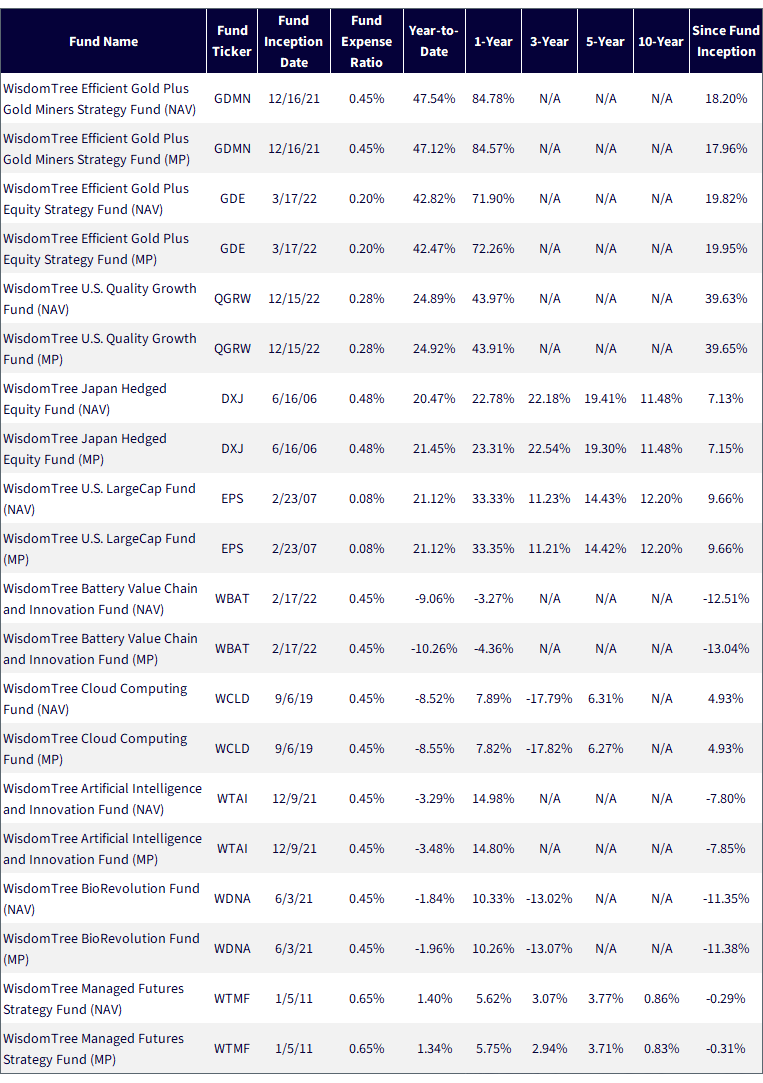
Source: WisdomTree, specifically data from the Fund Comparison Tool in the PATH suite of tools, as of 10/14/24. NAV denotes total return
performance at net asset value. MP denotes market price performance. Past performance is not indicative of future results. Investment
return and principal value of an investment will fluctuate so that an investor’s shares, when redeemed, may be worth more or less
than their original cost. Current performance may be lower or higher than the performance data quoted. For the most recent month-
end and standardized performance, click the relevant ticker: GDMN, GDE, QGRW, DXJ, EPS, WBAT, WCLD, WTAI, WTMF, WDNA.
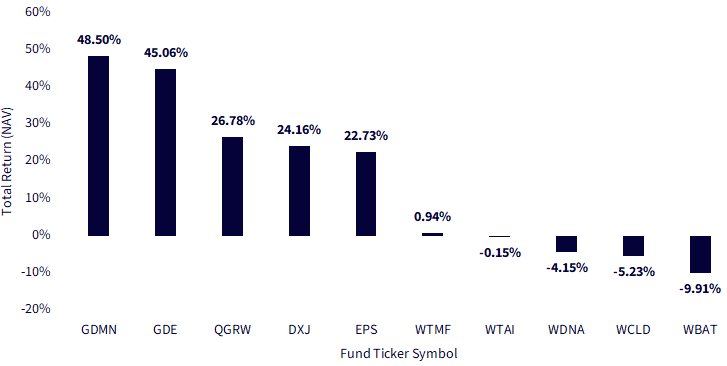
Source: WisdomTree, specifically data from the Performance-at-a-Glance Tool in the PATH suite of tools, as of 10/14/24. NAV denotes total
return performance at net asset value. MP denotes market price performance. Past performance is not indicative of future results.
Investment return and principal value of an investment will fluctuate so that an investor’s shares, when redeemed, may be
worth more or less than their original cost. Current performance may be lower or higher than the performance data quoted.
For the most recent month-end and standardized performance, click the relevant ticker: GDMN, GDE, QGRW, DXJ, EPS, WBAT,
WCLD, WTAI, WTMF, WDNA.
The remarkable thing about the investment landscape in 2024 regards the incredible degree of choice available. It is natural to imagine that some investors are thinking about gold. They can think about:
Connecting investment strategies across these concepts:
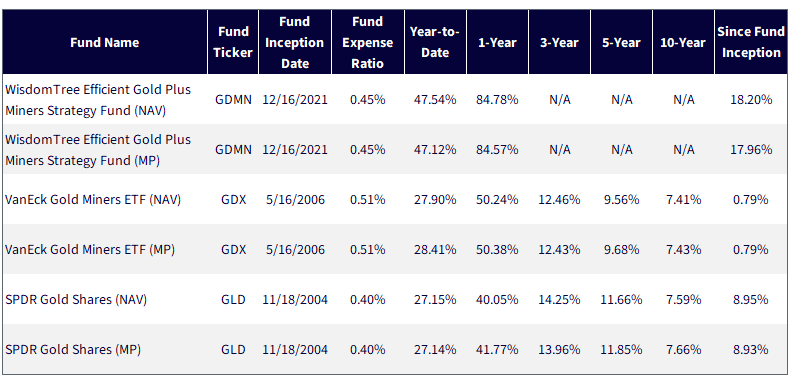
Source: WisdomTree, specifically data from the Fund Comparison Tool in the PATH suite of tools, as of 10/14/24. NAV denotes total return performance
at net asset value. MP denotes market price performance. Past performance is not indicative of future results. Investment return and principal
value of an investment will fluctuate so that an investor’s shares, when redeemed, may be worth more or less than their original cost.
Current performance may be lower or higher than the performance data quoted. For the most recent month-end and standardized
performance, click the relevant ticker: GDMN, GDX, GLD. All funds are managed differently and do not react the same to economic or market events. The
investment objectives, strategies, policies or restrictions of other funds may differ and more information can be found in their respective prospectuses.
Therefore, we generally do not believe it is possible to make direct fund to fund comparisons in an effort to highlight the benefits of a fund versus
another similarly managed fund.
Specifying these strategies allows us to look at how they are performing so far in 2024—or really any period for which live history is available. In 2024, gold’s price has appreciated significantly, at times eclipsing the $2,600 per ounce level. The return of gold miners has also been positive.
We noted previously that GDMN represents a long exposure to both equities of gold miners and the gold price, expressed in futures. For each hypothetical $100 investment, $90 is exposed to the miners and $90 is exposed to the gold futures, for a total of $180. A year like 2024—so far—with both components positive, creates a nice tailwind for the strategy.
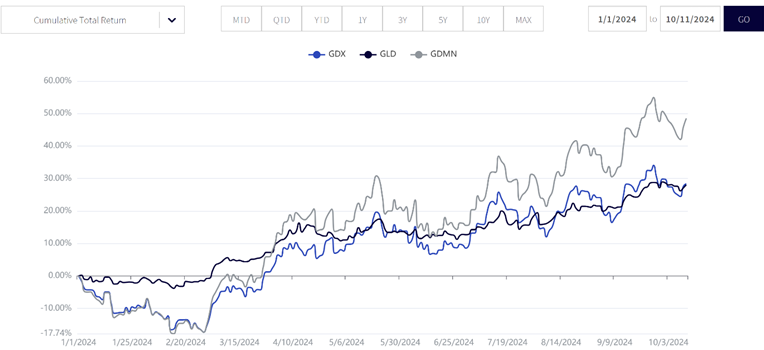
Source: WisdomTree, specifically data from the Fund Comparison Tool in the PATH suite of tools, as of 10/14/24. NAV denotes total return
performance at net asset value. MP denotes market price performance. Past performance is not indicative of future results. Investment
return and principal value of an investment will fluctuate so that an investor’s shares, when redeemed, may be worth more or less
than their original cost. Current performance may be lower or higher than the performance data quoted. For the most recent month-
end and standardized performance, click the relevant ticker: GDMN, GDX, GLD.
As gold has been on a terrific run, a combination of factors is turning the tide in favor of gold—a weaker U.S. dollar, falling bond yields and central bank purchases alongside rising geopolitical risks. Up until now, gold linked ETF purchases were quite lackluster. However, the latest monthly statistics show that gold ETFs recorded inflows for the fourth month in a row in August.2 All regions showed rising ETF holdings, with North America and Europe posting the highest inflows.
The Federal Reserve has begun the easing of monetary policy, starting with a 50-basis point rate cut on September 18, 2024. The anticipation of further interest rate cuts over the coming months is enabling gold’s price to escalate as it lowers the opportunity cost of holding gold.
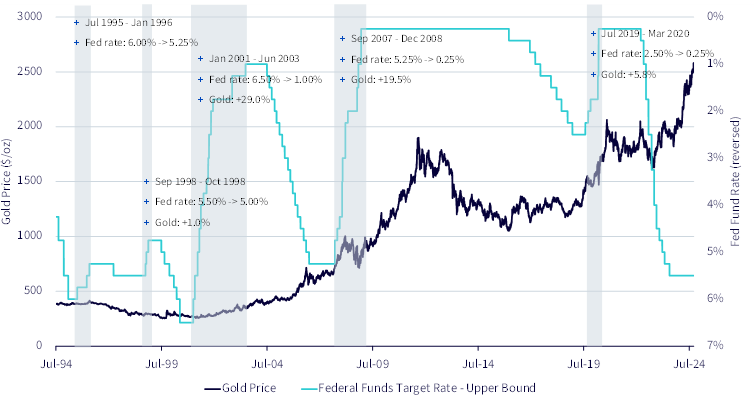
Source: Bloomberg, WisdomTree, as of 9/16/24. Past performance is not indicative of future results.
We noted before that gold miners are important beneficiaries of rising gold prices. The gold price is the single most important fundamental driver of earnings and returns on capital. Historically, gold mining stocks tend to act as a leveraged play on the gold price. We are beginning to see this trend play out in 2024. Since the start of the year, gold mining stocks are up 26.9%, while gold is up 24.6%.3 Gold mining stocks have plenty of catching up to do, as their recent outperformance versus gold is still at its nascency.
If we try to think of the reasons that held back gold miners’ performance versus gold, inflation does spring to mind. The rampant inflation we have been accustomed to since the COVID pandemic has been a key driver of gold miners’ operational costs, thereby resulting in an erosion of profits. Energy was the key cost driver accounting for almost half of the all-in sustaining costs (AISC) of gold miners. The higher interest rate environment has also raised borrowing costs for gold miners. Added to that, the increased focus on environmental, social and governance (ESG) investing principles has made it harder for miners to obtain capital investment. Gold miners bring in added complications as well, as tighter regulations tend to raise miners’ costs as they often operate in parts of the world where standards of governance and transparency remain weak.
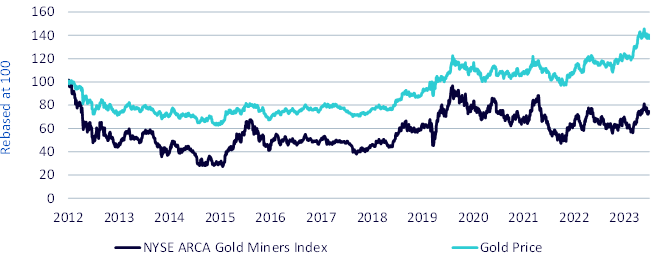
Source: Bloomberg, WisdomTree, as of 9/16/24. Please note, gold miners’ performance is represented by the NYSE Arca Gold
Miners Index. Past performance is not indicative of future results.
The average AISC for primary gold operations are projected to drop by 4% in 2024 to an average of $1,218/oz, marking the first decline since 2016.4 Increased averaged gold grades and higher recoveries are also expected to help the overall cost profile of gold miners in 2024. The significant advancement in productivity is poised to drive margin expansion in this highly capital-intensive industry. More importantly, amid gold’s sustained move higher, industry cost pressures have begun to ease, paving the way for higher margins in H2 2024.
Figure 7: AISC Buoyed by Rising Gold Prices
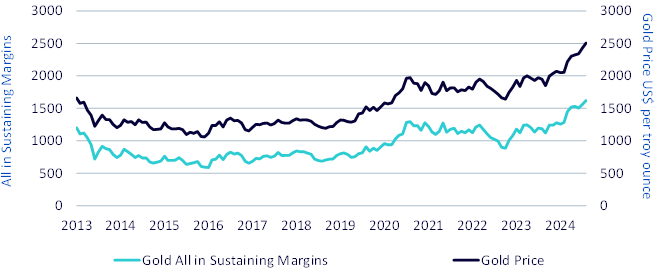
Source: Bloomberg, WisdomTree, as of 9/16/24. Please note, gold miners’ AISC is weighted average AISC of the constituents
in the NYSE Arca Gold Miners Index. Past performance is not indicative of future results.
We always learn by looking at the top- and bottom-performing ETFs at WisdomTree over different periods. With GDMN in the top spot, we wanted to address the fact that many may not even realize such an investment—with exposure to BOTH the price movements of gold AND gold miner equities in ONE solution—exists. We think that anyone considering an exposure to gold or to gold miner equities should include this strategy, GDMN, in the analysis to note how it compares and to see if it is a better fit with an overall investment thesis on the gold space.
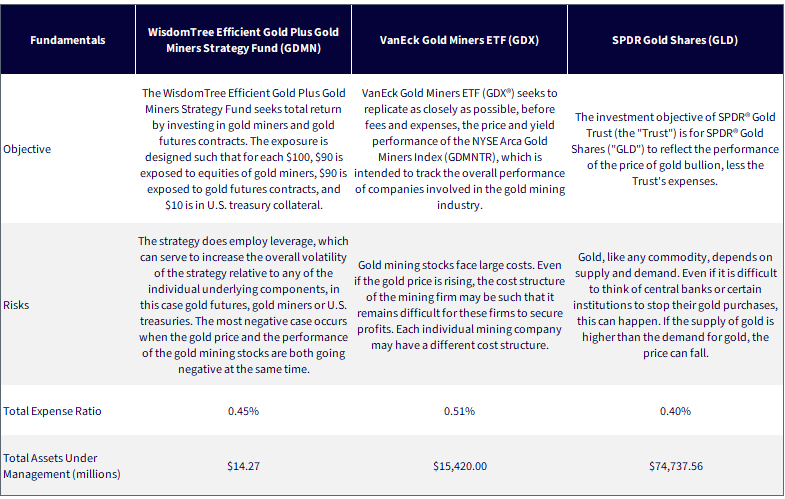
Sources: WisdomTree, VanEck and SPDR. Assets under management are current as of 9/19/24.
1 Chat GPT launched in November 2022, and this application changed the way many people and companies were thinking about the possibilities of the AI megatrend.
2 World Gold Council, as of 8/30/24.
3 Bloomberg. Gold mining stocks are represented by NYSE Arca Gold Miners Index (Ticker: GDM Index) from 1/1/24–9/17/24.
4 S&P Global Commodity Insights, as of March 2024.
There are risks associated with investing, including the possible loss of principal. Please read the Fund’s prospectus for specific details regarding the Fund’s risk profile.
GDMN: The Fund is actively managed and invests in U.S.-listed gold futures and global equity securities issued by companies that derive at least 50% of their revenue from the gold mining business (“Gold Miners”). The Fund’s use of U.S.-listed gold futures contracts will give rise to leverage, magnifying gains and losses and causing the Fund to be more volatile than if it had not been leveraged. Moreover, the price movements in gold and gold futures contracts may fluctuate quickly and dramatically, and have a historically low correlation with the returns of the stock and bond markets. By investing in the equity securities of Gold Miners, the Fund may be susceptible to financial, economic, political or market events that impact the gold mining sub-industry, including commodity prices and the success of exploration projects. The Fund may invest a significant portion of its assets in the securities of companies of a single country or region, including emerging markets, and thus, the Fund is more likely to be impacted by events and political, economic or regulatory conditions affecting that country or region, or emerging markets generally. The Fund’s investment strategy will also require it to redeem shares for cash or to otherwise include cash as part of its redemption proceeds, which may cause the Fund to recognize capital gains.
GDE: The Fund is actively managed and invests in U.S.-listed gold futures and U.S. equity securities. The Fund’s use of U.S.-listed gold futures contracts will give rise to leverage, magnifying gains and losses and causing the Fund to be more volatile than if it had not been leveraged. Moreover, the price movements in gold and gold futures contracts may fluctuate quickly and dramatically and have a historically low correlation with the returns of the stock and bond markets. U.S. equity securities, such as common stocks, are subject to market, economic and business risks that may cause their prices to fluctuate. The Fund’s investment strategy will also require it to redeem shares for cash or to otherwise include cash as part of its redemption proceeds, which may cause the Fund to recognize capital gains.
QGRW: Growth stocks, as a group, may be out of favor with the market and underperform value stocks or the overall equity market. Growth stocks are generally more sensitive to market movements than other types of stocks. The Fund is non-diversified. As a result, changes in the market value of a single security could cause greater fluctuations in the value of Fund shares than would occur in a diversified fund. The Fund invests in the securities included in, or representative of, its Index regardless of their investment merit. The Fund does not attempt to outperform its Index or take defensive positions in declining markets and the Index may not perform as intended.
DXJ: Foreign investing involves special risks, such as risk of loss from currency fluctuation or political or economic uncertainty. The Fund focuses its investments in Japan, thereby increasing the impact of events and developments in Japan that can adversely affect performance. Investments in currency involve additional special risks, such as credit risk, interest rate fluctuations, derivative investments which can be volatile and may be less liquid than other securities, and more sensitive to the effect of varied economic conditions. As this Fund can have a high concentration in some issuers, the Fund can be adversely impacted by changes affecting those issuers. Due to the investment strategy of this Fund it may make higher capital gain distributions than other ETFs. Dividends are not guaranteed, and a company currently paying dividends may cease paying dividends at any time.
EPS: Funds focusing their investments on certain sectors increase their vulnerability to any single economic or regulatory development. This may result in greater share price volatility.
WBAT: The Fund invests in equity securities of exchange-listed companies globally involved in the investment themes of battery and energy storage solutions (BESS) and innovation. The value chain of BESS companies is divided into four categories: raw materials, manufacturing, enablers and emerging technologies. Innovation companies are those that introduce a new, creative or different technologically enabled product or service in seeking to potentially change an industry landscape, as well as companies that service those innovative technologies. The Fund invests in the securities included in, or representative of, its Index regardless of their investment merit. The Fund does not attempt to outperform its Index or take defensive positions in declining markets and the Index may not perform as intended.
WCLD: The Fund invests in cloud computing companies, which are heavily dependent on the internet and utilizing a distributed network of servers over the internet. Cloud computing companies may have limited product lines, markets, financial resources or personnel and are subject to the risks of changes in business cycles, world economic growth, technological progress and government regulation. These companies typically face intense competition and potentially rapid product obsolescence. Additionally, many cloud computing companies store sensitive consumer information and could be the target of cybersecurity attacks and other types of theft, which could have a negative impact on these companies and the Fund. Securities of cloud computing companies tend to be more volatile than securities of companies that rely less heavily on technology and, specifically, on the internet. Cloud computing companies can typically engage in significant amounts of spending on research and development, and rapid changes to the field could have a material adverse effect on a company’s operating results. The composition of the Index is heavily dependent on quantitative and qualitative information and data from one or more third parties and the Index may not perform as intended.
WTAI: The Fund invests in companies primarily involved in the investment theme of artificial intelligence (AI) and innovation. Companies engaged in AI typically face intense competition and potentially rapid product obsolescence. These companies are also heavily dependent on intellectual property rights and may be adversely affected by loss or impairment of those rights. Additionally, AI companies typically invest significant amounts of spending on research and development, and there is no guarantee that the products or services produced by these companies will be successful. Companies that are capitalizing on innovation and developing technologies to displace older technologies or create new markets may not be successful. The Fund invests in the securities included in, or representative of, its Index regardless of their investment merit and the Fund does not attempt to outperform its Index or take defensive positions in declining markets. The composition of the Index is governed by an Index Committee and the Index may not perform as intended.
WDNA: There are risks associated with investing, including possible loss of principal. The Fund invests in BioRevolution companies, which are companies significantly transformed by advancements in genetics and biotechnology. BioRevolution companies face intense competition and potentially rapid product obsolescence. These companies may be adversely affected by the loss or impairment of intellectual property rights and other proprietary information or changes in government regulations or policies. Additionally, BioRevolution companies may be subject to risks associated with genetic analysis. The Fund invests in the securities included in, or representative of, its Index regardless of their investment merit and the Fund does not attempt to outperform its Index or take defensive positions in declining markets. The composition of the Index is governed by an Index Committee and the Index may not perform as intended. Please read the Fund’s prospectus for specific details regarding the Fund’s risk profile.
WTMF: An investment in this Fund is speculative, involves a substantial degree of risk, and should not constitute an investor's entire portfolio. One of the risks associated with the Fund is the complexity of the different factors which contribute to the Fund's performance, as well as its correlation (or non-correlation) to other asset classes. These factors include use of long and short positions in commodity futures contracts, currency forward contracts, swaps and other derivatives. Derivatives can be volatile and may be less liquid than other securities and more sensitive to the effects of varied economic conditions. In addition, bitcoin and bitcoin futures are a relatively new asset class. They are subject to unique and substantial risks, and historically, have been subject to significant price volatility. While the bitcoin futures market has grown substantially since bitcoin futures commenced trading, there can be no assurance that this growth will continue. The Fund should not be used as a proxy for taking long only (or short only) positions in commodities or currencies. The Fund could lose significant value during periods when long only indexes rise (or short only) indexes decline. The Fund's investment objective is based on historic price trends. There can be no assurance that such trends will be reflected in future market movements. The Fund generally does not make intra-month adjustments and therefore is subject to substantial losses if the market moves against the Fund's established positions on an intra-month basis. In markets without sustained price trends or markets that quickly reverse or "whipsaw" the Fund may suffer significant losses. The Fund is actively managed thus the ability of the Fund to achieve its objectives will depend on the effectiveness of the portfolio manager. Due to the investment strategy of this Fund it may make higher capital gain distributions than other ETFs.

Director, Macroeconomic Research, WisdomTree Europe
@AneekaGuptaWTAneeka Gupta is Director of Research at WisdomTree. Prior to the acquisition of ETF Securities in April 2018, Aneeka worked as an Equity & Commodities Strategist at the company. Aneeka has 17 years of experience working as a Research Analyst across a wide range of asset classes. In her current role she is responsible for conducting analysis for all in-house equity, commodity and macro publications and assisting the sales team with client queries around products and markets. Prior to WisdomTree, Aneeka began her career as an equity analyst at Bear Stearns International Ltd in London. She also worked as an Equity Sales Trader at Sunrise Brokers across US and Pan European Exchanges. Before that she worked as an Equity Derivatives Sales Manager at Mashreq Bank in Dubai. Aneeka holds a Masters in Mathematics from Oxford University and a BSc in Mathematics from the University of Delhi, India. She is also a CFA Charterholder.

Global Head of Research
Christopher Gannatti began at WisdomTree as a Research Analyst in December 2010, working directly with Jeremy Schwartz, CFA®, Director of Research. In January of 2014, he was promoted to Associate Director of Research where he was responsible to lead different groups of analysts and strategists within the broader Research team at WisdomTree. In February of 2018, Christopher was promoted to Head of Research, Europe, where he was based out of WisdomTree’s London office and was responsible for the full WisdomTree research effort within the European market, as well as supporting the UCITs platform globally. In November 2021, Christopher was promoted to Global Head of Research, now responsible for numerous communications on investment strategy globally, particularly in the thematic equity space. Christopher came to WisdomTree from Lord Abbett, where he worked for four and a half years as a Regional Consultant. He received his MBA in Quantitative Finance, Accounting, and Economics from NYU’s Stern School of Business in 2010, and he received his bachelor’s degree from Colgate University in Economics in 2006. Christopher is a holder of the Chartered Financial Analyst Designation.
